
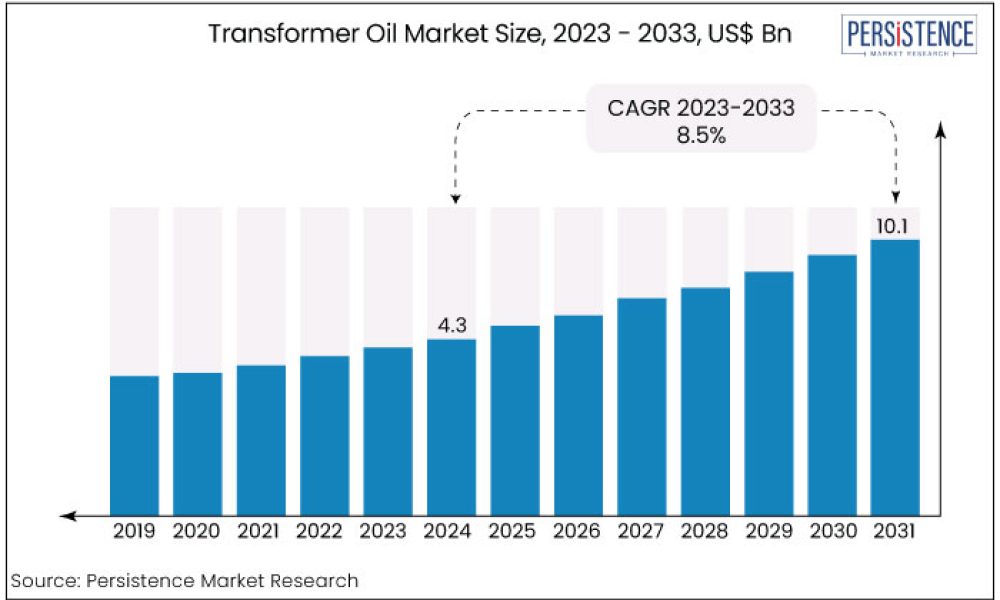
The global transformer oil market is witnessing robust growth, propelled by the increasing demand for reliable electrical infrastructure and the rising deployment of power transformers across industrial and utility sectors. Transformer oil, also known as insulating oil, plays a critical role in cooling and insulating transformers, ensuring efficient performance and extending the lifespan of equipment. The market is expected to reach a valuation of US$10.1 billion by 2033, registering a CAGR of 8.5% during the forecast period from 2024 to 2033. This growth reflects the rising investments in renewable energy, modernization of aging power grids, and a surge in electricity demand worldwide.
In terms of market statistics, mineral oil-based transformer oils dominate the product landscape due to their cost-effectiveness, proven performance, and availability, while synthetic and natural ester-based oils are gaining traction due to their environmentally friendly and biodegradable characteristics. Among end-users, the power generation and distribution segment is leading the market owing to the continuous expansion of transmission networks and increasing capacity additions in emerging economies. Geographically, the Asia-Pacific region stands as the largest consumer of transformer oil, primarily driven by rapid urbanization, industrialization, and the expansion of the renewable energy sector in countries such as China and India. The region’s strategic investments in smart grids and high-voltage transmission projects further strengthen its leading position in the market.
Get a Sample PDF Brochure of the Report (Use Corporate Email ID for a Quick Response): https://www.persistencemarketresearch.com/samples/33160
Key Highlights from the Report:
• The transformer oil market is projected to reach US$10.1 billion by 2033.
• Mineral oil remains the leading product segment by type.
• Power generation and distribution segment dominates the end-user category.
• Asia-Pacific is the largest and fastest-growing regional market.
• Rising demand for renewable energy infrastructure fuels market growth.
• Biodegradable and natural ester oils are gaining popularity for eco-friendly solutions.
Market Segmentation:
The transformer oil market is broadly segmented by product type, end-user, and application. By product type, the market includes mineral oil-based, synthetic oil-based, and natural ester-based transformer oils. Mineral oils dominate due to their cost efficiency and established performance record, while synthetic and natural ester oils are increasingly preferred for environmental compliance and fire safety considerations. In terms of end-users, the market serves power generation and distribution, industrial, and railways and transport sectors, with power utilities contributing the largest share due to ongoing expansion of electrical networks. Application-wise, transformer oils are extensively used in distribution transformers, power transformers, and other electrical equipment, ensuring insulation, cooling, and protection from electrical faults.
Regional Insights:
Regionally, the transformer oil market is led by Asia-Pacific, attributed to rapid industrialization, urban infrastructure development, and government initiatives for electricity expansion. Countries like China, India, and Japan are investing heavily in power transmission networks and renewable energy infrastructure, driving demand for both mineral and biodegradable transformer oils. North America maintains steady growth due to modernization of existing power grids and technological adoption, while Europe focuses on eco-friendly transformer oils and stricter environmental regulations. The Middle East and Africa exhibit potential growth due to ongoing electrification projects and investments in oil and gas infrastructure. In contrast, Latin America shows moderate growth with new industrial projects and grid expansion initiatives.
🔗Dive deeper into the market data: https://www.persistencemarketresearch.com/market-research/transformer-oil-market.asp
Market Drivers:
The primary drivers of the transformer oil market include the rising demand for electricity, expansion of power infrastructure, and the growing adoption of renewable energy sources. Increasing investments in smart grids, high-voltage transmission, and industrial automation further bolster market demand. The emphasis on maintaining transformer efficiency and longevity drives utilities to prefer high-quality insulating oils. Additionally, environmental regulations promoting biodegradable and eco-friendly oils are encouraging manufacturers to innovate and diversify product offerings, enhancing market growth prospects globally.
Market Restraints:
Despite the positive outlook, the market faces certain restraints, including high costs associated with synthetic and natural ester-based transformer oils compared to conventional mineral oils. Fluctuations in raw material prices and supply chain disruptions may impact production costs and market stability. Additionally, the recycling and disposal of used transformer oils pose environmental challenges, which may hinder widespread adoption, especially in regions with stringent waste management regulations.
Market Opportunities:
Significant opportunities exist in the adoption of eco-friendly and biodegradable transformer oils in Europe and North America, driven by regulatory mandates and sustainability goals. Emerging economies in Asia-Pacific, Latin America, and Africa present opportunities due to infrastructure development and increasing electricity demand. Furthermore, technological advancements in oil formulations to enhance fire safety, cooling efficiency, and dielectric performance open new avenues for market growth. The growing focus on renewable energy and industrial automation also creates a lucrative landscape for innovative transformer oil products.
Reasons to Buy the Report:
1. Comprehensive analysis of the global transformer oil market with key statistics and projections.
2. In-depth understanding of market segmentation by product type, end-user, and application.
3. Detailed regional insights to identify high-growth markets and investment opportunities.
4. Analysis of market drivers, restraints, and future growth prospects for strategic planning.
5. Competitive landscape overview with key players, market share, and recent developments.
Frequently Asked Questions (FAQs):
How Big is the Transformer Oil Market in 2024 and beyond?
Who are the Key Players in the Global Transformer Oil Market?
What is the Projected Growth Rate of the Transformer Oil Market during 2024-2033?
What is the Market Forecast for Transformer Oil for 2032?
Which Region is Estimated to Dominate the Transformer Oil Industry through the Forecast Period?
Company Insights:
• ABB Ltd. – Focused on expanding sustainable transformer oil solutions and biodegradable products.
• General Electric Company – Introduced advanced mineral and synthetic oils for high-voltage transformers.
• Siemens AG – Developing eco-friendly insulating oils for renewable energy applications.
• Cargill, Incorporated – Producing natural ester-based transformer oils with high thermal stability.
• Shell PLC – Offering a wide range of mineral and synthetic transformer oils globally.
• ExxonMobil Corporation – Investing in R&D for improved dielectric performance oils.
Recent Developments:
• Siemens AG launched a new biodegradable transformer oil in 2024 designed for high-performance industrial transformers.
• ABB Ltd. announced a strategic partnership with regional utilities in India to supply eco-friendly transformer oils for renewable energy projects.
The transformer oil market is positioned for steady expansion driven by rising electricity demand, infrastructure development, and growing adoption of sustainable solutions. Technological innovations, regional investments in power distribution, and increasing awareness of environmentally friendly alternatives will continue to shape the competitive landscape. With robust opportunities across Asia-Pacific and a focus on green transformer oil solutions in developed regions, the market presents a dynamic and lucrative environment for manufacturers, investors, and stakeholders in the coming decade.




