
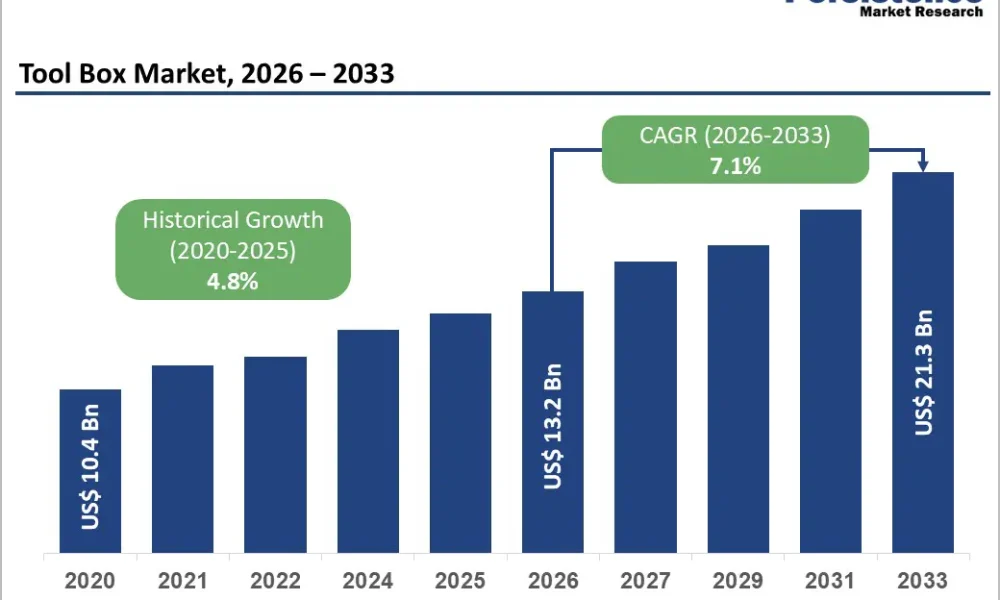
The global tool box market is witnessing substantial growth, driven by increasing professional tool ownership across industries such as construction, automotive repair, and industrial maintenance, as well as a surge in DIY and home improvement activities. The market is projected to reach US$ 13.2 billion in 2026 and expand to US$ 21.3 billion by 2033, growing at a CAGR of 7.1% during the forecast period. Rising infrastructure spending, stable automotive service demand, and a growing culture of DIY enthusiasts are boosting the adoption of versatile and durable tool storage solutions globally. Furthermore, technological advancements such as modular rolling tool boxes, integrated charging systems for power tools, and digital tool tracking features are adding value, attracting both professionals and hobbyists.
Among different product types, metal tool boxes continue to dominate due to their durability, security, and ability to store heavy-duty tools safely. Plastic and composite tool boxes are gaining traction in residential and light commercial segments because of their portability, lightweight design, and lower cost. Geographically, North America leads the market, driven by high adoption of power tools, steady construction activities, and widespread DIY culture. Europe follows closely, supported by industrial maintenance demands and government incentives promoting vocational skills and professional training, while Asia Pacific is emerging rapidly due to growing construction and automotive sectors in India, China, and Southeast Asia.
Key Highlights from the Report
• The global tool box market is expected to grow from US$ 13.2 billion in 2026 to US$ 21.3 billion by 2033.
• Metal tool boxes dominate the market owing to durability and load-bearing capacity.
• Modular and rolling tool box systems are gaining popularity in professional segments.
• North America leads the market due to high professional tool ownership and DIY adoption.
• Technological innovations such as integrated charging and digital tracking enhance product appeal.
• Growth is further supported by rising construction, automotive, and industrial maintenance activities worldwide.
𝐆𝐞𝐭 𝐚 𝐒𝐚𝐦𝐩𝐥𝐞 𝐏𝐃𝐅 𝐁𝐫𝐨𝐜𝐡𝐮𝐫𝐞 𝐨𝐟 𝐭𝐡𝐞 𝐑𝐞𝐩𝐨𝐫𝐭: https://www.persistencemarketresearch.com/samples/36108
Market Segmentation
The tool box market is segmented based on product type, material, end-user, and sales channel. By product type, the market includes stationary tool boxes, portable tool boxes, rolling tool cabinets, and modular systems. Stationary boxes are commonly used in workshops and industrial facilities, while portable boxes cater to on-site work or DIY enthusiasts. Rolling cabinets and modular systems are gaining traction for professional applications, as they combine mobility, organization, and flexibility for large tool collections.
Material segmentation includes metal, plastic, and composite tool boxes. Metal boxes are preferred in commercial and industrial environments due to robustness and longevity. Plastic and composite variants are more common in home and light commercial use because of affordability, portability, and resistance to corrosion.
End-users of tool boxes range from professional tradespeople, industrial maintenance teams, automotive service centers, and DIY/home improvement enthusiasts. Professional users drive demand for heavy-duty and specialized storage solutions, whereas DIY enthusiasts seek compact, portable, and multifunctional tool boxes.
By sales channel, tool boxes are distributed via direct sales, retail hardware stores, online marketplaces, and wholesale distributors. E-commerce is increasingly influential, offering convenience, customization options, and wider product variety, particularly in developed markets like North America and Europe.
Regional Insights
North America dominates due to a well-established construction industry, widespread DIY culture, and high professional tool ownership. The U.S. leads adoption, supported by consistent infrastructure projects, vocational training programs, and industrial maintenance demand.
Europe exhibits steady growth, led by Germany, France, and the UK, driven by automotive repair services, industrial maintenance, and vocational initiatives encouraging skilled labor. Advanced manufacturing practices and high consumer spending on home improvement further contribute.
Asia Pacific is emerging as a high-growth region, with China, India, and Southeast Asian nations expanding tool box demand due to rapid urbanization, construction booms, and rising automotive service sectors. Government programs to support infrastructure development and skill development also bolster market growth.
Latin America and Middle East & Africa show moderate growth, fueled by industrialization, automotive maintenance, and rising adoption of professional tool storage solutions. Brazil, Mexico, South Africa, and Saudi Arabia are key contributors.
𝐎𝐧𝐞 𝐂𝐥𝐢𝐜𝐤 → 𝐘𝐨𝐮𝐫 𝐂𝐮𝐬𝐭𝐨𝐦 𝐌𝐚𝐫𝐤𝐞𝐭 𝐕𝐢𝐞𝐰: https://www.persistencemarketresearch.com/request-customization/36108
Market Drivers
Market growth is primarily driven by rising professional tool ownership, increasing infrastructure spending, and a growing DIY culture. Professionals in construction, automotive, and industrial sectors require durable, secure, and organized storage solutions, while DIY enthusiasts increasingly invest in portable and versatile tool boxes. Technological advancements such as integrated charging stations, modular configurations, and digital inventory management further boost market adoption. Rising awareness of safety and efficiency also compels users to invest in high-quality tool storage solutions.
Market Restraints
Growth is restrained by high manufacturing costs for advanced systems, volatility in raw material prices, and competition from low-cost alternatives. Metal and modular tool boxes often have high upfront costs, which can deter small-scale businesses or hobbyists. Fluctuating steel and plastic prices affect production and final pricing. Additionally, cheaper, imported tool boxes with limited durability can limit premium product adoption in cost-sensitive markets.
Market Opportunities
Opportunities lie in smart tool boxes, modular and rolling systems, and expansion into emerging economies. IoT-enabled tool boxes with tracking and inventory features offer enhanced convenience and security. Rolling and modular systems cater to professionals handling large, varied tool collections. Emerging markets in Asia Pacific, Latin America, and Middle East & Africa present growth potential due to increasing industrialization, urbanization, and rising adoption of power tools. Environmentally friendly and lightweight composite materials also create opportunities for product differentiation.
𝐆𝐞𝐭 𝐈𝐧𝐬𝐭𝐚𝐧𝐭 𝐀𝐜𝐜𝐞𝐬𝐬 𝐓𝐨𝐝𝐚𝐲—𝐌𝐚𝐤𝐞 𝐒𝐦𝐚𝐫𝐭𝐞𝐫 𝐃𝐞𝐜𝐢𝐬𝐢𝐨𝐧𝐬 : https://www.persistencemarketresearch.com/checkout/36108
Company Insights
Key players in the tool box market focus on innovation, regional expansion, and technology integration to strengthen their competitive positioning.
• Stanley Black & Decker
• Bosch Power Tools
• Keter Group
• Makita Corporation
• Hilti AG
• Husky Tools
• DeWalt (Stanley Black & Decker)
• Craftsman (Stanley Black & Decker)
• Facom Group
• Beta Utensili
Recent Developments
Recent market developments include the launch of IoT-enabled smart tool boxes with tracking and theft prevention features to appeal to professionals and industrial users. Another trend is modular rolling systems with integrated charging for power tools, allowing simultaneous storage and charging, enhancing convenience and productivity in industrial and construction environments.
Conclusion
The tool box market is poised for robust growth through 2033, driven by increasing adoption among professionals, DIY enthusiasts, and industrial maintenance sectors. North America leads adoption due to strong DIY culture and infrastructure investments, while Asia Pacific emerges as a high-growth region fueled by urbanization, construction, and automotive expansion. Metal tool boxes dominate due to durability, while modular and rolling systems gain traction for professional applications. Technological advancements, including integrated charging and digital tracking features, are transforming traditional tool storage into smart, efficient, and secure solutions, supporting market expansion worldwide. With sustained infrastructure development, rising professional tool ownership, and growing consumer interest in home improvement, the global tool box market is expected to surpass US$ 21.3 billion by 2033, reflecting steady adoption, innovation, and global demand.




