
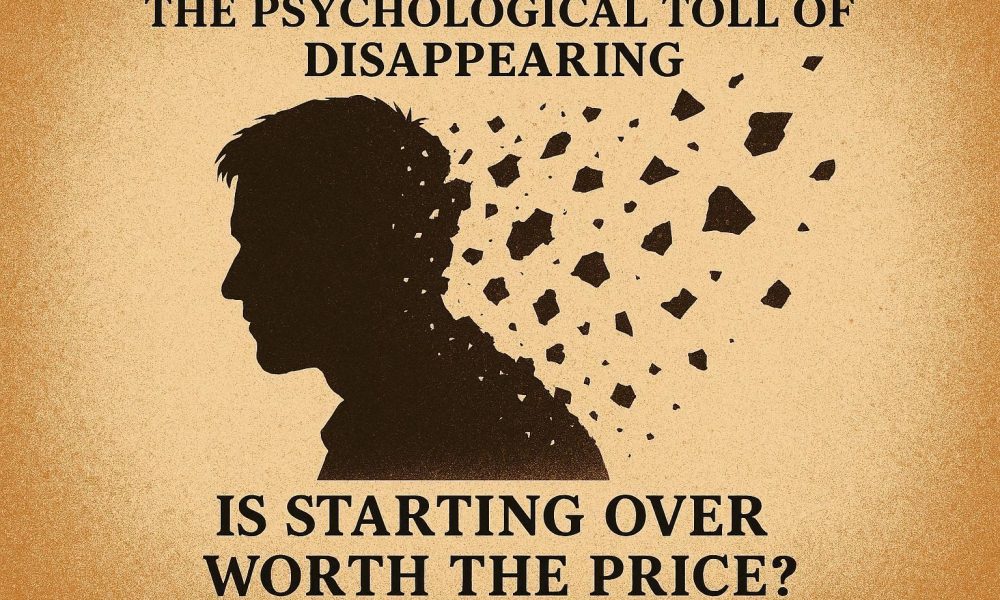
Mental health experts weigh in on the emotional consequences of cutting all ties and building a new identity
WASHINGTON, DC, May 6, 2026
The fantasy of disappearing has always carried a powerful emotional charge, because a new name, a new country, a new phone number, and a blank social circle can look like liberation to someone trapped by fear, scandal, harassment, danger, or exhaustion.
For people facing stalking, identity theft, domestic abuse, reputational harm, political pressure, or genuine safety threats, starting over may be a rational act of protection, but mental health professionals warn that cutting all ties can also create grief, isolation, identity confusion, and emotional shock.
The central question is not whether a person can build a new life, because many people do, but whether they understand the psychological cost of leaving behind the relationships, routines, memories, and social mirrors that helped define who they were.
Disappearing can feel like freedom at first, but the emotional bill often arrives later
The first stage of starting over can feel almost euphoric because distance creates relief, the phone stops ringing, familiar pressures fade, and the person finally experiences silence after months or years of exposure.
That relief is real and should not be dismissed, especially when the old life involved threats, coercion, public humiliation, unsafe relationships, or relentless digital visibility that made ordinary life feel impossible.
Yet the second stage can be far more difficult, because once immediate danger or pressure recedes, the person may confront loneliness, homesickness, guilt, uncertainty, and the strange emotional emptiness of being unknown.
Mental health professionals often describe this as a delayed reaction because survival mode can keep a person moving until the new environment becomes quiet enough for grief to surface.
The human brain does not reset simply because the documents change
A legal name change, new passport, foreign residence, or private relocation can alter the external structure of life, but it does not automatically erase trauma, shame, fear, attachment, or the emotional patterns built over the years.
People who start over sometimes expect a new identity to produce a new personality, only to discover that anxiety, mistrust, hypervigilance, anger, sadness, and unresolved grief can travel across borders with them.
That realization can be painful because the person may feel they failed at reinvention, when the truth is that identity is psychological as well as legal, social, financial, and administrative.
The healthiest fresh starts usually include therapy, support planning, routines, community building, and realistic expectations, because privacy may create safety, but emotional recovery still requires human care.
Isolation is not a side issue; it is a health risk
The U.S. public health conversation around loneliness has become more urgent because government officials and researchers increasingly treat social disconnection as a serious risk factor rather than a private inconvenience.
The U.S. Surgeon General’s official advisory on social connection and isolation warns that loneliness and weak social connections are associated with serious physical and mental health risks, including depression, anxiety, cardiovascular disease, and premature death.
That warning matters deeply to people considering disappearance, because a person who cuts all ties may solve one security problem while inadvertently creating another through prolonged isolation.
The goal should never be loneliness disguised as privacy, because a sustainable new life requires a trusted connection, even if that connection is smaller, safer, more selective, and more carefully managed than before.
A clean break can become grief without a funeral
One of the least-discussed consequences of disappearance is ambiguous grief, because the people, places, habits, and identities left behind may still exist, but the person can no longer safely or practically access them.
A mother may still be alive, a hometown may still be familiar, old friends may still gather, and family rituals may still continue, yet the person starting over may feel exiled from those emotional landmarks.
That kind of loss can be confusing because it does not always receive sympathy, especially when outsiders assume the person chose the new life and should therefore feel grateful for it.
In reality, choosing safety can still involve mourning, because even a necessary escape may require abandoning pieces of belonging that once gave life texture, continuity, and emotional meaning.
Starting over can fracture the sense of self
Identity is not only a legal category, because it is built through memory, language, family roles, work history, friendships, personal reputation, photographs, routines, and the small daily confirmations that tell a person who they are.
When someone takes a new name or relocates into a private life, those familiar confirmations may disappear, leaving the person unsure whether they are becoming free or becoming invisible.
This can create a split between the old self and the new self, especially when the person must avoid certain stories, limit biographical details, or explain their past carefully to protect privacy.
The psychological challenge is learning to integrate the past without being trapped by it, because a healthy, fresh start does not require pretending the old life never happened.
The danger is believing that privacy requires emotional starvation
People trying to live privately sometimes overcorrect, cutting off friends, avoiding intimacy, refusing community, deleting every public trace, and treating ordinary human connections as a threat.
That approach may feel safer in the short term, but it can create a life dominated by suspicion, where every conversation feels dangerous, and every new relationship must pass an impossible security test.
A more sustainable strategy is controlled connection, meaning the person builds a small circle of trusted relationships while limiting unnecessary exposure to strangers, public platforms, and casual acquaintances.
Privacy should protect the person’s ability to live, not shrink life into a bunker where safety exists only because joy, friendship, romance, family, and community have been sacrificed.
Mental health experts warn that loneliness can distort decision-making
Recent Associated Press reporting on America’s loneliness crisis described how social disconnection has become a broad public concern, with declining participation in communities, friendships, civic groups, and shared public spaces.
That larger trend matters because people who disappear may be entering a world where building connections is already harder, especially in unfamiliar cities, foreign countries, or communities where language and culture create additional barriers.
Loneliness can also distort judgment, because people who feel isolated may become more vulnerable to scammers, controlling partners, extremist communities, impulsive financial decisions, or unhealthy dependency on the first person who offers acceptance.
A new life should therefore be built on an emotional infrastructure, not only on legal documents, because the absence of support can make even a well-planned relocation feel unstable.
The people most likely to succeed do not simply vanish; they rebuild
Successful reinvention usually requires a deliberate rebuilding process, including new routines, secure housing, lawful banking, medical care, professional support, exercise, community contact, and a realistic plan for earning income or managing assets.
The person starting over should identify safe anchors, such as a therapist, lawyer, doctor, accountant, trusted adviser, faith community, private peer group, language class, or local activity that creates healthy social contact.
These anchors do not need to expose the person publicly, because a private life can still include confidential professional care and carefully chosen relationships that support emotional stability.
The key is to build belonging slowly and intelligently, because the person who starts over with no support system may find that freedom becomes frightening once the novelty fades.
Children and families experience disappearance differently from adults
When a family starts over, children may experience the move as adventure, loss, confusion, or betrayal, depending on how much they understand, how abruptly the change occurs, and whether they lose contact with important people.
A child who changes schools, countries, names, languages, or family routines may need careful emotional support because identity development depends heavily on continuity, trusted adults, and a stable explanation of what is happening.
Adults may frame the move as protection, but children may quietly grieve grandparents, friends, sports teams, pets, bedrooms, holidays, and familiar streets that gave them a sense of safety.
A responsible fresh start should therefore include age-appropriate explanations, continuity of schooling, mental health support, and enough emotional truth to prevent children from feeling as if their whole lives became a secret overnight.
Digital disappearance can create its own withdrawal symptoms
Social media deletion can be healthy, especially when platforms fuel harassment, comparison, reputational harm, stalking, or compulsive exposure, but sudden digital silence can also feel like social death for people accustomed to constant feedback.
Likes, messages, comments, tags, and online recognition can become psychological mirrors, and removing them abruptly may create anxiety, restlessness, sadness, or the fear that one no longer exists socially.
The healthier approach is digital reduction paired with replacement connection, meaning the person reduces harmful exposure while building real-world routines, private communication channels, and direct relationships that do not depend on public performance.
A person who deletes the internet without rebuilding community may discover that online exposure was unhealthy, but that total silence is not automatically healing.
Lawful identity change must be separated from fantasy disappearance
Some people need lawful identity restructuring for safety, privacy, or long-term relocation, but the process should be built around government recognition, documentation, compliance, and a realistic understanding of what identity change can and cannot do.
Amicus International Consulting’s work on legal identity solutions reflects the lawful side of identity planning, where a new beginning must remain distinct from false documents, evasion, dark-web shortcuts, or attempts to circumvent legal obligations.
The psychological benefit of lawful structure is important because the person does not have to live in constant fear that a single document check, bank review, or border question will collapse their entire new life.
A lawful identity transition may still be emotionally difficult, but it offers a stronger foundation than illegal concealment because the person can build stability without living inside permanent deception.
Second citizenship can offer mobility, but it cannot solve loneliness
A second passport, a new residence, or a foreign relocation can offer practical advantages, including safer travel, reduced political risk, family contingency planning, and access to new jurisdictions.
Amicus International Consulting’s overview of second passport planning belongs to the lawful mobility conversation, where eligibility, documentation, tax compliance, and recognized government issuance matter more than speed or secrecy.
Yet a second passport cannot create friendship, heal trauma, restore trust, or replace the emotional labor required to build a meaningful life in another place.
Mobility can open the door, but the person still has to build a home, and home is rarely created by documents alone.
The old life may still need closure
People who disappear abruptly often underestimate the emotional weight of unfinished conversations, unresolved apologies, unpaid debts, open family wounds, abandoned friendships, or professional relationships left without explanation.
In unsafe situations, closure may be impossible or dangerous, and the person should prioritize survival, legal advice, and professional support over emotional completeness.
In lower-risk situations, however, some form of controlled closure can reduce guilt and psychological fragmentation, even if it is handled through lawyers, written notices, financial settlements, or carefully managed communication.
A fresh start becomes more stable when the person is not constantly haunted by unfinished obligations that could have been resolved lawfully before departure.
The private life should be peaceful, not paranoid
A person who starts over may initially interpret every question as a threat, every friendship as exposure, and every administrative request as a danger, especially after years of conflict, public scrutiny, or fear.
That level of vigilance can be understandable, but if it becomes permanent, the new life may feel like another prison where the person is physically free but emotionally trapped.
Therapy can help distinguish real risks from trauma-driven alarms, allowing the person to develop practical boundaries without living in constant suspicion.
The goal is not to become careless, but to become calm enough that privacy supports ordinary life rather than controlling every decision.
The answer depends on what someone is leaving and what they are building
Starting over may be worth the price when the old life is genuinely unsafe, when legal options have been reviewed, when support systems are planned, and when the person understands that reinvention is a process rather than a magic cure.
It may not be worth the price when the motivation is panic, shame, revenge, avoidance, fantasy, or the belief that a new identity will erase psychological pain without professional help.
The difference is whether the person is moving toward a safer, healthier, lawful future or merely running away from feelings, obligations, and unresolved patterns that will follow them into the next life.
A new identity can protect the body, the reputation, and the future, but only emotional work can help the person inhabit that new future without feeling like a fugitive from themselves.
The true cost of disappearing is paid in connection
The hardest part of starting over is not always the legal paperwork, the relocation, the digital cleanup, or the financial planning, because the deepest cost is often the loss of being known.
People need witnesses to their lives, trusted relationships that remember their history, understand their humor, recognize their growth, and offer continuity when everything else changes.
A person who disappears completely may gain privacy but lose the quiet comfort of being understood without explanation, and that loss can become heavier than expected.
The healthiest fresh start preserves enough connection to keep the person human, even if the circle becomes smaller, safer, and more private than before.
Starting over can be worth it, but only if the new life is actually livable
Disappearing is not a destination, because it is a transition that must lead somewhere emotionally sustainable, socially connected, legally stable, and psychologically honest.
The best new beginnings are not built on total erasure, but on selective privacy, lawful documentation, trauma-informed support, careful relationships, and the courage to build a future without pretending the past never existed.
For some people, starting over is not only worth the price, but it may also be necessary for survival, dignity, and freedom after years of threat or exposure.
For others, the better answer may be repair rather than disappearance, because what they truly need is safety, therapy, boundaries, legal advice, and community rather than a complete break from everyone who once knew their name.
The psychological truth is that a new identity can open a door, but the person inside that new life cannot walk through it alone, because they still need connection, purpose, memory, and a reason to stay.




