
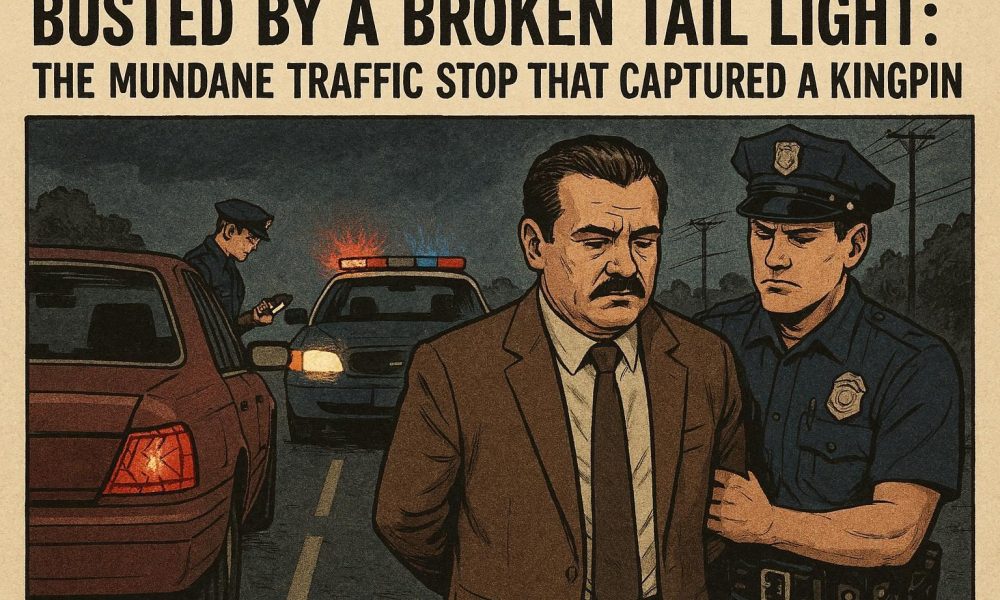
A multi-agency international task force spent millions searching for him, but it was a vigilant local patrol officer on a rural highway who finally slapped the cuffs
WASHINGTON, DC, May 6, 2026,
The story sounds almost too ordinary to belong in the world of cartel bosses, encrypted phones, false passports, private safe houses, and multinational task forces, yet major fugitive cases often end through the smallest failures of routine discipline.
For years, the kingpin had been treated as a ghost, moving through aliases, trusted drivers, rented vehicles, proxy companies, cash couriers, foreign residences, and layers of communication designed to keep his name off roads, bank counters, airports, and police databases.
Then a broken taillight on a rural highway created the one thing years of surveillance, intelligence sharing, and financial tracing had not produced: a calm, lawful stop by a patrol officer who noticed the ordinary defect hiding an extraordinary fugitive.
The manhunt ended because the small detail survived where the grand strategy failed
International task forces often spend years building intelligence files that stretch across borders, but fugitives usually survive by avoiding the dramatic moments that create headlines, choosing instead the dull discipline of short trips, quiet houses, careful drivers, and predictable secrecy.
That discipline can collapse through a minor mechanical failure, because a taillight, expired tag, lane drift, missing plate, speeding violation, or insurance question gives local police a lawful reason to ask who is inside the vehicle.
The officer on the rural highway did not need to know the entire history of the fugitive network because the first job was simpler, safer, and more procedural: stopping a vehicle that did not meet the basic rules of the road.
The kingpin’s empire had been built to withstand international pressure, but it had not been built to withstand the ordinary vulnerability of a vehicle that invited attention at the worst possible moment.
Routine policing remains one of the most underestimated tools in fugitive enforcement
Large manhunts depend on federal agencies, foreign partners, border alerts, intelligence reports, financial records, extradition requests, and watchlists, yet the final contact with a fugitive may still occur through a local officer working an ordinary shift.
That reality is familiar to investigators because history has repeatedly shown that fugitives can evade elite task forces while still being exposed by habits, traffic violations, suspicious documents, nervous behavior, or a mismatch between a story and a database.
The FBI’s public Most Wanted program reflects the national scale of fugitive pressure, but even the most sophisticated listing becomes more powerful when a local officer, clerk, hotel employee, or border agent checks the right detail at the right time.
The rural stop mattered because local policing created the physical encounter that intelligence systems often need, turning a name in a database into a person standing beside a vehicle under flashing lights.
The broken taillight became a legal doorway into a hidden life
A lawful traffic stop does not automatically solve a manhunt, but it creates a structured moment where identity, documents, registration, insurance, vehicle ownership, travel purpose, and passenger behavior can all be observed in real time.
The officer’s first questions likely sounded ordinary, yet each answer created pressure because fugitives are strongest when they control distance and weakest when asked to explain themselves unexpectedly in front of someone trained to notice inconsistency.
A false name may work in a hotel lobby, a borrowed vehicle may work in a city, and a forged document may work in a rushed interaction, but roadside policing is different because the officer can slow the moment down.
The kingpin’s problem was not only that the taillight was broken, but that the stop forced his hidden identity to perform under conditions he had not scheduled, scripted, or controlled.
The officer noticed the paperwork before he understood the prize
Major fugitive captures often begin with something that seems slightly wrong rather than obviously criminal, such as a nervous passenger, an inconsistent destination, a registration problem, a document that feels rehearsed, or a driver who answers too quickly.
In this case, the officer’s vigilance turned procedure into intuition because the vehicle details did not fully align, the passengers appeared unusually controlled, and the identity documents raised enough doubt to justify deeper verification.
The first database check may have returned nothing under the alias, but the officer’s persistence mattered because fugitives often rely on the assumption that a tired patrol shift will accept the first plausible explanation.
When the second layer of checks began, the hidden world began to surface, connecting photographs, biometric records, past warrants, foreign notices, and intelligence flags that had been waiting for a single lawful encounter.
The task force had built the net, but the patrol officer closed it
The international task force deserves credit because the arrest did not happen in a vacuum; fugitive flags, intelligence notes, border records, aliases, photographs, and law enforcement bulletins had been built over years of shared work.
The local officer’s stop became decisive because that work had been placed where ordinary policing could use it, allowing a rural traffic violation to connect with federal databases and international alerts.
This is the quiet genius of modern fugitive enforcement, because the system does not always need every officer to know every case, but it does need records, warnings, and identification tools to be ready when chance creates contact.
A multi-agency manhunt can spend millions narrowing the world around a fugitive, but the final arrest may still depend on whether one officer takes an extra minute to question a story that sounds too smooth.
The kingpin’s greatest mistake was trusting movement itself
Fugitives often recognize that homes, offices, phones, banks, and airports are dangerous, yet they underestimate the risks posed by cars because driving feels flexible, private, and less formal than crossing a border or entering a financial institution.
Vehicles, however, create exposure through license plates, insurance records, cameras, tolls, fuel stops, rental agreements, traffic laws, maintenance failures, and the unavoidable fact that roads are shared public spaces governed by ordinary police authority.
A rural highway can feel invisible to someone used to city surveillance, but it can become more dangerous because fewer vehicles make small defects stand out, and fewer distractions give an officer more time to observe.
The broken taillight was not the cause of the kingpin’s downfall by itself, because the real cause was the belief that movement could be managed without creating any ordinary points of contact.
The capture exposed the fragility of false identities
The kingpin had reportedly carried documents designed to survive casual inspection, but false identity systems are fragile because they must match the face, the vehicle, the story, the travel route, the phone records, and the behavior of the person using them.
A fake document can look convincing in isolation while failing under comparison, especially when an officer checks names, dates of birth, vehicle ownership, warrants, aliases, immigration history, and photographs across multiple systems.
Amicus International Consulting’s work around legal identity solutions reflects the lawful side of identity planning, where government recognition, documented continuity, and compliance are fundamentally different from fugitive aliases or fraudulent papers.
The roadside encounter showed why that distinction matters: a lawful identity can be verified through records, while a false identity must survive by hoping nobody asks one question too many.
The body language of a fugitive can betray what papers hide
Experienced officers often describe traffic stops as behavioral events, because the paperwork matters, but so do hands, eyes, pauses, passenger silence, rehearsed answers, excessive politeness, and the strange calm that can appear when someone is trying too hard.
A kingpin used to command may struggle in a roadside encounter where he has no leverage, no armed entourage, no trusted intermediary, and no control over whether the officer asks for backup.
That power reversal can be psychologically destabilizing because the fugitive who has spent years managing risk suddenly becomes dependent on the judgment of one patrol officer holding a flashlight and a radio.
The officer may not know the person is a kingpin at first, but the fugitive knows exactly what discovery would mean, and that hidden fear can leak through even the most practiced disguise.
Local roads can defeat international safe houses
The mythology of fugitive life focuses on safe houses, corrupt officials, foreign passports, private aircraft, and encrypted phones, but the ordinary road remains a dangerous equalizer because it forces people in hiding into public systems.
Every vehicle must display a plate, every driver must obey traffic rules, every passenger may be observed, and every defect creates a potential opening for lawful inspection.
That is why major criminal figures often employ drivers, switch vehicles, avoid routine routes, and delegate errands, because they understand that one roadside mistake can undo years of careful separation.
The broken taillight became the visible crack in a larger security system, revealing that even a cartel boss must eventually depend on ordinary mechanics, ordinary roads, and ordinary human judgment.
The arrest changed the meaning of the manhunt
Before the stop, the fugitive was an abstraction in intelligence briefings, a face on a warning notice, a name in international files, and a strategic target discussed by agencies that had spent years tracking his network.
After the stop, he became a handcuffed suspect beside a vehicle, stripped of the mythology that had made him appear unreachable to rivals, associates, investigators, and communities harmed by his organization.
That symbolic collapse matters because criminal empires depend on fear, and fear often grows from the belief that the leader exists above the ordinary rules applied to everyone else.
When a kingpin is captured over a broken taillight, the myth weakens because the public sees that distance, wealth, violence, and secrecy can still be defeated by lawful procedure.
The financial network began shaking before the booking photo was released
An arrest like this rarely affects only the man in custody because associates immediately begin asking what devices were seized, what names were recovered, which vehicles were connected, and whether the suspect had documents linking him to hidden assets.
Money movers worry about account records, couriers worry about messages, lawyers prepare emergency filings, relatives move carefully, and lieutenants reassess whether loyalty still protects them.
That is why the first hours after arrest can be as important as the traffic stop itself, because investigators may exploit phones, papers, vehicle contents, contact lists, hotel keys, receipts, and travel notes before the wider network understands what has happened.
The kingpin’s broken taillight may have stopped one vehicle, but the arrest likely triggered a chain reaction across the financial and logistical systems that kept him alive.
Second passports can help lawful travelers, but they cannot save fugitives from ordinary policing
International mobility can be legitimate, valuable, and protective for families, executives, investors, and high-risk individuals who want lawful resilience in an unstable world.
Amicus International Consulting’s work in second-passport planning falls within that lawful framework, where eligibility, source-of-funds clarity, tax compliance, and recognized government issuance matter more than secrecy.
For fugitives, additional documents may create more exposure rather than less, because every passport, visa, residence file, bank account, and travel record becomes another point investigators can compare against a claimed identity.
The traffic stop proved that mobility is not immunity, because a person can cross borders successfully and still be caught when a rural officer asks why the vehicle’s rear light is not working.
The case also shows why databases need human curiosity
Technology matters, but the officer’s curiosity mattered more because databases cannot ask follow-up questions unless a human decides the first answer is not enough.
A patrol officer who accepts the alias, writes a warning, and leaves the scene may never discover the hidden warrant, whereas an officer who notices an inconsistency can bring the full weight of the fugitive system to a stop.
This is the human element that criminals fear because it cannot be fully predicted, purchased, or defeated by encryption, since a careful officer can turn a mundane roadside detail into a major investigative breakthrough.
The officer did not need to be part of the international task force to contribute to it, because good policing at the local level can become the final move in a global operation.
The kingpin was not beaten by bad luck alone
It is tempting to call the broken taillight bad luck, but fugitives usually create their own luck through repeated exposure, carelessness, poor vehicle maintenance, complacency, and the belief that small rules no longer apply to them.
A person living under pressure must manage every detail, which means the defective light was not merely mechanical but operational, showing that the fugitive’s security discipline had begun to decay.
Long manhunts often end this way because secrecy becomes routine, routine becomes confidence, confidence becomes shortcuts, and shortcuts create the opening that investigators have been waiting to exploit.
The taillight did not outsmart the kingpin, but it revealed the quiet erosion that eventually affects almost every hidden life built on pressure, deception, and constant movement.
The final lesson is that no empire is bigger than procedure
The capture will be remembered because it inverted the usual hierarchy of law enforcement, with a rural patrol stop succeeding where international surveillance, foreign intelligence, financial tracing, and expensive task-force operations had yet to secure custody.
That does not mean the task force failed, because it created the conditions that made the stop meaningful once the officer found the right person under the wrong taillight.
It means the rule of law often works through accumulation, where major investigations, public alerts, careful databases, local vigilance, and small legal procedures combine until a fugitive finally runs out of margin.
The kingpin had survived because he made himself complicated, but the arrest happened because the law remained simple enough for one officer to apply on a quiet rural highway.
In the end, the broken taillight became more than a vehicle defect because it became the small red signal that exposed a hidden empire, ended a costly manhunt, and proved that even the most protected fugitive can be undone by the most ordinary rule on the road.




