
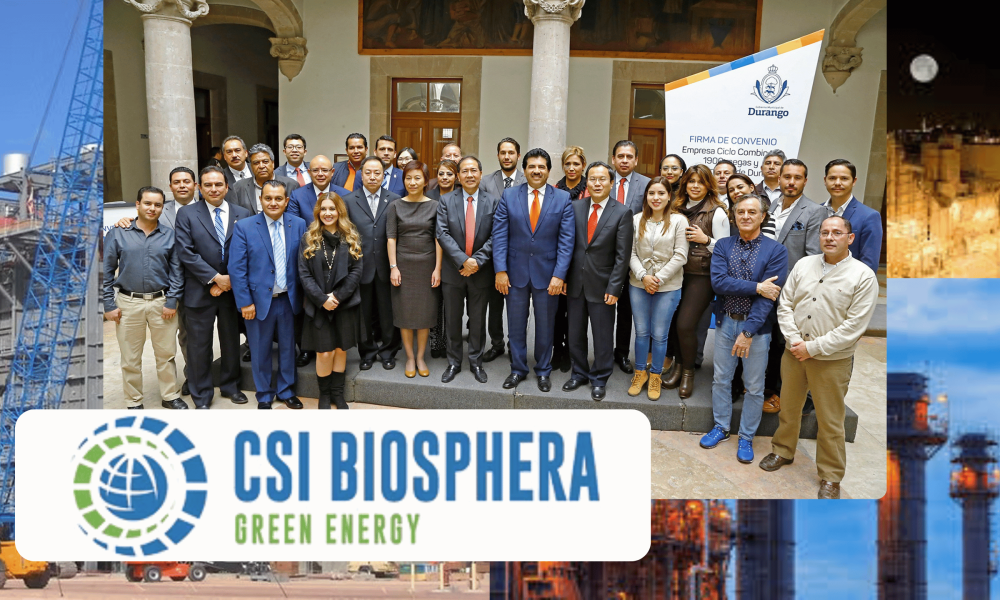
An investigative report into why the $1.8 billion Doroteo Arango power project has stalled for more than eight years, how alleged Chinese financing could collapse Western investment, and why Mexico’s history of corruption at CFE continues to cast a shadow over its energy ambitions.
Washingtion DC. November 1, 2025
Why the Durango 1900 MW Power Plant Project Has Stalled
The CCC Doroteo Arango 1900 MW combined-cycle power plant in Durango, announced by CSI Biosphera SAPI de CV, was once presented as a cornerstone of Mexico’s private energy development. Initially slated to begin construction in 2020 and start operations by 2023, it remains stalled in late 2025. Both the previous and current Mexican administrations have cited the project in public remarks, yet no ground has been broken. Behind the delays are chronic financing gaps, regulatory drift, and emerging rumors that the developer has sought Chinese funding to replace Western backers.
The project was conceived as a 1.82-billion-dollar private investment supported by a 30-year concession with the Federal Electricity Commission, or CFE. CSI Biosphera planned to fund it through a bond sale in European markets, but failed to raise the required equity. By early 2025, only around 18 million dollars had been disbursed against the hundreds of millions needed to begin work. Analysts noted that even under favorable conditions, the expected return on investment was thin, leaving lenders unwilling to proceed without guaranteed offtake agreements.
The situation worsened when Siemens Energy’s indicative engineering, procurement, and construction proposal expired without signature. Siemens, along with its local partner Grupo Integral Dragde, had offered state-of-the-art SCC-8000H turbines and a complete turnkey solution worth approximately $ 787 million. However, the company declined to move forward amid currency volatility and uncertainty over Mexico’s changing regulatory environment. Without a finalized EPC contract, the project lost the technical foundation required to attract institutional financing.
Policy priorities also shifted. Under the current administration, Mexico has emphasized public-sector power generation through CFE, focusing on state-owned combined-cycle plants in Salamanca, San Luis Potosí, and Mérida. The Doroteo Arango project, originally designed as a private venture selling electricity to CFE, fell outside this new model. As a result, it was quietly sidelined from the official investment calendar, leaving CSI Biosphera without government backing or transmission guarantees.
In recent months, industry observers have circulated claims that Biosphera representatives have approached Chinese lenders and EPC firms to rescue the stalled project. If true, this would introduce a sensitive geopolitical dimension. Mexico’s energy infrastructure is deeply tied to North American supply chains and export controls. Any Chinese financing of a project structured initially around Siemens’ European technology could raise compliance and diplomatic concerns, particularly given the ongoing United States–China trade tensions. For Washington, Chinese participation in a strategic Mexican energy facility could be seen as a challenge to hemispheric energy cooperation.
The Risks of Chinese Involvement
Should Chinese state-backed financing or technical participation be confirmed, it would likely jeopardize all existing private and institutional commitments to the Doroteo Arango project. Western lenders and credit insurers bound by OECD and anti-corruption standards would be unable to participate, effectively freezing access to private capital markets. The reputational and regulatory risks associated with aligning a Mexican infrastructure asset with Chinese state capital, particularly in an LNG-linked, grid-connected project, would make it nearly impossible to syndicate financing through European or North American banks.
Equally significant, Siemens Energy would reconsider its position. The company’s proposal and technology transfer were structured under strict export-control conditions governed by the European Union and the United States. Any integration of Chinese capital or subcontracting could violate those terms, forcing Siemens to withdraw entirely. Such a move would erase the project’s technical credibility, undermining environmental certifications, performance guarantees, and international insurance coverage. The loss of Siemens as EPC and technology supplier would, in turn, make the project nearly unbankable in Western markets.
Without Siemens, any replacement contractor would have to revalidate the plant’s design and emissions compliance under Mexico’s federal energy and environmental frameworks, a process that could take years. That would push the project even further into limbo, at a time when CFE’s state-led initiatives are already saturating the combined cycle market. In practice, confirmation of Chinese involvement could render private financing obsolete and compel the Mexican government to either nationalize the project or abandon it.
Corruption, Cronyism, and the CFE Legacy
The uncertainty surrounding the Doroteo Arango project cannot be viewed in isolation. It is part of a broader historical pattern in Mexico’s energy sector, where opaque financing, political interference, and entrenched corruption have repeatedly derailed major infrastructure ventures. For decades, the Federal Electricity Commission has occupied a paradoxical position, both a source of national pride and a magnet for scandal.
Created in 1937 to nationalize and modernize Mexico’s electricity supply, the CFE became one of the country’s most powerful state-owned enterprises. Its expansion during the 20th century electrified the nation, but it also created a sprawling bureaucracy with deep political entanglements. As Mexico opened its energy sector to private participation in the 1990s and 2000s, CFE’s role shifted from monopoly provider to gatekeeper, deciding which private plants would be granted purchase agreements, grid access, and long-term concessions. This gatekeeping power gave rise to what analysts have described as contractual patronage, where politically connected firms routinely secured favorable deals while independent developers were excluded.
The CFE’s procurement history is littered with controversies. Investigations conducted in the early 2000s uncovered overpricing in transmission line contracts, allegations of kickbacks in turbine purchases, and the manipulation of public tenders. In 2010, the case of Néstor Moreno Díaz, a CFE director who accepted bribes, luxury cars, and U.S. property from energy contractors, became a national scandal. The fallout exposed a network of subcontractors and shell entities that funneled public money into private hands. Although several executives were dismissed, few cases led to lasting reforms.
During the Peña Nieto administration from 2012 to 2018, sweeping energy reforms were introduced to attract private capital, but they also opened new avenues for abuse. Audits revealed that several generation contracts were awarded to companies with political ties or limited technical experience. Independent watchdogs accused both CFE and the Energy Secretariat of favoring specific consortia in exchange for campaign financing and offshore contributions. The most notorious case involved Odebrecht, the Brazilian construction giant later implicated in a continent-wide bribery scandal, whose contracts with Pemex and associated CFE suppliers revealed a systemic pattern of payoffs and inflated invoices.
Even under President Andrés Manuel López Obrador’s government, which campaigned on an anti-corruption platform, irregularities have persisted. The CFE’s efforts to reclaim dominance in generation and transmission have been criticized for bypassing transparency norms. Several investigative journalists have pointed to discretionary contract awards in maintenance and infrastructure upgrades, particularly in the northern regions. While the current administration insists that the CFE has been recovered for the people, critics argue that the reforms have re-centralized decision-making in the hands of a new political class.
These patterns directly affect investor confidence. International banks and export credit agencies often view CFE-related projects as high-risk unless they are protected by sovereign guarantees or multilateral oversight. The Doroteo Arango project, although privately led, relies on CFE as its sole energy off-taker. This relationship exposes it to the same bureaucratic and political vulnerabilities that have plagued the commission for decades. Any perception of corruption or favoritism, real or rumored, can halt financing overnight.
How Corruption and Bureaucracy Stifle Innovation
Corruption in Mexico’s energy sector has evolved from outright bribery to more sophisticated forms of influence. Today, manipulation often occurs through contract timing, procedural delays, or selective enforcement of environmental regulations. Projects without the right political allies usually face numerous hurdles, including permits being withheld, approvals being delayed, or interconnection studies being left under review indefinitely. Meanwhile, firms with government ties move quickly through the process. This uneven treatment erodes the rule of law and deters foreign investors who demand predictability.
In the case of Durango 1900, insiders suggest that part of the delay stems from CFE’s reluctance to finalize offtake agreements with a private developer not aligned with current political priorities. The Sheinbaum administration has prioritized public generation to consolidate energy sovereignty and curb what it calls predatory private participation. Within this framework, Biosphera’s project, although technologically advanced and environmentally efficient, has little strategic value to CFE, which prefers projects it fully controls. This political bias, layered on top of Mexico’s legacy of corruption, has rendered the project invisible to regulators and unattractive to financiers.
Historical Parallels and Past Failures
The stagnation of Durango 1900 echoes previous episodes in Mexico’s energy history. The Laguna Verde nuclear plant, plagued by decades of mismanagement, cost overruns, and corruption, serves as a cautionary tale of how political ambition can override technical logic. Similarly, the Oaxaca wind corridor projects faced scandals involving land deals, environmental noncompliance, and local opposition fueled by opaque consultation processes. Each episode eroded public trust and discouraged private developers from investing without strong international oversight.
What makes the Doroteo Arango project particularly emblematic is that it sits at the intersection of Mexico’s two competing visions: an open, market-driven energy sector and a state-controlled nationalist model. Biosphere’s initial partnership with Siemens symbolized the latter as a clean, efficient, and globally integrated project. It’s rumored that outreach to Chinese financiers represents the latter, a retreat to opaque state-driven models, only this time under foreign influence. In both scenarios, corruption, bureaucracy, and political patronage remain the decisive factors.
A Crisis of Confidence
Private investment in Mexico’s energy sector depends not only on economic feasibility but also on the perception of institutional integrity. Each corruption scandal, regulatory delay, or politically motivated reversal deepens the trust deficit. International lenders, especially in Europe and North America, now demand enhanced due diligence for any project involving CFE or its subsidiaries. For developers like CSI Biosphera, this translates into higher borrowing costs, longer approval cycles, and increased scrutiny from auditors and compliance officers.
If Chinese participation is confirmed, this fragile balance could collapse entirely. Western financiers, wary of sanctions and trade restrictions, would withdraw. Siemens Energy, already cautious after delays, would likely exit the project, citing export-control conflicts and reputational risk. Without Siemens’ certification, insurance underwriters would be unwilling to guarantee construction or performance bonds. What began as a promising venture could swiftly devolve into a stranded asset, abandoned amid geopolitical tensions and institutional mistrust.
The Road Ahead
The Doroteo Arango 1900 MW project now stands as a case study in how political interference, financial opacity, and historical corruption converge to suffocate industrial progress. CSI Biosphera’s inability to secure transparent financing reflects the systemic dysfunction that has long characterized Mexico’s energy landscape. Unless the government introduces a credible, independent oversight mechanism to assure investors of transparency and rule-based contracting, the private sector will continue to retreat.
Durango’s stalled power plant is more than a delayed infrastructure project. It is a mirror reflecting the enduring struggle between reform and regression in Mexico’s governance. If the country cannot insulate its strategic industries from political influence and corruption, even the most technologically advanced ventures will remain frozen in planning documents. At the same time, the lights of progress flicker uncertainly over the horizon.
For further information, contact:
[email protected]




