

Synthetic Fuel Market Overview
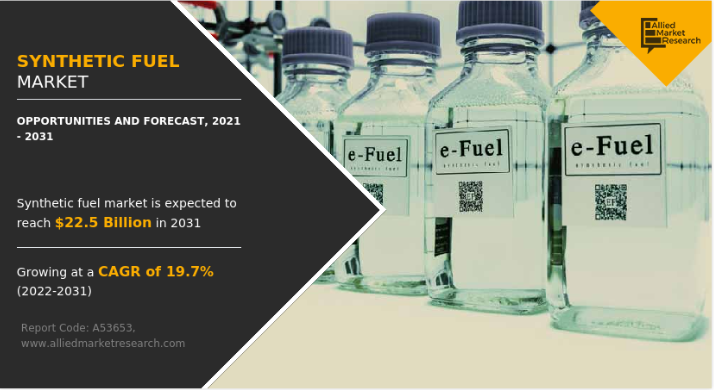
According to a new report published by Allied Market Research, the global Synthetic Fuel Market size was valued at $3.9 billion in 2021 and is projected to reach $22.5 billion by 2031, growing at a robust CAGR of 19.7% from 2022 to 2031. Increasing efforts to reduce carbon emissions, enhance energy security, and develop sustainable alternatives to conventional fuels are key factors driving the expansion of the Synthetic Fuel Market worldwide.
What Are Synthetic Fuels?
Synthetic fuels, also known as synfuels, are liquid or gaseous fuels produced from synthesis gas (syngas), a mixture of carbon monoxide and hydrogen. Syngas is typically generated through gasification of solid feedstocks such as coal or biomass or through reforming of natural gas.
These fuels closely resemble conventional petroleum-based fuels in both properties and performance. Synthetic fuels can be used in existing engines and fuel infrastructure with minimal modifications, making them an attractive transitional solution toward cleaner energy systems.
Unlike many alternative fuels that require new infrastructure, synthetic fuels are compatible with current storage, transportation, and distribution networks. This compatibility significantly accelerates their adoption across transportation and industrial sectors.
Download PDF Brochure: https://www.alliedmarketresearch.com/request-sample/54128
Role in the Energy Transition
Synthetic fuels can be produced from both fossil and renewable resources. However, the primary objective of developing synfuels is to reduce greenhouse gas emissions while maintaining reliable energy supply.
Many governments and companies are investing heavily in research and development to improve production efficiency and sustainability. By utilizing captured carbon dioxide and renewable feedstocks, synthetic fuels have the potential to significantly lower lifecycle emissions compared to traditional fuels.
As countries strive to achieve climate goals without disrupting existing energy systems, the Synthetic Fuel Market is gaining momentum as a practical low-carbon solution.
Key Market Drivers
One of the major drivers of the Synthetic Fuel Market is the rising cost and volatility of conventional oil and gas supplies. Energy security concerns, geopolitical tensions, and fluctuating fossil fuel prices are encouraging nations to diversify their energy sources.
Synthetic fuels can be produced domestically using locally available feedstocks, reducing dependence on imported oil. This advantage is particularly important for countries seeking energy independence.
In addition, synthetic fuels can serve as drop-in replacements for gasoline, diesel, and jet fuel, making them suitable for aviation, maritime transport, and heavy-duty vehicles where electrification may be challenging.
Challenges Hindering Market Growth
Despite strong growth prospects, high production costs remain a significant barrier to the widespread adoption of synthetic fuels. Producing synfuels often requires complex processes, advanced catalysts, and substantial energy input, making them more expensive than conventional fuels.
The abundant availability of traditional fossil fuels in many regions also limits market penetration. Furthermore, scaling up production to commercial levels requires large investments in infrastructure and technology.
Nevertheless, ongoing innovation and policy support are expected to gradually reduce costs and improve competitiveness.
Market Segmentation by Raw Material
Based on raw material, the Synthetic Fuel Market is segmented into coal, natural gas, food-crop/plant-based feedstocks, and non-food crop-based biomass.
Non-food biomass sources such as corn stover, hardwood, softwood, switchgrass, and miscanthus are increasingly used for sustainable fuel production. During the process, carbon dioxide generated from combustion can be captured and reused, enhancing environmental benefits.
Natural gas-based feedstocks are projected to witness the highest growth rate due to their widespread availability and established processing technologies.
Segmentation by Fuel Type
By type, the market includes extra heavy oils, gas-to-liquid (GTL) fuels, shale oils, coal-to-liquid (CTL), biomass-to-liquid (BTL), and others.
Gas-to-liquid fuels dominated the market in 2021 due to their high efficiency and cleaner combustion characteristics. These fuels are produced by converting natural gas into liquid hydrocarbons using advanced chemical processes.
Extra heavy oils also serve as a source for synthetic crude, known as syncrude, which requires further refining before commercial use. Syncrude is commonly utilized for producing jet fuel, kerosene, and gasoline.
Application Insights
Based on application, the Synthetic Fuel Market is divided into gasoline, diesel, and kerosene.
Gasoline held the largest market share in 2021, reflecting strong demand from the transportation sector. However, synthetic diesel is gaining significant attention due to its superior performance characteristics.
Synthetic diesel contains high cetane levels and minimal sulfur, resulting in improved engine efficiency and reduced emissions. It can be used in existing diesel engines without modifications and transported through current fuel infrastructure, making it a highly practical alternative fuel.
Kerosene-based synthetic fuels are also widely used in aviation, where reducing carbon emissions remains a major challenge.
Synthetic Fuel Market Regional Analysis
Regionally, Europe has emerged as a major hub for the Synthetic Fuel Market, led by countries such as Germany and United Kingdom. Strong investments in clean energy technologies and aggressive climate policies are driving regional growth.
The European Union’s efforts to reduce dependence on fossil fuels—particularly following geopolitical disruptions such as the Russia-Ukraine conflict—have accelerated the development of alternative fuels, including synfuels.
North America also holds a significant market share and is expected to grow rapidly due to technological advancements and abundant natural gas resources.
Asia-Pacific is projected to witness substantial growth as industrialization and transportation demand increase across countries like China and India.
Competitive Landscape
The global Synthetic Fuel Market features several major energy and technology companies investing in innovative production methods. Key players include Sasol, Indian Oil Corporation, Shell plc, Exxon Mobil, Reliance Industries, Robert Bosch GmbH, Air Liquide, PetroChina, Phillips 66, and SG Preston Company.
Innovative firms such as INERATEC are developing power-to-liquid technologies that convert renewable electricity into synthetic fuels. Strategic partnerships, technological advancements, and new production facilities are shaping the competitive landscape.
Get a Customized Research Report: https://www.alliedmarketresearch.com/request-for-customization/A53653
Synthetic Fuel Market Future Outlook
The future of the Synthetic Fuel Market appears highly promising as nations pursue sustainable energy pathways while maintaining existing transportation systems. Synfuels offer a practical bridge between fossil fuels and fully renewable energy solutions.
Advancements in carbon capture, renewable energy integration, and process efficiency are expected to enhance the environmental and economic viability of synthetic fuels.
Conclusion
The global Synthetic Fuel Market is poised for significant expansion through 2031, driven by climate policies, energy security concerns, and technological innovation. Although high production costs and competition from conventional fuels remain challenges, growing investment and supportive regulations are likely to sustain long-term growth.
As the world transitions toward a low-carbon future, synthetic fuels will play a crucial role in decarbonizing sectors that are difficult to electrify, ensuring reliable and sustainable energy supply for decades to come.
Other Trending Reports:-
About Us
Allied Market Research (AMR) is a full-service market research and business-consulting wing of Allied Analytics LLP based in Portland, Oregon. Allied Market Research provides global enterprises as well as medium and small businesses with unmatched quality of “Market Research Reports” and “Business Intelligence Solutions.” AMR has a targeted view to provide business insights and consulting to assist its clients to make strategic business decisions and achieve sustainable growth in their respective market domain.
Pawan Kumar, the CEO of Allied Market Research, is leading the organization toward providing high-quality data and insights. We are in professional corporate relations with various companies and this helps us in digging out market data that helps us generate accurate research data tables and confirms utmost accuracy in our market forecasting. Each and every data presented in the reports published by us is extracted through primary interviews with top officials from leading companies of domain concerned. Our secondary data procurement methodology includes deep online and offline research and discussion with knowledgeable professionals and analysts in the industry.




