
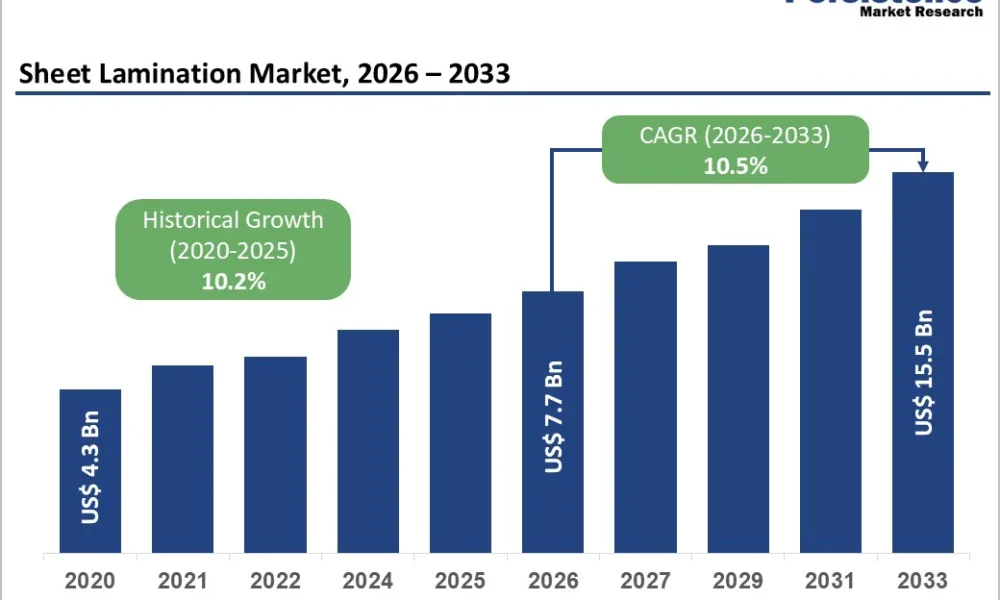
The global sheet lamination market is entering a dynamic growth phase, fueled by rising demand for protective, durable, and visually enhanced finishing solutions. According to industry estimates, the market is projected to be valued at US$7.7 billion in 2026 and is expected to reach US$15.5 billion by 2033, expanding at a robust CAGR of 10.5% between 2026 and 2033. Historically, the market recorded a CAGR of 10.2% from 2020 to 2025, demonstrating consistent momentum.
Sheet lamination has become a critical process across packaging, printing, labeling, and graphic arts industries. As businesses seek to improve product shelf life, enhance brand visibility, and ensure durability in transportation and retail environments, laminated materials are increasingly becoming indispensable.
Sheet Lamination Market Overview
Sheet lamination involves bonding a protective film layer to printed sheets or substrates to enhance strength, durability, moisture resistance, and visual appeal. Laminated sheets are widely used in packaging cartons, labels, tags, brochures, covers, and industrial applications.
The growth of the market is closely linked to:
- Increasing consumption of packaged foods and beverages
- Rapid expansion of e-commerce logistics
- Rising demand for premium branding and packaging aesthetics
- Advancements in digital printing technologies
- Growing emphasis on sustainable materials
As consumer expectations evolve and regulatory frameworks tighten, lamination technologies are also undergoing innovation to balance performance with environmental responsibility.
Market Drivers
- Increasing Demand for Protective Packaging Solutions
The surge in global packaged goods consumption is one of the strongest growth drivers. Food, beverages, pharmaceuticals, and consumer goods manufacturers rely heavily on laminated materials to:
- Protect products from moisture and oxygen
- Prevent physical damage during transit
- Maintain freshness and extend shelf life
- Enhance product presentation
E-commerce growth has significantly amplified the need for durable packaging. Products now undergo multiple handling stages, long-distance shipping, and warehousing. Laminated films—especially polypropylene and polyester—provide the strength, clarity, and tear resistance necessary for such logistics.
Moreover, laminated packaging enhances shelf appeal. High-gloss finishes, superior print compatibility, and vibrant colors enable brands to differentiate themselves in competitive retail spaces.
- Expansion of Digital Printing and Labeling Applications
The rapid growth of digital printing has positively impacted the sheet lamination market. Digital printing allows shorter production runs, customization, and faster turnaround times. Laminated films complement these benefits by ensuring durability and print protection.
Laminated labels are especially critical in:
- Pharmaceutical packaging
- Cosmetic products
- Beverage bottles
- E-commerce shipping labels
The increasing need for regulatory compliance and clear product information further drives demand for laminated labels that resist smudging, fading, and tearing.
- Sustainability and Eco-Friendly Innovations
Sustainability has emerged as both a driver and a differentiator in the sheet lamination market. As governments introduce restrictions on plastic waste and single-use plastics, manufacturers are investing in recyclable, biodegradable, and bio-based lamination films.
Recyclable PET laminates and water-based adhesives are gaining popularity. These solutions maintain product performance while reducing environmental impact. Brands adopting sustainable laminated packaging can strengthen their reputation among environmentally conscious consumers.
Market Restraints
Stringent Environmental Regulations on Plastics
While sustainability creates opportunities, regulatory pressure also presents challenges. Traditional lamination processes often involve multi-layer structures that are difficult to recycle.
Governments in North America and Europe are enforcing stricter packaging regulations. Compliance may require manufacturers to shift toward recyclable or biodegradable materials, which can:
- Increase production costs
- Disrupt supply chains
- Require new equipment investments
Balancing environmental responsibility with affordability and performance remains a central industry challenge.
Emerging Opportunities
Development of Bio-Based and Recyclable Films
The development of sustainable lamination materials represents one of the most promising opportunities in the market.
Bio-based films derived from renewable sources provide comparable durability and moisture resistance while reducing carbon footprints. Recyclable PET-based laminates are also being adopted across food, beverage, and personal care sectors.
Collaboration between packaging companies, material innovators, and research institutions is accelerating innovation in this segment. As circular economy initiatives expand globally, eco-friendly sheet lamination solutions will likely command premium demand.
Elevate your business strategy with comprehensive market data. Request a sample report now: https://www.persistencemarketresearch.com/samples/20023
Category-Wise Analysis
Material Type Insights
Polypropylene – The Leading Segment
Polypropylene is projected to account for approximately 40% of market revenue in 2026, making it the dominant material type.
Its popularity stems from:
- Excellent clarity
- Strong moisture barrier properties
- Cost-effectiveness
- Lightweight structure
Biaxially oriented polypropylene (BOPP) films are widely used for snack packaging, cookies, nuts, and beverage labels. The balance between affordability and performance makes polypropylene ideal for mass-market applications.
Polyester – The Fastest-Growing Segment
Polyester is expected to be the fastest-growing material segment, driven by demand for high-strength, heat-resistant films.
Polyester laminates are valued for:
- High durability
- Heat resistance
- Superior clarity
- Premium finish
Companies such as Toray Industries, Inc. utilize polyester laminates in luxury and high-end packaging applications.
The rise of recyclable PET-based polyester films further strengthens this segment’s growth prospects.
Application Insights
Packaging – The Dominant Application
Packaging is projected to account for over 45% of total market revenue in 2026, making it the leading application segment.
Laminated packaging plays a vital role in:
- Food and beverage safety
- Pharmaceutical protection
- Consumer goods durability
- Retail branding
Beverage cartons, for example, use laminated layers to provide liquid resistance and visual appeal. High-speed lamination and digital printing integration further enhance efficiency in packaging production.
Labels and Tags – The Fastest-Growing Application
Labels and tags are emerging as the fastest-growing application segment. The expansion of e-commerce, stricter labeling regulations, and branding priorities drive this growth.
Laminated labels offer:
- Resistance to moisture and abrasion
- Long-lasting print clarity
- Improved aesthetic appeal
Pharmaceutical packaging particularly depends on laminated labels to preserve dosage instructions and safety warnings throughout the product lifecycle.
Regional Insights
North America – Market Leader
North America is expected to account for around 30% of global market share in 2026.
The region benefits from:
- Advanced digital printing infrastructure
- Strong food and retail packaging demand
- Strict regulatory standards
- Investments in sustainable technologies
Major packaging players such as Amcor plc extensively use laminated films in snack packaging and beverage labeling to enhance shelf life and brand visibility.
Regulatory frameworks enforced by agencies such as the FDA are pushing innovation in recyclable and antimicrobial lamination solutions.
Europe – Sustainability-Focused Growth
Europe remains a key sheet lamination market, supported by a strong packaging and luxury goods industry.
Companies like Tetra Pak use laminated materials to preserve freshness and extend shelf life in beverage and confectionery packaging.
The European Union’s environmental policies are encouraging adoption of recyclable and biodegradable films. As sustainability remains central to regional strategies, bio-based lamination materials are gaining momentum.
Asia Pacific – Fastest-Growing Region
Asia Pacific is projected to be the fastest-growing regional market in 2026.
Growth drivers include:
- Rapid industrialization
- Low-cost manufacturing
- Expanding domestic consumption
- Booming e-commerce sector
- Rising pharmaceutical production
Countries like China, India, and Japan are witnessing increasing adoption of laminated films in packaging and labeling applications. The region’s competitive manufacturing landscape attracts both domestic and international players investing in specialty films and capacity expansion.
Competitive Landscape
The global sheet lamination market is moderately fragmented, featuring established manufacturers and innovative niche players competing on technology, product quality, and geographic reach.
Key companies include:
- Boxford
- CAM-LEM
- Cubic Technologies
- Sterling Finishing
- Mcor Technologies
- Wuhan Binhu Mechanical and Electrical
- Stratasys Ltd.
- 3D Systems Corporation
These companies compete through:
- R&D investment
- Technological innovation
- Strategic partnerships
- Geographic expansion
- Sustainability initiatives
Key Industry Developments
In November 2025, Singapore startup Lapis introduced a novel sheet lamination metal 3D printing process derived from research at Nanyang Technological University. The technology combines laminated object manufacturing with laser welding and ablation, producing high-resolution metal components without powder.
In October 2025, Nobelus launched the Orbis Dual 61, an automated two-sided thermal laminating system designed to enhance efficiency and output quality in packaging and graphic arts. The system integrates feeding, lamination, and trimming in a high-speed configuration.
Future Outlook
The sheet lamination market is poised for sustained expansion through 2033. Growth will be driven by:
- Continued rise in global packaging demand
- E-commerce expansion
- Premium branding requirements
- Sustainable material innovations
- Digital printing integration
While environmental regulations pose structural challenges, they also catalyze innovation in recyclable and bio-based lamination technologies.
As brands increasingly prioritize durability, aesthetics, and sustainability, sheet lamination will remain an essential finishing solution across packaging, labeling, and graphic arts industries.
With a projected market value of US$15.5 billion by 2033 and steady double-digit growth, the sheet lamination industry is set to play a pivotal role in the future of global packaging and advanced manufacturing.
Related Reports:




