
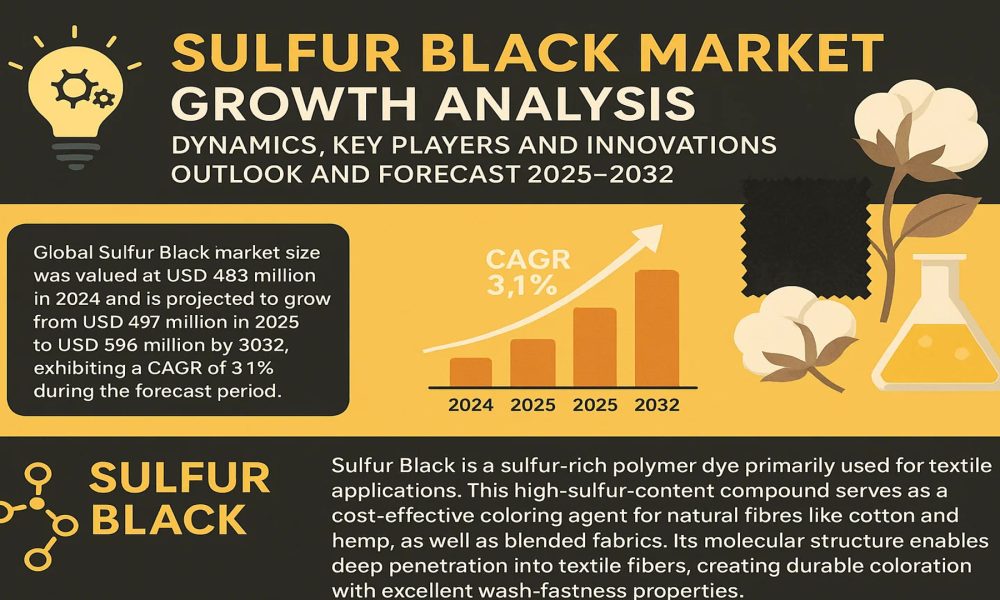
Global Sulfur Black market size was valued at USD 483 million in 2024 and is projected to grow from USD 497 million in 2025 to USD 596 million by 2032, exhibiting a CAGR of 3.1% during the forecast period.
Sulfur Black is a sulfur-rich polymer dye primarily used for textile applications. This high-sulfur-content compound serves as a cost-effective coloring agent for natural fibers like cotton and hemp, as well as blended fabrics. Its molecular structure enables deep penetration into textile fibers, creating durable coloration with excellent wash-fastness properties.
What is Sulfur Black?
Sulfur Black represents a specialized polymer dye compound containing elevated sulfur content, primarily utilized for dyeing cotton textiles, and secondarily for hemp, viscose, and blended fabrics. As the most economical black dye for cellulosic fibers, it accounts for approximately 40% of sulfur dye production volume globally. The compound achieves coloration through a vat dyeing process requiring alkaline conditions and reduction to soluble leuco forms before oxidation to the final insoluble color.
📥 Download FREE Sample Report:
Sulfur Black Market – View in Detailed Research Report
The market growth is driven by steady demand from the textile industry, particularly in developing economies with expanding garment manufacturing sectors. However, environmental regulations regarding sulfur emissions pose challenges for manufacturers. Recent production capacity adjustments in China – where dye output declined from 992,000 tons in 2017 to 769,000 tons in 2020 before recovering to 835,000 tons in 2021 – have impacted global supply chains. Leading producers including Shanxi Linfen Dyeing Chemicals and Zhejiang Jihua Group are adapting to these market conditions through technological upgrades and sustainable production methods.
MARKET DRIVERS
Growing Textile Industry Fueling Sulfur Black Demand
The global textile industry, valued at over $1.5 trillion, continues to expand with rising apparel consumption across developing economies. Sulfur black dyes remain indispensable for cotton dyeing due to their excellent colorfastness and cost-effectiveness compared to alternatives. With cotton accounting for approximately 25% of global fiber production, the sheer scale of textile manufacturing creates sustained demand. Emerging markets in Asia and Africa are witnessing particularly strong growth in textile output, with countries like India and Bangladesh increasing production capacities by 8-10% annually. This industrial expansion directly correlates with rising sulfur black consumption for fabric dyeing applications.
Superior Economic Profile Compared to Alternative Dyes
Sulfur black maintains significant cost advantages over competing dye categories, with price points typically 30-40% lower than reactive dyes and 50-60% below premium synthetic alternatives. This economic benefit proves decisive for high-volume textile manufacturers operating on thin margins. The dye’s efficient consumption rate of roughly 3-5% of fabric weight further enhances its value proposition. In price-sensitive markets like bulk cotton dyeing, these cost efficiencies make sulfur black the preferred choice despite environmental concerns. Recent innovations in sulfur black formulations have additionally improved dye yield by 15-20%, strengthening its competitive position.
MARKET OPPORTUNITIES
Development of Environmentally Optimized Sulfur Black Variants
Innovation in sulfur black chemistry presents significant growth opportunities. Leading manufacturers are developing low-sulfide and sulfide-free formulations that retain the economic benefits while meeting stricter environmental standards. These advanced variants currently command 20-25% price premiums but offer compliance advantages in regulated markets. Process innovations like continuous dyeing systems are also reducing sulfur black consumption per unit of fabric by up to 30%. As environmental regulations intensify globally, these cleaner alternatives are forecast to capture over 40% of the sulfur black market by 2030, creating new revenue streams for forward-thinking producers.
Expansion in Emerging Textile Manufacturing Hubs
The ongoing relocation of textile production to Southeast Asia and Africa presents untapped opportunities. Countries like Vietnam, Ethiopia, and Indonesia are experiencing rapid growth in textile exports, with sector expansions frequently exceeding 15% annually. These developing hubs often prioritize cost-effectiveness over environmental concerns in their early industrialization phases, creating ideal conditions for sulfur black adoption. Strategic partnerships with local dye houses and distributors could secure long-term market positions in these high-growth regions before sustainability standards catch up with production scaling.
By Type
- Powder
- Liquid
Powder form is more prevalent in industrial applications due to its stability and longer shelf life compared to liquid variants, which are preferred for specialized dye formulations.
By Application
- Cotton Dyeing
- Hemp Dyeing
- Viscose Dyeing
- Others
Cotton Dyeing is the dominant application, as sulfur black dye’s polymer properties bind effectively with cotton fibers, ensuring color longevity and resistance to fading.
By End User
- Textile Manufacturers
- Dye & Chemical Producers
- Exporters
Textile Manufacturers account for the highest demand, driven by the need for cost-effective and durable dye solutions in large-scale fabric production.
By Region
- Asia-Pacific
- North America
- Europe
- Others
Asia-Pacific leads sulfur black production and consumption, with China being the largest contributor due to its extensive textile industry and synthetic dye manufacturing capabilities.
List of Key Sulfur Black Companies Profiled
- Shanxi Linfen Dyeing Chemicals (China)
- Henan Luoran (China)
- Hebei Lead Bio-Chemicals (China)
- Jiangsu Dipu Technology (China)
- Zhejiang Jihua Group (China)
- Inner Mongolia Yabulai Salinization (China)
- Atul Ltd. (India)
- Alan Chemical (India)
- Bengbu Yongyan Dye (China)
SULFUR BLACK MARKET TRENDS
Growing Demand for Cotton Dyeing to Drive Sulfur Black Consumption
The global Sulfur Black market, valued at $483 million in 2024, is projected to reach $596 million by 2032, growing at a CAGR of 3.1%. This growth is primarily fueled by its widespread application in cotton dyeing, which accounts for over 65% of total consumption. The textile industry’s continuous expansion, especially in developing economies, has created sustained demand for cost-effective dye solutions like Sulfur Black. While synthetic fibers gain popularity, natural fibers maintain their dominance in many apparel segments, ensuring stable market growth for sulfur-based dyes.
Other Trends
Environmental Regulations Reshaping Production Landscape
Stringent environmental policies are significantly impacting sulfur dye manufacturing worldwide. China’s production output declined from 992,000 tons in 2017 to 769,000 tons in 2020 due to environmental compliance pressures, causing market consolidation. Smaller manufacturers without proper waste treatment facilities exited the market, while leading players invested heavily in cleaner production technologies. This shift has improved product quality but also created occasional supply constraints and price volatility in regional markets.
Recent Developments
- Shift to low-salt, low-sulfide processes: Producers are upgrading sulfur dye synthesis and dyeing auxiliaries to reduce COD/BOD and sulfide in effluents.
- Liquid & low-temperature grades: Launches of liquid Sulfur Black and low-temp dyeing variants to cut steam use and improve shade build on cellulosics.
- Compliance-driven investments: Upgrades for ZDHC MRSL, bluesign®, and REACH alignment; more ETP/zero-liquid-discharge (ZLD) projects at dye plants.
- Capacity debottlenecking in APAC: Incremental capacity adds and plant modernizations in India and China to serve denim and knitwear hubs in South & SE Asia.
- Supply chain localization: Textile clusters in Bangladesh, Vietnam, and Indonesia increase local sourcing via tolling/ JV arrangements to reduce lead times.
- Productivity boosters: New dispersing/wetting packages that improve liquor stability, leveling, and penetration on high-liquor-ratio machines.
- Shade consistency initiatives: Tighter QC, inline analytics, and recipe digitization to reduce lot-to-lot variance for denim blacks and deep charcoals.
- Cost dynamics: Volatility in sulfur, sodium sulfide, and energy prices drives selective price adjustments and long-term supply contracts with mills.
.
📘 Get Full Report Here:
Sulfur Black Market – View in Detailed Research Report
Report Highlights
- Granular 8-year forecasts by product, application and region
- Supplier market share analysis
- Production cost structure breakdown
- Regulatory impact assessment
- Price trend analysis and forecasts
About Intel Market Research
Intel Market Research is a leading provider of strategic intelligence, offering actionable insights in chemicals, materials, and industrial technologies. Our research capabilities include:
- Plant-level production analysis
- Trade flow mapping
- Technology benchmarking
- Over 300+ chemicals & materials reports annually
Trusted by Fortune 500 companies, our insights empower decision-makers to navigate complex industrial markets.
🌐 Website: https://www.intelmarketresearch.com
📞 International: +1 (332) 2424 294
📞 Asia-Pacific: +91 9169164321
🔗 LinkedIn: Follow Us




