
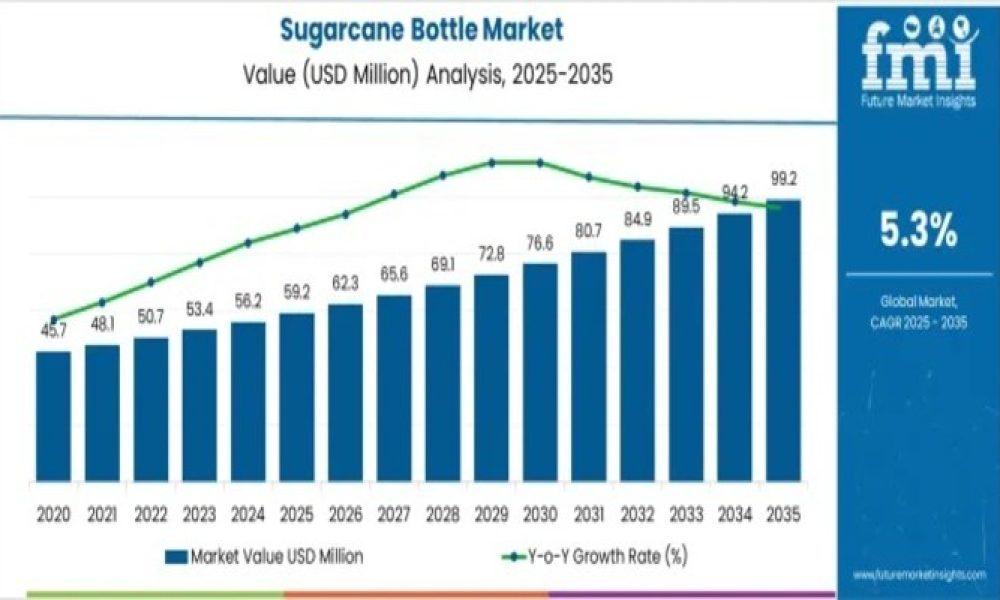
The global Sugarcane Bottle Market is gaining strong momentum as sustainability moves from a brand differentiator to a business imperative. With governments tightening regulations on single-use plastics and consumers actively choosing eco-friendly alternatives, sugarcane-based bottles are emerging as a viable, scalable solution for the packaging industry. According to industry analysis, the market is projected to grow from USD 59.2 million in 2025 to USD 99.2 million by 2035, registering a compound annual growth rate (CAGR) of 5.3% during the forecast period.
Sugarcane bottles, derived from renewable sugarcane biomass, offer recyclability, biodegradability, and reduced carbon emissions compared to conventional PET bottles. These attributes align closely with circular economy goals and corporate sustainability commitments across food & beverage, cosmetics, personal care, and pharmaceutical industries.
Discover Growth Opportunities in the Market – Get Your Sample Report Now
Market at a Glance: Key Highlights
- Market Value (2025): USD 59.2 million
- Forecast Value (2035): USD 99.2 million
- Forecast CAGR (2025–2035): 5.3%
- Leading Capacity Segment (2025): 251 ml to 500 ml (34.6% share)
- Dominant Material Type: Sugar-based material (73.6% share)
- Top End-Use Industry: Cosmetics and Personal Care (39.8% share)
- Key Growth Regions: Asia-Pacific, North America, and Europe
Sustainability and Innovation Driving Market Growth
The shift toward low-carbon packaging alternatives is a major catalyst for the sugarcane bottle market. Advancements in biopolymer technology have significantly improved bottle durability, chemical resistance, and aesthetic appeal—making sugarcane bottles suitable for premium and mass-market applications alike.
Leading FMCG and personal care brands are increasingly integrating sugarcane-based bottles into their portfolios to meet ESG targets and appeal to environmentally conscious consumers. Additionally, sugarcane bottles are less vulnerable to crude oil price fluctuations, providing long-term cost stability compared to petroleum-based plastics.
Segmental Insights: What’s Powering Demand
251 ml to 500 ml Capacity Leads the Market
- Accounts for 34.6% of total revenue in 2025
- Preferred for beverages, cosmetics, and travel-friendly packaging
- Balances portability, cost efficiency, and consumer convenience
- Strong adoption among SMEs and e-commerce brands
Sugar Material Type Dominates
- Holds 73.6% market share in 2025
- Renewable, high-yield, and carbon-neutral alternative to fossil plastics
- Supports recyclability and regulatory compliance
- Widely used in FMCG and personal care packaging
Cosmetics and Personal Care Remain the Largest End Use
- Contributes 39.8% of market revenue
- High demand for premium, sustainable, and customizable packaging
- Sugarcane bottles used in:
- Lotion and pump bottles
- Roll-on and squeeze bottles
- Skincare and hygiene packaging
Regional Outlook: Asia-Pacific Emerges as a Growth Engine
Asia-Pacific is expected to witness the fastest growth due to abundant sugarcane availability, supportive government policies, and rising consumer awareness.
- India: CAGR 5.5% – driven by Plastic Waste Management Rules and strong sugarcane production
- China: CAGR 5.2% – fueled by food & beverage expansion and rising disposable income
- Thailand: CAGR 4.8% – supported by subsidies and raw material availability
In North America, regulatory pressure and strong CSR adoption are boosting demand, while Europe’s advanced recycling infrastructure and circular economy focus continue to encourage market uptake.
Challenges to Watch
Despite its strong outlook, the sugarcane bottle industry faces challenges:
- Higher production costs compared to traditional PET bottles
- Limited consumer awareness in price-sensitive markets
- Raw material sourcing and processing complexities
Addressing these challenges through scale, innovation, and education will be critical for long-term adoption.
Competitive Landscape and Industry Developments
The market is moderately fragmented, with players competing on innovation, sustainability credentials, and manufacturing scale. Key players include:
- Berry Global Inc.
- Bottle Up
- Worthy
- BE O Lifestyle
- LYSPACKAGING
- SHENZHEN UNIQUE PACK CO., LTD.
- Reyoung Corp.
- The Natural Bottle
- Eurobottle, Retulp, Fortis X, and others
Recent Developments:
- Bottle Up expanded its recyclable bottle presence to 35 international airports in Europe (2025)
- Berry Global Group partnered with Bhoomi to launch 100% sugarcane-based bottles (2024)
- Idealpak expanded its sugarcane packaging portfolio for cosmetics and pharmaceuticals
Outlook
As sustainability becomes central to packaging strategies worldwide, sugarcane bottles are well-positioned to transition from niche to mainstream. Continuous innovation, expanding application scope, and supportive regulations are expected to keep the Sugarcane Bottle Market on a steady growth trajectory through 2035, reshaping the future of bio-based packaging.
Why FMI: https://www.futuremarketinsights.com/why-fmi
About Future Market Insights (FMI)
Future Market Insights, Inc. (FMI) is an ESOMAR-certified, ISO 9001:2015 market research and consulting organization, trusted by Fortune 500 clients and global enterprises. With operations in the U.S., UK, India, and Dubai, FMI provides data-backed insights and strategic intelligence across 30+ industries and 1200 markets worldwide.



