
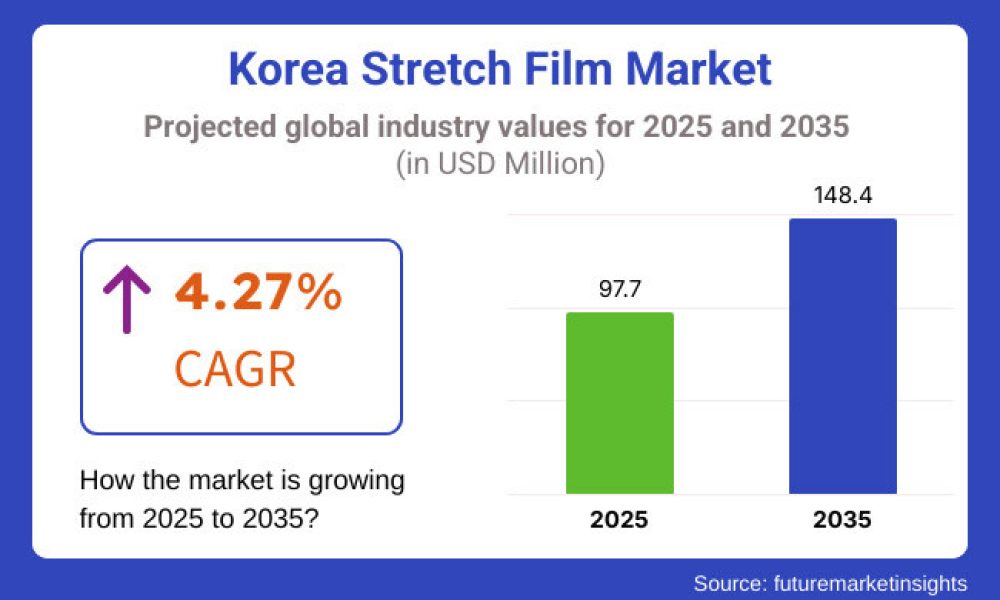
The Korea stretch film market is poised for a transformative decade, projected to grow from USD 97.7 million in 2025 to USD 148.4 million by 2035, registering a steady CAGR of 4.27%. As industries across logistics, food & beverage, and manufacturing intensify their demand for secure, sustainable packaging, stretch films are emerging as a critical enabler of operational efficiency and environmental compliance.
Key Market Insights at a Glance
- Market Size (2025): USD 97.7 million
- Forecasted Value (2035): USD 148.4 million
- CAGR (2025–2035): 4.27%
- Top Growth Drivers: E-commerce logistics, pallet unitization, sustainability mandates
- Key End-Use Sectors: Logistics & warehousing, food & beverage, industrial packaging
Segment Overview: High-Performance Films Take the Lead
The market is segmented by material type, manufacturing process, and end-use industry. LLDPE (Linear Low-Density Polyethylene) remains the dominant material, favored for its superior stretchability and puncture resistance. Machine stretch films are gaining traction due to their consistency and efficiency in high-volume operations, while hand stretch films continue to serve small-scale and manual packaging needs.
Among end-use sectors, logistics and warehousing lead the demand curve, driven by Korea’s booming e-commerce and export-oriented economy. The food & beverage segment is also expanding rapidly, with stretch films ensuring hygienic, tamper-evident packaging for perishables.
Regional Overview: Korea’s Strategic Edge in Northeast Asia
South Korea’s strategic location and advanced logistics infrastructure make it a regional hub for packaging innovation. The country’s robust manufacturing base and export-driven economy are fueling demand for high-performance stretch films. Additionally, government initiatives promoting eco-friendly packaging and waste reduction are accelerating the adoption of recyclable and biodegradable film variants.
The Seoul Capital Area, home to major logistics centers and industrial parks, accounts for the lion’s share of consumption. However, emerging industrial zones in Busan and Incheon are witnessing rapid uptake, particularly in cold chain logistics and automotive exports.
Competitive Landscape: Innovation and Sustainability at the Core
The Korean stretch film industry is moderately consolidated, with a mix of domestic manufacturers and global players. Leading companies are investing in bio-based polymers, multi-layer extrusion technologies, and automated film application systems to differentiate their offerings.
Key players are also forming strategic alliances with logistics providers and packaging automation firms to deliver integrated solutions. The focus is shifting from commodity films to value-added, application-specific products that reduce film usage while enhancing load stability.
Key Players of Sustainable Label Industry
While stretch films dominate the packaging narrative, the sustainable label segment is gaining parallel momentum. Companies like SKC Co., Ltd., Toray Advanced Materials Korea, and LG Chem are pioneering eco-labels and recyclable film substrates, aligning with Korea’s Green New Deal and ESG investment trends. These players are leveraging their R&D capabilities to develop low-carbon, high-performance labeling solutions that complement stretch film applications in retail and logistics.
Recent Strategic Developments
- Product Innovation: Several Korean firms have launched nanotechnology-enhanced stretch films that offer superior cling and load retention with reduced material usage.
- Sustainability Milestones: A leading Seoul-based manufacturer recently unveiled a 100% recyclable stretch film line, targeting carbon-neutral supply chains.
- Capacity Expansion: Investments in automated extrusion lines and AI-driven quality control systems are reshaping production efficiency and scalability.
- Export Growth: Korean stretch film exports to Southeast Asia and the Middle East have surged, driven by demand for premium, sustainable packaging solutions.
Market Outlook: Powering the Next Decade
As Korea positions itself as a packaging innovation hub, the stretch film market is set to benefit from digital transformation, circular economy policies, and smart logistics integration. The next decade will witness a shift from volume-based growth to value-driven innovation, with sustainability, automation, and customization defining competitive advantage.
With rising demand across sectors and strong policy support, Korea’s stretch film industry is not just wrapping pallets—it’s wrapping up a future of smarter, greener packaging.
To access the complete data tables and in-depth insights, request a sample report here: https://www.futuremarketinsights.com/reports/sample/rep-gb-18525
Why FMI: https://www.futuremarketinsights.com/why-fmi
About Future Market Insights (FMI)
Future Market Insights, Inc. (ESOMAR certified, recipient of the Stevie Award, and a member of the Greater New York Chamber of Commerce) offers profound insights into the driving factors that are boosting demand in the market. With a vast team of over 400 analysts worldwide, FMI provides global, regional, and local expertise on diverse domains and industry trends across more than 110 countries.



