
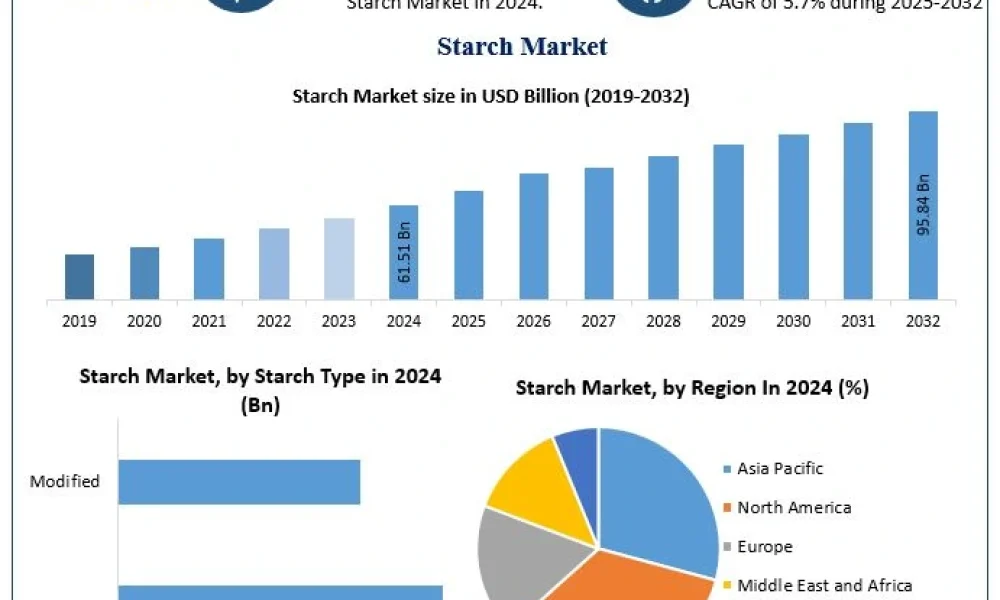
Starch Market Overview:
Starch Market valued at USD 61.51 billion in 2024, is poised to grow at a CAGR of 5.7%, reaching nearly USD 95.84 billion by 2032. Asia Pacific emerges as the dominating region owing to its expansive food processing industry, rapid industrialization, and increasing adoption of starch derivatives across pharmaceuticals, textiles, and bio-based sectors. The versatile nature of starch and its growing use as a clean label, natural ingredient in diverse applications is propelling market expansion worldwide.
Key Highlights & Insights
Market Size & Growth: Estimated at USD 61.51 billion in 2024, expected to reach USD 95.84 billion by 2032, growing at a CAGR of 5.7%.
Dominating Region: Asia Pacific leads with the largest market share, supported by the presence of major manufacturers, growing population, food industry demand, and government support for bio-based materials.
Leading Segment: Modified starch dominates the product type segment, accounting for over 56% market share due to its enhanced functionality and wide application in processed foods and industrial processes.
Key Driver: Rising demand for processed and convenience foods, growing pharmaceutical and personal care sectors, and increasing emphasis on clean-label, natural ingredients drive starch market growth.
► Get a sample of the report:https://www.maximizemarketresearch.com/request-sample/112948/
Recent Developments
2024–2025: Archer Daniels Midland (ADM) expanded corn starch processing capacity to meet increased demand from food and bio-based chemical sectors.
Tate & Lyle introduced novel modified starch variants with improved solubility and stability for industrial food applications.
Roquette Freres and Ingredion Inc. have invested in R&D for organic and clean-label starch products to cater to increasing consumer health awareness.
Asia Pacific companies accelerated production capacity with focus on sustainable sourcing and advanced processing techniques to meet regional demand.
Market Dynamics
Growth Drivers:
Increasing consumption of processed foods and beverages requiring starch as a thickener, stabilizer, and additive.
Expansion of pharmaceutical industries using starch as excipients and binders.
Rising awareness of natural and bio-based ingredients boosting demand for native and organic starch.
Technological advancements enabling starch modification to serve specific industrial needs.
Challenges:
Price volatility of raw materials like corn and wheat impacting production costs.
Regulatory scrutiny on labeling and claims for clean-label and organic products.
Substitution threats from alternative hydrocolloids and thickeners.
Regional Analysis
Asia Pacific: Largest and fastest-growing market fueled by China, India, Japan, and Southeast Asia, supported by expanding food processing, pharmaceuticals, and industrial base.
North America: Mature market driven by food innovation, health trends, and large-scale industrial applications.
Europe: Significant market with a focus on organic, natural, and clean-label starch applications driven by consumer demand and regulatory frameworks.
Latin America and Middle East/Africa: Emerging markets poised for growth amid rising food production and pharmaceutical industries.
Product Segmentation
By Type: Native starch, modified starch (dominant), specialty starches.
By Source: Corn (largest share), wheat, potato, tapioca, others.
By Application: Food and beverages, pharmaceuticals, personal care, industrial applications, paper, textile.
By Region: Asia Pacific, North America, Europe, Latin America, Middle East & Africa.
Key Trends
Shift towards organic and non-GMO starch products reflecting consumer health consciousness.
Development of multi-functional modified starches for cleaner labels and tailored industrial processing.
Rising investment in sustainable starch production aligned with environmental standards.
Growing use of starch in bio-based packaging and green chemistry applications.
Integration of advanced processing technologies enhancing yield and quality.
Frequently Asked Questions (FAQs)
What is starch used for? Starch is widely used as a thickening agent, stabilizer, binder, and texture improver in food and beverage products and is also essential in pharmaceuticals and industrial applications.
Which starch type is most common? Modified starch holds the largest market share due to its functional versatility.
Which region leads starch consumption? Asia Pacific is the largest consumer and producer of starch globally.
Are organic starch products growing? Yes, organic and clean-label starches are growing fast, driven by consumer health and sustainability trends.
Conclusion
The global starch market is experiencing substantial growth driven by increasing processed food demand, expanding pharmaceutical applications, and evolving sustainability standards. With Asia Pacific leading production and consumption, innovations in modified and organic starch products are poised to broaden applications across sectors. Continued advancements in processing, coupled with clean-label trends and environmental consciousness, will catalyze the starch market’s evolution through 2032 and beyond.
◉ Get Market Research Latest Trends
♦ Global IdentityasaService (IDaaS) Market
♦ Maximize Market Research is launching a subscription model for data and analysis in the MMR Statistics
Contact Maximize Market Research:
3rd Floor, Navale IT Park, Phase 2
Pune Bangalore Highway, Narhe,
Pune, Maharashtra 411041, India
[email protected]
+91 96071 95908, +91 9607365656
About Maximize Market Research:
Maximize Market Research is a multifaceted market research and consulting company with professionals from several industries. Some of the industries we cover include medical devices, pharmaceutical manufacturers, science and engineering, electronic components, industrial equipment, technology and communication, cars and automobiles, chemical products and substances, general merchandise, beverages, personal care, and automated systems. To mention a few, we provide market-verified industry estimations, technical trend analysis, crucial market research, strategic advice, competition analysis, production and demand analysis, and client impact studies.




