
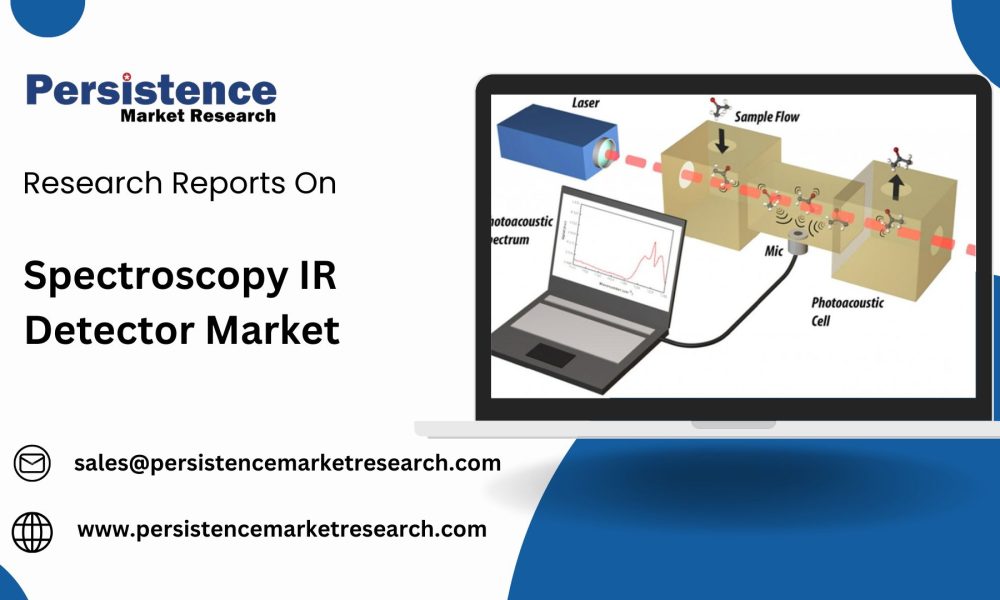
The global spectroscopy IR detector market is entering a phase of sustained growth and innovation. Valued at US$ 211.0 million in 2024, the market is projected to reach US$ 825.8 million in 2025 and further grow to US$ 1,370 million by 2032, expanding at a compound annual growth rate (CAGR) of 7.5% from 2025 to 2032.
This growth trajectory underscores the increasing global reliance on advanced spectroscopic techniques for environmental monitoring, chemical analysis, material characterization, and medical diagnostics.
Understanding Spectroscopy IR Detectors
Infrared (IR) spectroscopy detectors are devices designed to detect and analyze infrared light absorbed or emitted by materials. By measuring the specific IR wavelengths absorbed by molecules, scientists can identify the molecular structure, chemical composition, and concentration of substances.
In essence, spectroscopy IR detectors act as the “eyes” of analytical instruments, translating invisible infrared light into actionable data. This ability to identify chemical fingerprints makes them indispensable across pharmaceutical, environmental, and industrial applications.
Infrared spectroscopy typically operates in three main regions: near-infrared (NIR), mid-infrared (MIR), and far-infrared (FIR). Depending on the wavelength, detectors can perform various analyses — from detecting impurities in drugs to monitoring pollutants in the atmosphere.
Market Overview: Strong Demand Across Industries
The demand for spectroscopy IR detectors is being fueled by a confluence of scientific, environmental, and technological factors. As industries prioritize precision, safety, and sustainability, spectroscopy-based detection systems are becoming essential components of modern laboratories and production facilities.
Key drivers contributing to market expansion include:
- Growing environmental monitoring initiatives to measure pollutants, greenhouse gases, and industrial emissions.
- Increasing pharmaceutical quality assurance needs, where spectroscopy helps in drug formulation, stability testing, and impurity profiling.
- Rising focus on food and agricultural safety, where IR detectors are used to detect contaminants and verify product authenticity.
- Adoption of advanced materials and nanotechnology, which require high-resolution analytical tools for molecular characterization.
Environmental Monitoring: A Key Growth Catalyst
Among all sectors, environmental monitoring is expected to be the most significant contributor to spectroscopy IR detector demand. Governments and organizations across the world are increasingly implementing regulations to measure and control air and water pollution levels.
Infrared spectroscopy plays a critical role here. It can detect a wide array of atmospheric gases—such as carbon dioxide (CO₂), methane (CH₄), nitrogen oxides (NOₓ), and volatile organic compounds (VOCs)—even at very low concentrations.
For example:
- Air quality analysis: IR detectors identify pollutants and toxic gases in urban and industrial environments.
- Water and soil analysis: They help detect organic contaminants, heavy metals, and microplastics.
- Emission monitoring: Industries use IR spectroscopy to monitor real-time emissions and comply with environmental standards.
As climate change mitigation efforts accelerate, these applications are expected to drive robust market growth through 2032.
Expanding Role in Pharmaceuticals and Healthcare
The pharmaceutical industry is another major end user of spectroscopy IR detectors. The technology enables precise molecular fingerprinting, making it vital for drug development, formulation testing, and process control.
Applications in pharma include:
- Identification of active pharmaceutical ingredients (APIs).
- Monitoring moisture content and stability in drug formulations.
- Ensuring quality compliance with regulatory standards such as FDA and EMA guidelines.
Furthermore, biomedical and clinical research is exploring spectroscopy for non-invasive diagnostics. Near-IR spectroscopy (NIRS) has shown potential for real-time monitoring of tissue oxygenation, glucose levels, and metabolic changes — signaling a promising avenue for future healthcare innovations.
Technological Advancements Shaping the Market
The future of the spectroscopy IR detector market will be heavily influenced by technological innovation. Manufacturers are developing next-generation detectors that are smaller, faster, and more energy-efficient, while maintaining high sensitivity and accuracy.
Key technological trends include:
- Integration with Artificial Intelligence (AI) and Machine Learning (ML):
Modern IR spectroscopy systems are being equipped with AI-driven software that automates data interpretation, enhances accuracy, and reduces human error. - Miniaturization of Spectroscopic Instruments:
Portable and handheld IR spectrometers are revolutionizing field applications, enabling on-site testing in remote or industrial locations. - Advances in Detector Materials:
New materials such as mercury cadmium telluride (MCT), indium antimonide (InSb), and thermoelectric sensors are improving performance in different spectral regions. - Enhanced Spectral Range and Resolution:
Ongoing research aims to expand the detection range and precision, allowing for more complex multi-component analysis.
These innovations are broadening spectroscopy’s appeal beyond traditional laboratories, making it a cornerstone of smart manufacturing and real-time process analytics.
Elevate your business strategy with comprehensive market data. Request a sample report now: https://www.persistencemarketresearch.com/samples/33506
Industrial Applications Driving Growth
Spectroscopy IR detectors are seeing growing integration in industrial and manufacturing processes where real-time monitoring is critical for quality control and efficiency.
For example:
- Petrochemical industry uses IR detectors to analyze hydrocarbon mixtures and detect leaks.
- Food and beverage processing employs spectroscopy to monitor freshness, detect adulteration, and ensure compliance with safety standards.
- Semiconductor and materials science leverage IR spectroscopy for thin-film characterization and surface analysis.
As industries embrace Industry 4.0 and IoT-enabled smart systems, spectroscopy instruments are increasingly being connected to centralized monitoring platforms. This integration of analytical data into digital ecosystems is driving a new wave of data-driven manufacturing and process optimization.
Regional Insights: North America and Asia-Pacific Lead the Market
North America
North America remains a dominant force in the spectroscopy IR detector market, driven by strong R&D investment and a mature scientific infrastructure. The United States, in particular, is home to leading spectroscopy instrument manufacturers and research laboratories.
Government initiatives promoting environmental monitoring and pharmaceutical innovation are further supporting demand. Additionally, partnerships between academic institutions and private companies continue to foster technology transfer and product development.
Europe
Europe’s market growth is driven by strict environmental regulations, especially in countries like Germany, France, and the United Kingdom. The European Union’s Green Deal and sustainability programs have intensified focus on emission control, air quality assessment, and industrial process monitoring.
Asia-Pacific
The Asia-Pacific region is emerging as the fastest-growing market for spectroscopy IR detectors. Rapid industrialization, increasing environmental concerns, and expanding pharmaceutical manufacturing bases in China, India, Japan, and South Korea are fueling adoption.
Government-backed environmental surveillance programs and investments in smart manufacturing are further accelerating market growth in this region.
Rest of the World
Regions such as the Middle East, Africa, and Latin America are also showing growing interest, primarily for oil and gas analysis, water quality testing, and agricultural applications. As awareness and affordability improve, these markets are expected to contribute significantly to global revenue by 2032.
Challenges and Restraints
Despite its promising outlook, the spectroscopy IR detector market faces a few notable challenges:
- High initial costs associated with advanced spectroscopic instruments can limit adoption among small and medium enterprises (SMEs).
- Technical complexity requires skilled operators and precise calibration, increasing training requirements.
- Interference from ambient conditions, such as temperature fluctuations and humidity, can affect measurement accuracy.
However, as technology becomes more user-friendly and cost-effective, these challenges are likely to diminish over the forecast period.
Competitive Landscape
The market is moderately consolidated, with several leading players focusing on product innovation, strategic collaborations, and regional expansion. Companies are investing in research to improve sensitivity, miniaturization, and integration with digital platforms.
Prominent market participants include:
- Hamamatsu Photonics K.K.
- Teledyne Technologies Incorporated
- FLIR Systems (Teledyne FLIR)
- Excelitas Technologies Corp.
- InfraTec GmbH
- Thorlabs, Inc.
- Newport Corporation
These companies are strengthening their portfolios through acquisitions and partnerships to enhance product capabilities and market reach.
Future Outlook: Toward a Sustainable and Data-Driven Era
Looking ahead, the spectroscopy IR detector market is poised for a transformative decade. The convergence of digital technologies, sustainability initiatives, and scientific innovation will redefine how spectroscopy is applied across industries.
By 2032, we can expect:
- Wider integration with IoT ecosystems, enabling real-time remote monitoring of industrial and environmental parameters.
- Emergence of AI-powered predictive analytics, helping users anticipate process deviations and improve efficiency.
- Growing adoption in personalized medicine, as spectroscopy finds new applications in biomarker detection and non-invasive diagnostics.
- Sustainable manufacturing practices, where spectroscopy ensures cleaner production and reduced environmental impact.
The growing importance of precision analytics in decision-making across industries positions spectroscopy IR detectors as key enablers of global scientific and environmental progress.
Conclusion
The Spectroscopy IR Detector Market (2025–2032) presents a compelling growth story shaped by technological innovation, sustainability priorities, and expanding industrial adoption. From laboratories to production floors and environmental monitoring stations, these detectors are at the forefront of a data-driven future.
As global demand for accurate, real-time chemical analysis continues to rise, the market will evolve into a critical pillar of green technology, healthcare innovation, and industrial intelligence. With a projected CAGR of 7.5%, spectroscopy IR detectors are set to illuminate new paths in scientific discovery and sustainable development worldwide.
Related Reports:




