
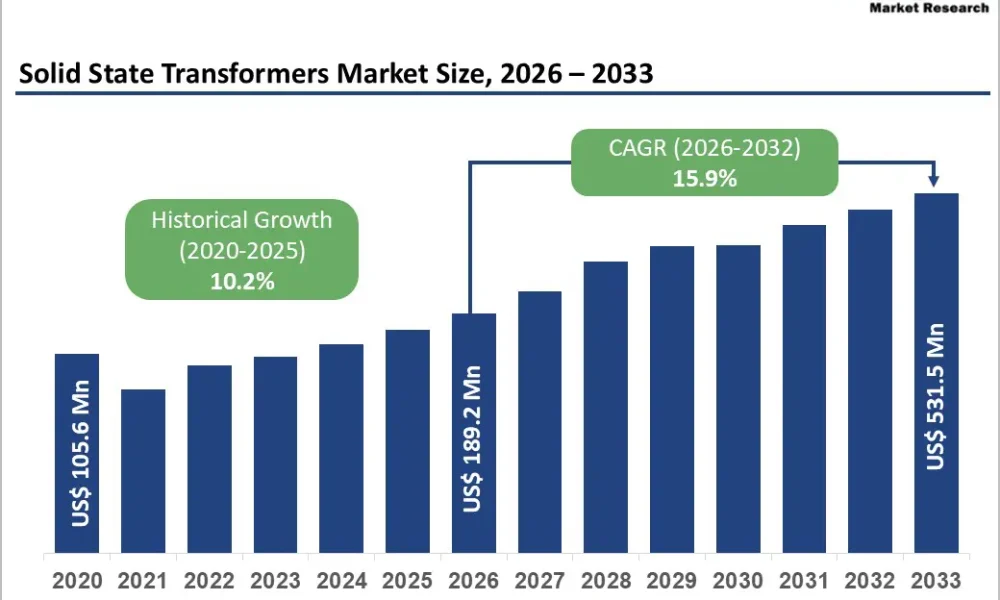
The global Solid State Transformers (SST) market is entering a transformative growth phase, fueled by rapid advancements in power electronics, renewable energy integration, and electric vehicle (EV) infrastructure expansion. Valued at US$ 189.2 Mn in 2026, the market is projected to surge to US$ 531.5 Mn by 2033, expanding at a robust CAGR of 15.9% between 2026 and 2033. This accelerated growth trajectory reflects the urgent need to modernize aging grid infrastructure, enhance energy efficiency, and accommodate the rising penetration of distributed energy resources.
Historically, between 2020 and 2025, the market registered a steady CAGR of 10.2%. However, the next phase of development signals a step-change in adoption, driven by policy mandates, digital grid transformation, and electrification of transportation.
Understanding Solid State Transformers
Solid State Transformers represent the next generation of power distribution equipment. Unlike conventional transformers that rely on magnetic core and copper windings, SSTs utilize advanced power electronics, high-frequency transformers, and semiconductor switches to convert and regulate voltage levels.
Their architecture typically consists of:
- AC-DC rectification stage
- DC-DC conversion stage
- DC-AC inversion stage
This configuration enables bidirectional power flow, precise voltage regulation, improved power quality, and integration of renewable sources and storage systems.
SSTs are especially valuable in smart grids, microgrids, EV charging stations, and renewable energy installations where dynamic control and flexibility are essential.
Market Growth Drivers
- Accelerating Grid Modernization Initiatives
Power grids worldwide are aging and increasingly strained. In regions like North America and Europe, large portions of transmission and distribution infrastructure are decades old. Utilities are investing heavily in modernization programs to improve resilience, reliability, and digital capabilities.
SSTs enable:
- Real-time monitoring and control
- Enhanced fault isolation
- Improved voltage stability
- Integration of distributed energy resources
With 92.5% of new electricity generation capacity globally in 2024 coming from clean energy sources, grid systems require intelligent transformers capable of managing intermittent and variable power flows.
- Rapid Expansion of EV Charging Infrastructure
The proliferation of electric vehicles is reshaping electricity demand patterns. EV charging infrastructure requires efficient, bidirectional, and scalable power conversion systems.
SSTs support:
- Vehicle-to-grid (V2G) integration
- Fast-charging applications
- Medium-voltage to low-voltage conversion
- Reduced energy losses
Governments worldwide are introducing aggressive EV adoption targets. In India, the FAME II scheme (INR 1,000 crore allocation) accelerates EV deployment and charging infrastructure rollout. Similar initiatives across the U.S., Europe, and China are fueling demand for SST-based solutions.
- Integration of Renewable Energy Sources
Solar and wind energy generation is inherently variable. Traditional transformers lack the flexibility required to manage dynamic load changes and voltage fluctuations.
Solid State Transformers provide:
- Active voltage regulation
- Power factor correction
- Harmonic mitigation
- Seamless integration with energy storage systems
As renewable penetration increases globally, especially in Asia Pacific and North America, SSTs are becoming critical enablers of energy transition.
- Growth of Smart Grids and Microgrids
Smart grid development is accelerating worldwide. SSTs play a crucial role in microgrid environments by enabling:
- Autonomous operation
- Efficient load balancing
- Distributed generation management
- Islanding capabilities
These advantages make SSTs highly attractive for urban smart city projects and industrial applications.
Market Segmentation Analysis
By Product Type
Distribution Solid State Transformers dominate the global market, accounting for approximately 37% of revenue share. Their importance lies in:
- Integration into modern distribution networks
- Supporting renewable energy inputs
- Enhancing grid reliability
Transmission SSTs and traction SSTs also represent emerging segments, particularly in rail electrification and industrial applications.
By Voltage Type
The medium-voltage to low-voltage SST segment is experiencing the fastest growth. This is largely due to:
- EV charging station installations
- Commercial and industrial grid applications
- Distributed renewable generation
High-voltage SSTs are still in early-stage commercialization but show long-term potential.
By Application
Automotive (Fastest Growing Segment)
Automotive applications are witnessing rapid growth driven by EV charging infrastructure expansion and V2G requirements. SSTs enable efficient bidirectional power conversion, making them critical in future EV ecosystems.
Renewable Power Generation
Solar and wind installations are increasingly integrating SSTs for enhanced grid connectivity and voltage management.
Industrial & Commercial
Industries seeking improved power quality and energy efficiency are deploying SST solutions in heavy-load environments.
Elevate your business strategy with comprehensive market data. Request a sample report now: https://www.persistencemarketresearch.com/samples/32413
Regional Analysis
North America – Market Leader (35% Share)
North America dominates the global SST market with a 35% revenue share. The United States leads regional adoption, supported by:
- Extensive grid modernization programs
- Infrastructure replacement initiatives
- Government incentives for renewable energy
- Rapid EV charging network deployment
The region’s technological leadership and strong R&D ecosystem contribute significantly to commercialization efforts.
Asia Pacific – Fastest Growing Region (30.4% CAGR)
Asia Pacific is projected to grow at an impressive CAGR of 30.4% through 2033. Growth is primarily driven by:
- China’s renewable energy dominance
- India’s EV infrastructure expansion under FAME II
- Government-backed smart city projects
- Rapid industrialization and urbanization
Countries such as China, India, Japan, and South Korea are investing heavily in grid digitalization and clean energy transitions.
Europe
Europe represents a strong growth market due to:
- Aggressive decarbonization goals
- Smart grid investments
- EV adoption growth
- Energy storage integration
The European Union’s Green Deal further accelerates demand for advanced power distribution technologies.
Competitive Landscape
The SST market is characterized by technological innovation and strategic collaborations. Key players focus on:
- Power electronics advancements
- Semiconductor efficiency improvements
- Modular transformer architectures
- Strategic utility partnerships
Companies are investing in silicon carbide (SiC) and gallium nitride (GaN) semiconductor technologies to enhance efficiency and reduce losses.
Pilot projects and demonstration installations remain critical in scaling commercialization.
Technological Advancements Shaping the Market
Wide Bandgap Semiconductors
SiC and GaN technologies improve switching efficiency, reduce thermal losses, and enable compact designs. These advancements make SSTs more viable for commercial deployment.
Digital Monitoring & IoT Integration
Integration of sensors and real-time analytics enhances predictive maintenance and operational reliability.
Modular and Scalable Design
Manufacturers are developing plug-and-play modular systems that simplify installation and maintenance.
Key Market Opportunities
EV Charging Infrastructure Buildout
The global push toward transportation electrification presents exceptional growth opportunities. Medium-voltage SSTs tailored for fast charging stations are expected to see significant adoption.
Renewable Energy Microgrids
Remote and off-grid areas increasingly rely on microgrids. SSTs enable efficient management of distributed generation systems.
Defense and Aerospace Applications
High-performance, compact SST systems are being explored for specialized defense and aerospace power systems.
Challenges and Restraints
Despite strong growth prospects, the market faces certain challenges:
- High initial costs compared to conventional transformers
- Limited large-scale commercial deployments
- Complex system integration requirements
- Semiconductor supply chain constraints
However, declining semiconductor costs and increasing economies of scale are expected to mitigate these challenges over time.
Future Outlook
The next decade will be pivotal for Solid State Transformers. With global decarbonization efforts intensifying and electrification accelerating across industries, SSTs are positioned as foundational components of modern energy infrastructure.
By 2033, as the market surpasses US$ 531.5 Mn, SST technology will likely transition from pilot-scale installations to mainstream adoption in:
- Urban smart grids
- High-capacity EV corridors
- Industrial energy systems
- Renewable-heavy power networks
Investment in R&D, regulatory support, and cross-industry collaboration will further catalyze growth.
Conclusion
The global Solid State Transformers market is undergoing a structural shift, driven by grid modernization, renewable energy integration, and EV infrastructure expansion. Growing from US$ 189.2 Mn in 2026 to US$ 531.5 Mn by 2033 at a CAGR of 15.9%, the sector represents one of the most promising advancements in power distribution technology.
North America currently leads the market, while Asia Pacific emerges as the fastest-growing region. Distribution SSTs dominate product demand, and automotive applications represent the most dynamic growth segment.
As energy systems worldwide evolve toward smarter, cleaner, and more resilient frameworks, Solid State Transformers will play a central role in enabling the next generation of electricity infrastructure.
Related Reports:




