
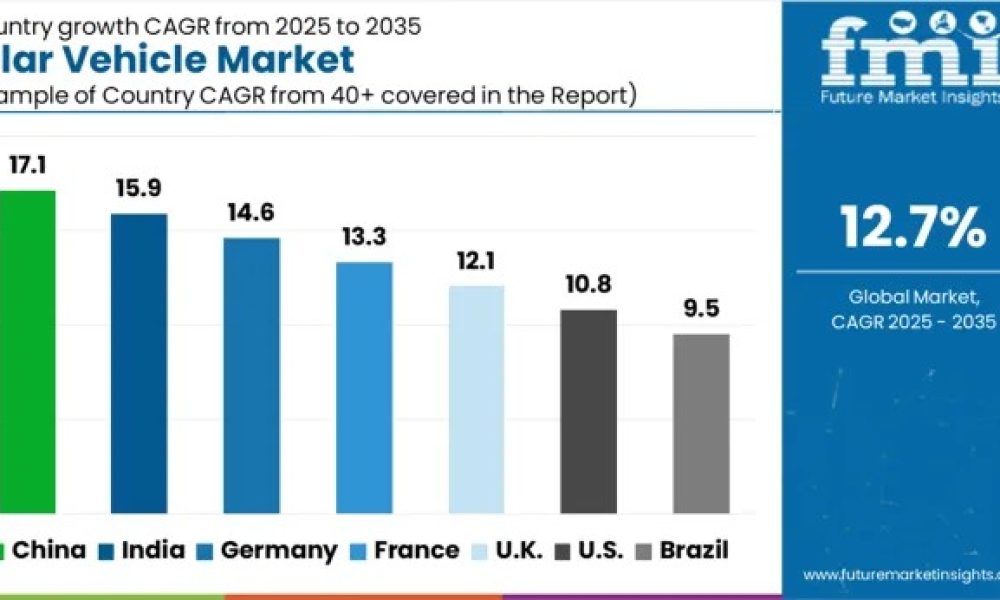
The global solar vehicle market is entering a high-growth phase, supported by advances in photovoltaic integration, energy storage technologies, and rising demand for sustainable mobility solutions. The market is projected to grow from USD 507.2 million in 2025 to USD 1,676.4 million by 2035, registering a robust compound annual growth rate (CAGR) of 12.7% over the forecast period. This expansion reflects the transition of solar vehicles from experimental concepts to viable solutions for niche, commercial, and specialized transportation applications.
During the early adoption phase between 2020 and 2024, the market expanded from USD 278.9 million to USD 507.2 million as manufacturers and fleet operators introduced solar-powered prototypes and pilot vehicles. These pilot programs focused on evaluating energy efficiency, operational reliability, and real-world driving range under varying climatic and usage conditions. By 2025, broader adoption is being observed through trial deployments and limited production runs, particularly among commercial fleets and environmentally conscious consumer segments.
From 2025 to 2035, the market is expected to progress through a scaling phase (2025–2030) followed by consolidation (2030–2035). By 2030, market value is forecast to exceed USD 818.1 million, driven by increased manufacturing capacity and expanded deployment across public, private, and commercial transport sectors. During the consolidation phase, growth is expected to moderate as leading manufacturers strengthen market positions and smaller participants merge or exit, resulting in a more structured competitive landscape.
Passenger Vehicles Anchor Market Leadership
Passenger vehicles are projected to account for 62.8% of total solar vehicle market revenue in 2025, establishing them as the dominant segment. This leadership is driven by rising consumer preference for clean mobility, lower operating costs, and continuous improvements in solar energy harvesting efficiency. Vehicle designs increasingly integrate solar panels without compromising aerodynamics or aesthetics, supported by intelligent energy management systems that optimize solar power utilization and extend driving range.
Government incentives for eco-friendly vehicles, combined with rising fuel prices, continue to improve the commercial attractiveness of solar passenger vehicles. As renewable energy awareness grows in both developed and emerging economies, passenger vehicles are expected to remain the primary growth engine of the market.
Get access to comprehensive data tables and detailed market insights — request your sample report today!
Battery Electric Vehicles Lead Propulsion Adoption
Battery electric vehicles (BEVs) are estimated to capture 57.4% of solar vehicle market revenue in 2025, positioning them as the leading propulsion category. The integration of solar charging with electric drivetrains enhances range and reduces reliance on conventional charging infrastructure, making BEVs particularly attractive for private users and fleet operators. Advances in battery performance, charging speed, and energy management systems are reinforcing confidence in solar-electric mobility.
Rising regulatory pressure to reduce emissions and the expansion of EV charging infrastructure further support BEV adoption. As solar panel efficiency and battery technologies continue to improve, BEVs are expected to maintain their dominant position within the solar vehicle ecosystem.
Lithium-Ion Batteries Dominate Energy Storage
Lithium-ion batteries are projected to hold 68.9% of market revenue in 2025, emerging as the preferred energy storage solution for solar vehicles. High energy density, lightweight construction, and long cycle life make lithium-ion technology well suited for complementing solar charging systems. Declining battery costs and expanding production capacity are accelerating adoption across both passenger and commercial solar vehicles.
Ongoing research into next-generation lithium-ion chemistries and improved thermal management systems is expected to further enhance performance, supporting longer range and higher efficiency solar vehicle designs.
Drive Your Business Growth Strategy: Checkout the Report for Key Insights
Market Growth Shaped by Technology, Infrastructure, and Policy
The solar vehicle market is being driven by increasing environmental awareness, rising fuel costs, and supportive government policies promoting clean transportation. Advances in photovoltaic efficiency, lightweight materials, and aerodynamic vehicle design are improving overall system performance, while integration with existing charging infrastructure enhances operational feasibility.
Regional adoption patterns vary based on solar irradiance, regulatory frameworks, and infrastructure readiness. North America and Europe emphasize high-efficiency, performance-oriented solar-electric vehicles, while Asia-Pacific markets focus on cost-effective solutions for urban mobility and fleet applications. Government incentives, subsidies, and clean energy mandates continue to play a critical role in shaping production scale, pricing strategies, and market penetration.
Asia-Pacific Emerges as a High-Growth Region
Country-level analysis highlights strong growth momentum across major economies. China leads with a projected CAGR of 17.1%, driven by large-scale manufacturing capacity, government support for renewable energy vehicles, and continued investment in research and development. India follows at 15.9%, supported by expanding electric mobility initiatives, rising fuel prices, and demand for cost-effective sustainable transport solutions.
Among OECD countries, Germany records a CAGR of 14.6%, reflecting strong regulatory support, advanced automotive engineering capabilities, and high consumer awareness. The United Kingdom grows at 12.1%, supported by green mobility initiatives, while the United States expands at 10.8% as a mature but steadily growing market backed by federal and state-level clean energy policies.
Competitive Landscape Focused on Innovation and Integration
The solar vehicle market is characterized by active participation from both established automotive manufacturers and specialized solar mobility innovators. Key players include Toyota Motor Corporation, Aptera, Fiat Chrysler Automobiles, Fisker, Ford Motor Company, Lightyear, Rivian Automotive, Sono Motors, Venturi Automobiles, and Volkswagen. These companies are investing in advanced photovoltaic integration, lightweight materials, and intelligent energy management systems to improve vehicle efficiency and commercial viability.
Collaborations, technology partnerships, and sustainability-focused manufacturing practices are central to competitive strategies as suppliers seek to scale production and broaden market reach. As solar vehicles continue to evolve from pilot deployments to practical mobility solutions, the market is positioned for sustained growth across passenger, commercial, and public transport segments over the coming decade.
Why Choose FMI: Empowering Decisions that Drive Real-World Outcomes: https://www.futuremarketinsights.com/why-fmi
About Future Market Insights (FMI)
Future Market Insights, Inc. (FMI) is an ESOMAR-certified, ISO 9001:2015 market research and consulting organization, trusted by Fortune 500 clients and global enterprises. With operations in the U.S., UK, India, and Dubai, FMI provides data-backed insights and strategic intelligence across 30+ industries and 1200 markets worldwide.



