
The global smart speakers market is entering a decisive growth phase, driven by rapid advancements in artificial intelligence, expanding smart home ecosystems, and increasing affordability across consumer segments. Once perceived primarily as novelty voice assistants for music playback, smart speakers have evolved into central control hubs for connected living, workplace automation, and digital services.
As voice interfaces become more intuitive and AI-powered interactions more human-like, smart speakers are positioning themselves as foundational components of next-generation digital environments. From managing household appliances to enabling personalized commerce, the scope of smart speaker functionality continues to widen.
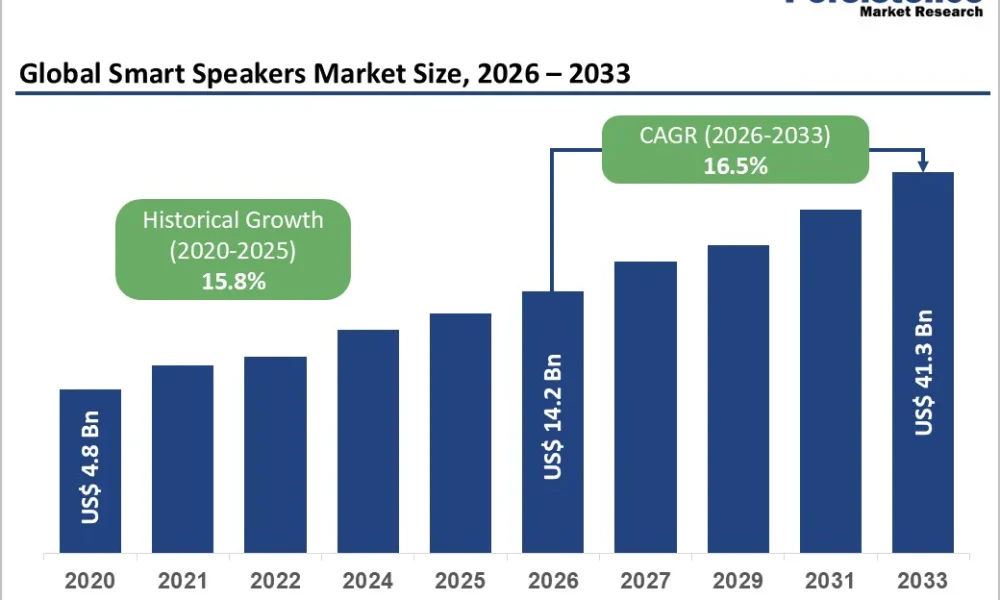
According to current projections, the global smart speakers market is expected to be valued at US$ 14.2 billion in 2026 and reach US$ 41.3 billion by 2033, expanding at a robust CAGR of 16.5% between 2026 and 2033. This sustained momentum reflects a convergence of technological maturity, ecosystem expansion, and shifting consumer behavior.
Market Overview: From Voice Assistants to Intelligent Ecosystems
Smart speakers are no longer standalone devices; they are embedded within broader digital ecosystems that connect homes, offices, vehicles, and cloud platforms. At their core, these devices integrate microphones, speakers, and AI-powered voice assistants capable of understanding and responding to natural language commands.
The evolution of smart speakers has been closely tied to breakthroughs in natural language processing (NLP), machine learning, and cloud-based AI services. These advancements have significantly improved speech recognition accuracy, contextual understanding, and multilingual support.
Simultaneously, declining hardware costs and improved digital infrastructure—including broadband expansion and mobile internet penetration—have lowered entry barriers, particularly in emerging markets. As a result, smart speakers are transitioning from premium gadgets to mass-market digital companions.
Smart Speakers Market Size and Growth Trajectory
The smart speakers market has demonstrated strong historical growth, expanding at a CAGR of 15.8% between 2020 and 2024. This growth was largely driven by early adoption in developed markets, increased work-from-home trends, and rising demand for hands-free digital interaction.
Looking ahead, growth is expected to accelerate further. Between 2026 and 2033, the market’s 16.5% CAGR reflects increasing adoption across residential and commercial environments, as well as the integration of generative AI capabilities.
By 2033, smart speakers are expected to evolve into multifunctional AI companions, capable of proactive assistance, real-time recommendations, and seamless integration across digital platforms. This transformation will significantly expand their value proposition beyond basic voice commands.
Key Growth Drivers Shaping the Smart Speakers Market
Rapid Adoption of Smart Home Ecosystems
One of the most significant drivers of smart speaker adoption is the global expansion of smart home ecosystems. Smart speakers act as centralized control points, allowing users to manage lighting, thermostats, security systems, entertainment devices, and appliances through voice commands.
As consumers increasingly seek convenience, energy efficiency, and automation, smart speakers offer a frictionless interface that simplifies daily routines. Their compatibility with a growing range of IoT devices enhances their utility and encourages ecosystem lock-in.
This trend is particularly strong in urban households, where space optimization, security concerns, and digital connectivity are key purchasing considerations.
Advancements in Artificial Intelligence and Natural Language Processing
Artificial intelligence has fundamentally transformed the smart speaker experience. Modern voice assistants can now understand conversational language, recognize individual voices, and respond with contextual awareness.
Advancements in NLP have enabled better handling of accents, dialects, and multilingual interactions, making smart speakers more accessible across diverse geographies. The integration of generative AI further enhances interaction quality, allowing devices to generate natural, human-like responses rather than scripted replies.
These improvements are increasing user engagement and expanding use cases across information retrieval, entertainment, productivity, and customer interaction.
Declining Device Costs and Expanding Digital Infrastructure
The declining cost of smart speaker hardware has played a crucial role in expanding market penetration. Increased competition among manufacturers, economies of scale, and standardized components have made entry-level smart speakers more affordable.
At the same time, expanding broadband connectivity, cloud computing adoption, and smartphone penetration have created a supportive infrastructure for voice-based technologies. In emerging economies, improved internet access is enabling first-time adoption among price-sensitive consumers.
Together, affordability and infrastructure development are unlocking new growth opportunities across both mature and developing markets.
Elevate your business strategy with comprehensive market data. Request a sample report now: https://www.persistencemarketresearch.com/samples/18478
Device Category Analysis: Platform Competition and Ecosystem Strength
Alexa-Enabled Smart Speakers: Market Leadership
Alexa-enabled smart speakers currently dominate the market, accounting for 46.4% of global market share. This leadership position is supported by extensive ecosystem integration, frequent hardware refresh cycles, and strong compatibility with third-party smart home devices.
Alexa’s open platform approach has attracted a large developer community, resulting in thousands of skills and integrations. This flexibility has made Alexa a preferred choice for consumers seeking broad functionality and device interoperability.
Additionally, aggressive pricing strategies and frequent promotional campaigns have reinforced Alexa-enabled devices’ mass-market appeal.
Google Assistant-Enabled Speakers: Fastest-Growing Segment
Google Assistant-enabled smart speakers represent the fastest-growing device segment, expanding at a CAGR of 19%. This growth is driven by superior multilingual capabilities, deep integration with the Android ecosystem, and expanding partnerships with OEMs.
Google’s strength in search, mapping, and contextual data enables more accurate and relevant responses, enhancing user satisfaction. Its focus on AI-driven personalization and seamless cross-device experiences positions Google Assistant as a strong challenger in the competitive landscape.
As platform convergence accelerates, Google Assistant’s ecosystem synergies are expected to drive sustained adoption across both consumer and enterprise use cases.
Application Analysis: Residential Dominance and Commercial Momentum
Residential Applications: Core Revenue Contributor
Residential applications dominate the smart speakers market, accounting for 54.3% of total market share. Smart speakers are increasingly used for home automation, entertainment, daily reminders, voice-controlled shopping, and information access.
The growing popularity of smart TVs, connected appliances, and home security systems further amplifies the value of smart speakers as central control hubs. Voice-enabled entertainment, including music streaming and podcasts, remains a key engagement driver.
As households become more digitally connected, smart speakers are evolving into essential household interfaces rather than optional accessories.
Commercial Applications: High-Growth Opportunity
Commercial deployments represent the fastest-growing application segment, expanding at a CAGR of 18%. Businesses across sectors are adopting smart speakers to enhance productivity, customer engagement, and operational efficiency.
In offices, smart speakers function as virtual assistants for scheduling, reminders, and information access. In hospitality, they enable room automation, concierge services, and personalized guest experiences. Retailers are leveraging voice-enabled systems to support in-store engagement and interactive product information.
As enterprise-grade security and customization improve, commercial adoption is expected to accelerate significantly.
Distribution Channel Trends: Online Dominance and Retail Reinvention
Online and E-Commerce Channels
Online and e-commerce platforms currently command 38.6% of total smart speaker sales. Competitive pricing, broader product selection, and convenience-oriented purchasing behaviors have made online channels the preferred choice for many consumers.
Digital marketplaces also enable easy comparison of features, reviews, and pricing, influencing informed purchasing decisions. Subscription bundles and ecosystem-based promotions further strengthen online sales momentum.
Organized Retail: Experiential Growth Engine
Organized retail channels are experiencing the fastest expansion, with 20–40% annual growth rates. Brands are increasingly investing in experiential in-store demonstrations, allowing consumers to interact with smart speakers before purchase.
Multi-brand display zones and consumer education initiatives are addressing adoption barriers among first-time users. This hands-on approach is particularly effective in emerging markets, where awareness and trust-building are critical.
Regional Analysis: Mature Markets and Emerging Powerhouses
North America: Market Leader
North America leads the global smart speakers market with a 35% share, supported by high smart home penetration and strong adoption among tech-savvy households. Early adoption of voice assistants, strong digital infrastructure, and widespread IoT integration have sustained regional dominance.
The region also benefits from frequent product launches, advanced AI capabilities, and strong brand loyalty.
Asia Pacific: Fastest-Growing Region
Asia Pacific is the fastest-growing regional market, expanding at a CAGR of 25%. Growth is driven by rapid urbanization, rising disposable incomes, and expanding digital ecosystems.
India stands out with a 24.8% CAGR, supported by increasing internet penetration, affordable devices, and multilingual voice assistant capabilities. China’s large-scale ecosystem consolidation and Southeast Asia’s emerging smart home adoption further strengthen regional growth prospects.
Strategic Market Developments and Future Opportunities
The next phase of smart speaker market growth will be shaped by generative AI-powered interactions, expanding commercial ecosystem deployments, and the rising popularity of display-based smart speakers.
These innovations are expected to unlock approximately US$ 3.0 billion in incremental annual market opportunities by 2033. Enhanced visual interfaces, proactive AI assistance, and deeper personalization will drive competitive differentiation.
As smart speakers become more intelligent, context-aware, and integrated into daily life, they will play a central role in shaping the future of human–technology interaction.
Conclusion: A Market Poised for Intelligent Expansion
The global smart speakers market is transitioning from rapid adoption to intelligent expansion. With strong growth fundamentals, expanding use cases, and continuous AI innovation, smart speakers are evolving into indispensable digital companions.
As residential adoption remains strong and commercial applications gain momentum, the market’s growth trajectory through 2033 appears robust and resilient. Companies that focus on ecosystem integration, AI-driven personalization, and regional customization will be best positioned to capture long-term value.
In an increasingly voice-first digital world, smart speakers are no longer just devices—they are the gateways to connected, intelligent living.
Related Reports:




