
In today’s hyper-connected digital economy, consumer trust has become a decisive competitive advantage. Every online interaction—logging into an app, making a digital payment, accessing an e-commerce account, or using a government e-service—relies on secure and seamless identity verification. This growing dependence on digital touchpoints has placed Consumer Identity and Access Management (CIAM) at the center of modern cybersecurity strategies.
CIAM solutions enable organizations to securely manage consumer identities, control access to digital services, and deliver frictionless user experiences without compromising security. As cyber threats grow more sophisticated and regulatory scrutiny intensifies, CIAM is evolving from a supportive IT function into a strategic business enabler.
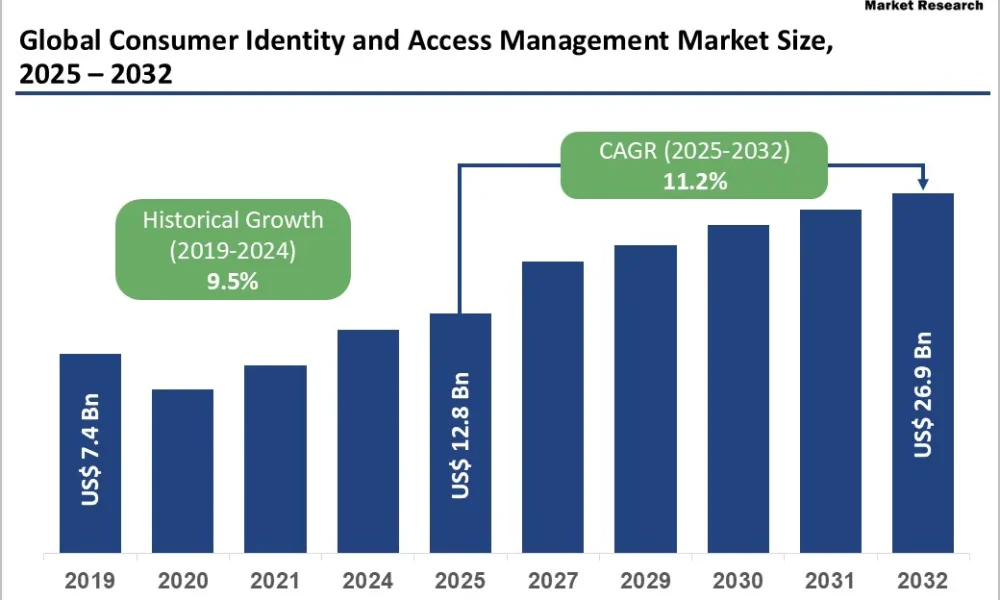
The global Consumer Identity and Access Management market is valued at US$12.8 billion in 2025 and is projected to reach US$26.9 billion by 2032, growing at a strong CAGR of 11.2% between 2025 and 2032. This growth reflects rising cybersecurity risks, stricter data protection regulations, and increasing consumer expectations for secure yet effortless digital experiences.
Understanding Consumer Identity and Access Management
Consumer Identity and Access Management refers to the technologies and processes that manage customer identities across digital platforms. Unlike workforce IAM, which focuses on employees, CIAM is designed for large, dynamic consumer populations that demand scalability, performance, and usability.
At its core, CIAM encompasses identity registration, authentication, authorization, profile management, consent handling, and access control. Modern CIAM platforms are built to support millions of users while maintaining high availability, compliance, and security standards.
What differentiates CIAM is its dual objective: strengthening cybersecurity defenses while improving customer experience. Organizations that fail to balance these priorities risk either data breaches or user abandonment—both costly outcomes in competitive digital markets.
Market Size and Growth Outlook
The CIAM market has demonstrated consistent growth over the past decade, supported by digital transformation across industries such as banking, retail, healthcare, telecom, and government services.
- Market size in 2025: US$12.8 billion
- Projected market value by 2032: US$26.9 billion
- Forecast CAGR (2025–2032): 11.2%
- Historical CAGR (2019–2024): 9.5%
The acceleration in growth reflects a shift in organizational priorities. Cybersecurity is no longer reactive; it is proactive, customer-centric, and embedded into digital experience design. CIAM plays a foundational role in this shift.
Rising Cybersecurity Threats as a Core Growth Driver
One of the most significant drivers of CIAM adoption is the surge in cybersecurity threats targeting consumer data. In 2024, the average cost of a data breach reached US$4.88 million, underscoring the financial and reputational damage associated with compromised identities.
Credential theft, phishing attacks, account takeover fraud, and bot-driven attacks are increasingly focused on consumer-facing applications. Password-based authentication alone is no longer sufficient to counter these threats.
CIAM platforms address these risks by enabling advanced authentication methods, adaptive access controls, anomaly detection, and real-time threat monitoring. By centralizing identity security, organizations can reduce attack surfaces and respond faster to evolving threats.
Regulatory Compliance and Data Protection Pressures
Regulatory compliance has become another powerful catalyst for CIAM market growth. Global and regional data protection laws such as GDPR, CCPA, and emerging privacy frameworks in Asia-Pacific, Latin America, and the Middle East impose strict requirements on how consumer data is collected, stored, and accessed.
CIAM solutions help organizations manage user consent, enforce data minimization, and ensure transparency in identity-related processes. Features such as consent dashboards, audit trails, and policy-based access controls simplify compliance while reducing legal and financial risks.
As regulations continue to evolve, CIAM platforms are increasingly viewed as compliance enablers rather than cost centers.
The Shift Toward Secure and Frictionless Consumer Experiences
Modern consumers expect digital interactions to be fast, intuitive, and secure. Long login processes, repeated authentication requests, and forgotten passwords directly impact user satisfaction and conversion rates.
CIAM addresses these challenges by enabling features such as single sign-on, social login integration, adaptive authentication, and personalized identity experiences. By reducing friction without weakening security, organizations can improve engagement, retention, and brand trust.
This alignment of security and usability is one of the most compelling reasons why CIAM investment is accelerating across consumer-facing industries.
Zero-Trust Architecture and CIAM Integration
The adoption of zero-trust security models is reshaping enterprise cybersecurity strategies. Zero trust operates on the principle of “never trust, always verify,” requiring continuous identity validation regardless of location or device.
CIAM plays a critical role in zero-trust frameworks by ensuring that consumer identities are continuously authenticated and authorized based on risk signals. Context-aware access decisions—using device health, behavior patterns, and geolocation—are becoming standard CIAM capabilities.
As zero trust transitions from concept to implementation, CIAM platforms are increasingly integrated with broader security ecosystems, including SIEM, SOAR, and endpoint protection tools.
Elevate your business strategy with comprehensive market data. Request a sample report now: https://www.persistencemarketresearch.com/samples/20446
Component Analysis: Identity Administration and Authentication Leads
Among CIAM components, identity administration and authentication dominates the market, accounting for approximately 38% of total market share in 2025. This segment forms the foundation of all CIAM deployments, enabling secure user onboarding, credential management, and access verification.
The dominance of this segment reflects its critical role in preventing unauthorized access and enabling advanced security features such as multi-factor authentication and adaptive access policies. As digital platforms scale, robust identity administration becomes indispensable.
Other components, including access governance, analytics, and consent management, are gaining traction but remain complementary to core authentication capabilities.
Deployment Trends: SaaS Emerges as the Fastest-Growing Model
Deployment models in the CIAM market are rapidly shifting toward cloud-based solutions. Software-as-a-Service (SaaS) is the fastest-growing deployment model, projected to grow at a CAGR of 16.4% through 2032.
Organizations favor SaaS CIAM platforms due to lower upfront costs, faster implementation, scalability, and reduced infrastructure complexity. SaaS deployments also benefit from continuous updates, ensuring compliance with evolving security standards and regulations.
While large enterprises may still adopt hybrid or on-premise solutions for sensitive use cases, SaaS is becoming the default choice for most consumer-facing organizations.
Regional Insights: North America Leads, Asia-Pacific Accelerates
North America remains the largest CIAM market, accounting for nearly 36% of global revenue in 2025. The region benefits from mature digital ecosystems, high cybersecurity spending, stringent regulatory environments, and advanced threat landscapes.
Financial services, e-commerce, healthcare, and technology companies in North America have been early adopters of CIAM, integrating identity security into broader digital transformation strategies.
In contrast, Asia-Pacific is the fastest-growing region, expected to exceed a 14.8% CAGR through 2032. Rapid digitalization, expanding e-government initiatives, new data protection laws, and increasing cyber risk exposure are driving strong demand.
Emerging economies across Asia-Pacific are leapfrogging legacy identity systems and adopting cloud-native CIAM solutions to support massive digital user bases.
Passwordless and Biometric Authentication: A Key Market Opportunity
One of the most promising opportunities in the CIAM market is the adoption of passwordless and biometric authentication. Traditional passwords are vulnerable, inconvenient, and costly to manage.
Biometric methods such as fingerprint scanning, facial recognition, and behavioral biometrics offer stronger security and superior user experiences. Passwordless authentication reduces friction while significantly lowering the risk of credential-based attacks.
Regulatory support for strong authentication methods and growing consumer acceptance are accelerating adoption. As these technologies mature, they are expected to become standard CIAM features rather than premium add-ons.
Industry Adoption Across Key Sectors
CIAM adoption spans multiple industries, each with unique requirements. Banking and financial services rely on CIAM for fraud prevention and regulatory compliance. Retail and e-commerce use CIAM to personalize customer journeys while securing transactions.
Healthcare organizations adopt CIAM to protect sensitive patient data and support telehealth platforms. Government agencies leverage CIAM to enable secure digital citizen services at scale.
Across all sectors, the common thread is the need to protect consumer identities while delivering seamless digital experiences.
Competitive Landscape and Innovation Trends
The CIAM market is highly competitive, with vendors focusing on innovation, integration, and user experience differentiation. Artificial intelligence, machine learning, and analytics are increasingly embedded into CIAM platforms to enable risk-based authentication and predictive threat detection.
Open standards, API-driven architectures, and interoperability with third-party applications are becoming critical selection criteria for organizations.
As competition intensifies, vendors that combine robust security with superior usability and scalability are best positioned to capture long-term market share.
Future Outlook: CIAM as a Strategic Growth Enabler
Looking ahead, CIAM will play an even more strategic role in digital ecosystems. Identity will become the central control point for security, personalization, and compliance.
With the market projected to nearly double by 2032, organizations that invest early in modern CIAM platforms will be better equipped to manage cyber risks, comply with regulations, and build lasting consumer trust.
CIAM is no longer just about access—it is about enabling secure growth in an increasingly digital world.
Conclusion
The Consumer Identity and Access Management market is entering a pivotal growth phase, driven by escalating cyber threats, regulatory demands, and rising expectations for seamless digital experiences. From passwordless authentication to SaaS deployment and zero-trust integration, CIAM is evolving rapidly to meet modern security challenges.
As digital identities become more valuable and vulnerable, CIAM stands as a cornerstone of trust in the digital economy. Organizations that recognize its strategic importance will not only protect their users but also unlock new opportunities for innovation, engagement, and sustainable growth.
Related Reports:




