
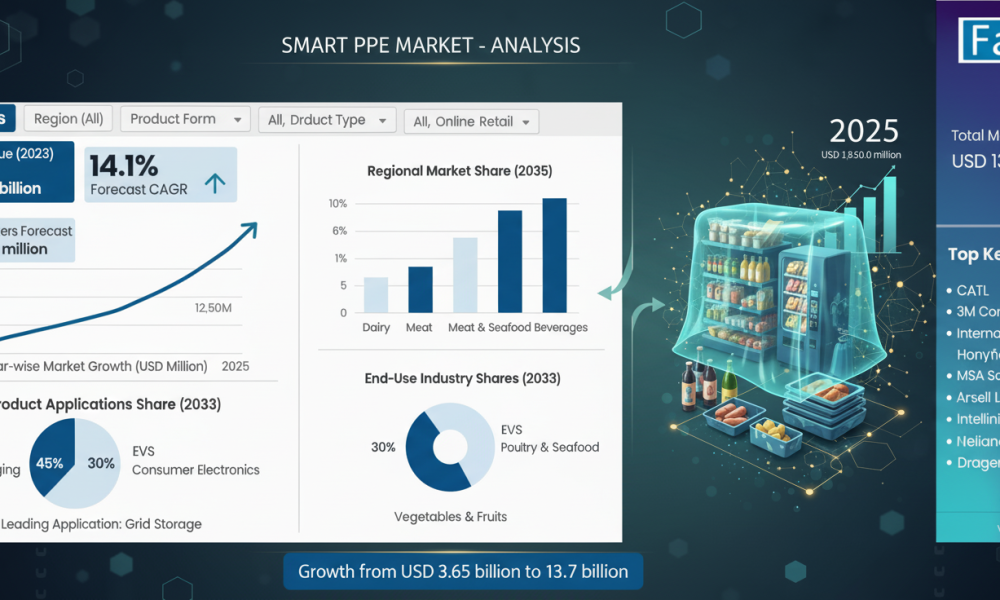
— The global market for smart personal protective equipment (Smart PPE) is poised for rapid expansion over the next decade, propelled by rising demand for connected safety wearables, industrial automation, and stringent worker-safety regulations. According to Fact.MR’s latest analysis, the market is valued at USD 3.65 billion in 2023 and is projected to reach USD 13.7 billion by 2033, expanding at a CAGR of 14.1%.
Smart PPE: The Next Frontier in Industrial Safety
Smart PPE refers to protective equipment that integrates sensors, connectivity, and data-driven technologies to enhance user safety and workplace monitoring. These include smart helmets, connected clothing, respirators, gloves, and footwear equipped with IoT capabilities for real-time hazard detection, fatigue tracking, and environmental monitoring.
“Smart PPE is transforming from compliance-driven safety gear into proactive prevention systems,” said a senior research analyst at Fact.MR. “By combining IoT and data analytics, companies can now predict safety incidents and improve operational efficiency.”
To access the complete data tables and in-depth insights, request a discount on the Report https://www.factmr.com/connectus/sample?flag=S&rep_id=4611
Key Market Insights at a Glance
| Metric | Estimate |
| Market Value (2023) | USD 3.65 billion |
| Forecast Value (2033) | USD 13.7 billion |
| Forecast CAGR (2023–2033) | 14.1% |
| Top Region (2023) | North America (~30% share) |
Segment Overview
By Product Type:
Protective clothing dominates the market, representing the largest share in 2023, owing to its wide sensor-integration capability. Head, eye, and face protection, followed by footwear and respiratory gear, also show strong growth potential.
By End-Use Industry:
The manufacturing and construction sectors remain leading end-users, driven by high-risk environments and regulatory compliance requirements. Oil & gas, firefighting, mining, and healthcare are rapidly adopting smart PPE for connected worker management and hazard prevention.
By Region:
North America leads the global smart PPE market due to early technology adoption and strict occupational safety laws. Asia-Pacific follows closely, supported by industrial expansion, rising awareness, and large-scale workforce populations. Europe continues to show steady growth due to high safety standards and smart factory integration.
Five Core Growth Drivers
- Stringent Workplace Regulations: Enhanced safety mandates are prompting companies to transition from traditional PPE to data-enabled smart wearables.
- Industrial Digitization: Integration of IoT and Industry 4.0 technologies is boosting demand for connected protective equipment.
- Workforce Safety Awareness: Increasing employer emphasis on health, safety, and liability prevention is driving adoption.
- Sensor and Connectivity Advancements: Smaller, cost-efficient sensors and low-energy communication systems enable real-time monitoring.
- Cross-Industry Application Expansion: Widespread use across oil & gas, construction, and healthcare sectors is broadening the market footprint.
Key Opportunities and Market Trends
- Smart Wearable Integration: Manufacturers are embedding biometric sensors, environmental trackers, and communication modules into traditional gear.
- Predictive Safety Analytics: Data platforms now provide early warnings of fatigue, gas leaks, and heat stress, preventing incidents before they occur.
- Subscription-Based Models: Enterprises are shifting toward PPE-as-a-Service, offering scalable adoption and continuous updates.
- Emerging Economies: Rapid industrialization in Asia and Latin America presents strong expansion opportunities for global suppliers.
Market Challenges
Despite growth prospects, the market faces certain challenges:
- High Product Costs: Smart PPE remains more expensive than conventional equipment, limiting adoption in cost-sensitive industries.
- Integration Complexity: Linking wearable data to enterprise systems requires advanced IT infrastructure.
- Data Privacy Concerns: Employee monitoring and cloud connectivity raise privacy and cybersecurity issues.
- Standardization Gaps: Lack of unified communication protocols hinders interoperability between devices.
Buy Now This Report: https://www.factmr.com/checkout/4611
Competitive Landscape
Leading players in the smart PPE market include:
- 3M Company
- Honeywell International Inc.
- MSA Safety Incorporated
- Ansell Limited
- Vuzix Corporation
- Intellinium
- Draegerwerk AG & Co.
These companies are investing in R&D for advanced sensor technologies, wearable data platforms, and strategic collaborations with software and industrial IoT providers. Their focus on product differentiation, reliability, and cloud-based analytics will shape the industry’s competitive direction through 2033.
Market Outlook: From Protection to Prediction
Over the next decade, the smart PPE industry is expected to evolve beyond passive protection toward predictive, self-diagnostic safety ecosystems. AI-driven systems that learn from behavioral data will become integral to connected-worker programs. Organizations adopting these systems stand to achieve fewer accidents, reduced downtime, and improved worker confidence.
“Connected safety is redefining the role of PPE—from reactive protection to proactive prevention,” added the Fact.MR analyst. “Companies that leverage data analytics to enhance workplace safety will set new performance standards across industries.”
Report Coverage and Deliverables
The Fact.MR report, “Smart PPE Market Size, Share, and Forecast 2023–2033,” provides:
- Global and regional forecasts through 2033
- Market share analysis by product type and end use
- Competitive intelligence and company benchmarking
- Emerging technology and regulatory trends
The study offers actionable insights for manufacturers, safety officers, IoT solution providers, and investors seeking to understand the evolving dynamics of workplace safety technologies.
To View Related Report:
Smart Logistics Service Market
About Fact.MR
Fact.MR is a global market research and consulting agency that delivers data-driven insights across a wide range of industry sectors. The firm helps clients identify growth opportunities, assess competitive landscapes, and make informed strategic decisions through reliable market intelligence and analytics.



