
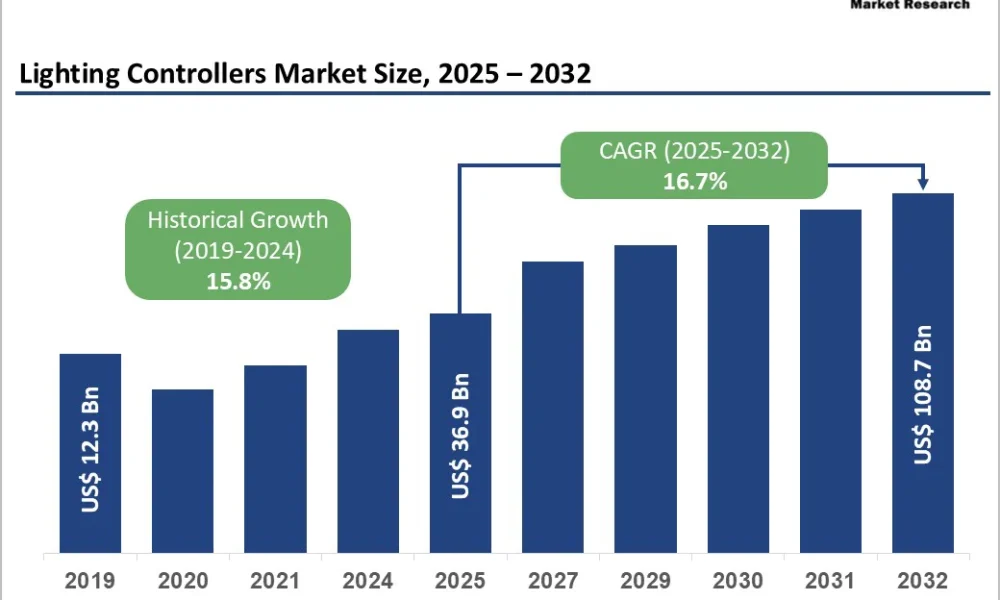
The global lighting controllers market is entering an era of unprecedented growth, driven by the convergence of energy efficiency mandates, smart building adoption, and the rise of the Internet of Things (IoT). Valued at US$ 36.9 billion in 2025, the market is projected to surge to US$ 108.7 billion by 2032, registering a robust CAGR of 16.7% between 2025 and 2032. This growth is not only fueled by increasing commercial and residential demand but also by technological innovations that enable intelligent lighting control across diverse applications.
Lighting represents roughly 30% of energy consumption in commercial buildings, and integrated lighting controllers can reduce this by up to 40% through occupancy sensors, daylight harvesting, and automated dimming. As building owners seek energy savings, cost reductions, and regulatory compliance, the adoption of advanced lighting control systems becomes both a business and sustainability imperative.
Key Market Highlights
The market is segmented by product type, connectivity, application, and region, with notable trends shaping each area:
Product Segments
- Sensors dominate with a 31.2% market share, driven by their role in occupancy detection, ambient light monitoring, and daylight harvesting systems.
- Smart switches are the fastest-growing segment, expanding at a 20% CAGR, as homeowners and commercial operators embrace Wi-Fi-enabled switches with app-based and voice control functionality via Alexa or Google Assistant.
Connectivity Segments
- Wired systems lead the market with 64% share, benefiting from established infrastructure, reliability, and adoption in commercial buildings.
- Wireless systems are the fastest-growing segment, expanding at 18% CAGR, supported by Bluetooth Mesh, Zigbee, and Thread protocols that reduce installation costs and enable easy retrofits.
Application Segments
- Residential applications hold 35.5% market share, driven by the rise of smart homes and integrated connected ecosystems.
- Commercial applications are growing fastest at 17% CAGR, fueled by energy-saving mandates and rapid adoption of smart building systems.
Regional Dynamics
- North America leads with 35% global market share, propelled by DOE lighting mandates, utility rebates, and strong adoption of connected controls.
- Asia Pacific is the fastest-growing region, with a 19.5% CAGR, led by China and India through smart city initiatives and infrastructure modernization.
Market Drivers
- Energy Efficiency Mandates and Cost Reduction
Global building energy regulations targeting 30% lighting energy reduction are a critical driver for automated lighting controls. Solutions such as dimming systems, occupancy sensors, and daylight harvesting allow commercial buildings to cut lighting energy consumption by 10-30%, achieving significant cost savings.
A practical example is Historic England, where integrating daylight harvesting with LED upgrades resulted in a 54% reduction in annual energy consumption, cutting 4,211 kWh to 1,941 kWh and reducing CO2 emissions by 930 kg. Regulatory frameworks such as the U.S. DOE energy disclosure requirements and the EU Energy Performance of Buildings Directive further compel building owners to adopt energy-efficient lighting controls.
- Smart Building Integration and BMS Convergence
Lighting controllers are no longer standalone systems. Modern Building Management Systems (BMS) integrate lighting with HVAC, security, and access controls, optimizing operations and energy efficiency. For instance, occupancy sensors can trigger lighting shutdown and HVAC setback simultaneously, delivering 15-25% additional energy savings.
The data generated by lighting sensors also contributes to space utilization analytics, facility planning, and broader IoT applications, providing value beyond energy savings. In smart cities, connected streetlights form the backbone for traffic management, environmental monitoring, public Wi-Fi, and emergency response, further driving market demand.
Market Restraints
- High Initial Investment
Comprehensive lighting control deployments can cost $8-25 per square foot for commercial buildings, including hardware, installation, and integration. High upfront costs are a barrier, particularly for small-to-medium enterprises.
- Complex Installation and Commissioning
Wired systems require structured cabling and centralized management platforms, often involving 50-70% of total system costs in installation labor. Commissioning requires skilled technicians, configuration of zones, programming of scenes, and performance validation, which can take 3-6 weeks and $2,000-10,000 in service fees.
- Interoperability Challenges
The market faces fragmentation due to competing wireless protocols such as Bluetooth Mesh, Zigbee, Thread, KNX, and proprietary systems. Lack of standardization and potential cybersecurity vulnerabilities can deter risk-averse buyers. Retrofit projects, in particular, face vendor lock-in risks and may require full system replacement to switch providers.
Elevate your business strategy with comprehensive market data. Request a sample report now: https://www.persistencemarketresearch.com/samples/21739
Market Opportunities
- Retrofit and Modernization
With over 200 billion square feet of global commercial building stock, retrofit opportunities are vast. Penetration of lighting controls in existing buildings remains below 15%, indicating an addressable market of US$ 120-180 billion.
Wireless systems eliminate rewiring requirements, enabling retrofits with 2-4 year payback periods through energy savings. Incentive programs in the U.S., EU, and India further accelerate adoption, while aging infrastructure provides natural replacement cycles, aligning LED retrofits with control system upgrades.
- Smart City Infrastructure
Smart cities, with over US$ 150 billion in annual investment, present significant opportunities. Intelligent street lighting systems provide a foundation for IoT networks, supporting municipal services such as traffic monitoring, air quality measurement, public Wi-Fi, and adaptive lighting.
LED streetlight conversions in cities like Los Angeles, New York, and London demonstrate energy savings of 50% beyond LED upgrades, with adaptive lighting reducing light pollution and optimizing safety.
Product Type Insights
- Sensors: Occupancy, PIR, and photocell sensors dominate energy-saving applications, while dual-technology sensors ensure accuracy in low-motion environments.
- Smart Switches: Wireless switches and smart dimmers enable easy retrofits and flexible layouts, integrating with voice assistants and mobile apps to enhance user convenience.
Connectivity Type Insights
- Wired Systems: Maintains dominance due to reliability, safety standards, and established protocols like DALI and 0-10V analog dimming, suitable for mission-critical applications.
- Wireless Systems: Fastest-growing, offering 50% cost reduction, easy retrofit, and seamless IoT integration. Bluetooth Mesh, Zigbee, and Thread enable large, self-healing networks with smartphone configuration and cloud control.
Application Insights
- Residential: Growth is driven by smart home adoption, DIY-friendly installations, and wireless retrofits that eliminate complex wiring. Smart switches and voice control enhance accessibility for tech-savvy users.
- Commercial: Rapid adoption in offices, retail, and industrial facilities is supported by energy savings of 30%, short 2-4 year ROI, and improved occupant comfort and productivity. Dynamic lighting enhances customer engagement in retail environments.
Regional Market Insights
North America
- Market Value (2025): US$ 12.9 billion
- CAGR (2025-2032): 15.2%
- Drivers: DOE mandates, utility rebates, commercial building stock, and smart building adoption.
- U.S. dominates with 82% regional share, supported by California Title 24 energy code requirements.
Europe
- Market Value (2025): US$ 9.2 billion
- CAGR (2025-2032): 16.8%
- Drivers: EU energy performance directives, KNX protocol adoption, smart city lighting, and industrial automation expertise.
- Germany leads with 28% regional share, emphasizing retrofits and energy efficiency leadership.
Asia Pacific
- Fastest-growing region, CAGR: 19.5%
- Drivers: Urbanization, smart city projects, manufacturing leadership, and government initiatives.
- China dominates regional demand, India is emerging with 22-26% CAGR through Smart Cities Mission, while Japan and South Korea contribute 16% combined share.
Competitive Landscape
The market is moderately fragmented. Leading players hold ~40% combined share, while regional suppliers and system integrators capture the rest.
- Signify (Philips Lighting): Market leader with 14% share, powered by Interact IoT platform.
- Legrand: 10% share with DALI leadership and North American market strength.
- Other major players: Acuity Brands, Lutron, OSRAM, Eaton, Honeywell, Schneider Electric, GE Lighting, Cree, and Hubbell.
Recent Developments
- CISCO & Morgan Solar (2024): Pilot projects integrating solar power for intelligent lighting solutions.
- GE Investments (2022-2023): USD 1.9B+ invested in advanced sensors, wireless controls, and AI-driven lighting systems.
Conclusion
The lighting controllers market is poised for exponential growth between 2025 and 2032. Fueled by energy efficiency mandates, smart building adoption, IoT integration, and retrofit opportunities, the market offers substantial benefits for commercial, residential, and municipal applications.
While high initial costs, installation complexity, and interoperability challenges pose constraints, the combined forces of regulatory support, technological innovation, and sustainability imperatives are creating a compelling business case for adoption.
Investments in wireless systems, smart switches, sensors, and smart city infrastructure are expected to dominate market growth, delivering significant energy savings, operational efficiency, and enhanced occupant experience. By 2032, the global market is expected to exceed US$ 108.7 billion, establishing lighting controllers as a cornerstone of smart, energy-efficient building management worldwide.
Related Reports:




