
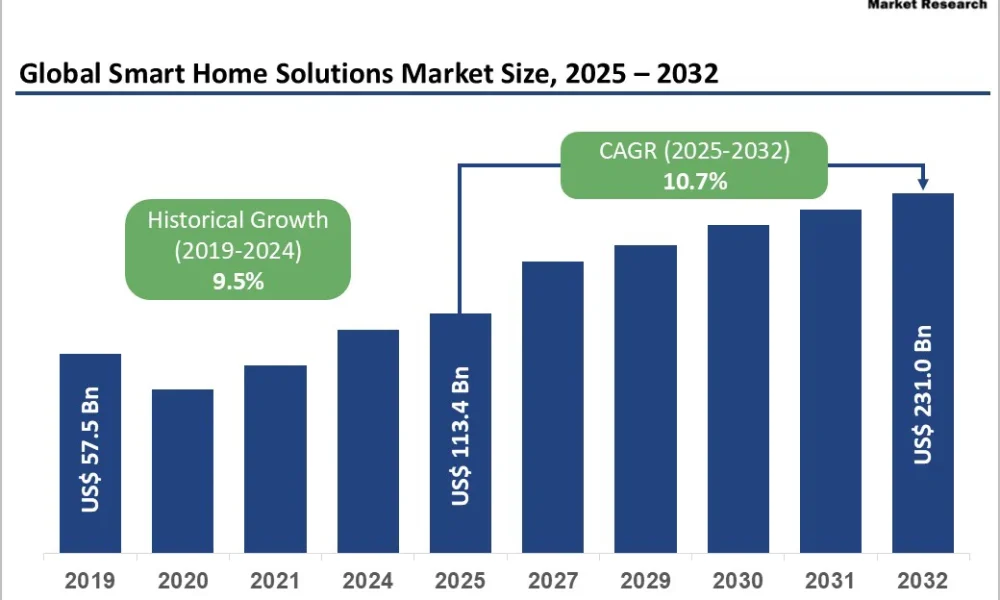
The global smart home solutions market is undergoing rapid expansion, driven by the convergence of technology, convenience, and energy efficiency imperatives. Valued at US$113.4 billion in 2025, the market is projected to reach US$231.0 billion by 2032, registering a robust CAGR of 10.7% from 2025 to 2032. This growth is underpinned by the proliferation of Internet of Things (IoT) devices, increasing household penetration of connected solutions, and rising demand for energy-saving and security-focused home automation.
With 21.1 billion connected devices globally in 2025, households are becoming smarter, safer, and more efficient. IoT-enabled smart homes are no longer a futuristic concept—they are mainstream. Around 77.6% of households have adopted at least one smart device, facilitated by popular platforms like Amazon Alexa and Google Assistant. These systems not only enhance convenience but also contribute to significant energy savings, reducing utility costs by up to 20% through automated climate control and smart lighting.
Key Market Highlights
Property Type Segmentation
Apartments dominate the smart home market with a 48.3% share, fueled by urban density, tech-savvy residents, and the feasibility of retrofit installations. Multi-dwelling units benefit from integrated internet infrastructure, enabling smooth adoption of devices like smart thermostats, lighting, and security systems.
Villas and bungalows are the fastest-growing segment, expanding at a 12% CAGR. These larger homes allow for comprehensive automation, including whole-home lighting, shading, audio, and security systems. With budgets ranging from US$8,000 to $25,000 per home, affluent homeowners are investing in complete smart home packages that enhance comfort, convenience, and property value.
Component Dynamics
Hardware leads the market with a 42.2% share, covering devices such as smart speakers, thermostats, lighting systems, locks, cameras, and sensors. Specialized devices like video doorbells and smart locks are contributing significantly to hardware revenue, and the standard 4-7 year replacement cycles ensure recurring demand.
Software is the fastest-growing component, recording a 12-15% CAGR, driven by AI-enabled automation, cloud analytics, and subscription services priced at US$15-40 per month. Software innovations provide predictive and personalized automation, allowing homeowners to optimize energy usage, enhance security, and integrate entertainment systems seamlessly.
Application Market Trends
Retrofit installations dominate with 67.3% market share, given the global base of 1.2 billion existing homes seeking incremental smart upgrades. Wireless technologies, plug-and-play devices, and DIY-friendly solutions facilitate easy integration without major home renovations.
New construction is the fastest-growing segment, with a 14-18% CAGR, thanks to builder partnerships that enable pre-wiring, structured cabling, and cost savings of 40-60% over retrofit installations. “Smart-ready” homes offer 3-5% price premiums, providing developers a competitive advantage while delivering long-term energy and lifestyle benefits to homeowners.
Regional Growth Patterns
North America
North America leads the global market with a 35% share and a 9.8% CAGR, largely driven by the US$43 billion U.S. smart home market. High disposable incomes, early technology adoption, and strong presence of tech giants like Amazon, Google, and Apple contribute to rapid adoption.
The United States accounts for approximately 85% of the North American market, with 77.6% of households owning at least one smart device. Canada contributes an additional 8-11%, benefiting from similar adoption patterns and integrated North American infrastructure.
Europe
Europe represents a US$28.4 billion market in 2025, capturing 20% global share. Energy efficiency consciousness, sustainability initiatives, and regulatory mandates drive adoption. Germany leads with 28-34% regional share, leveraging engineering excellence and environmental regulations. The UK contributes 18-24% through smart meter mandates, energy efficiency incentives, and strong consumer technology affinity. Other European markets like France, Spain, and the Nordics are experiencing steady growth through EU energy directives and renewable energy integration.
Asia Pacific
Asia Pacific is the fastest-growing region, projected to reach US$65 billion by 2032 with a 28% CAGR, accounting for 25% global market share. Rapid urbanization, expanding middle-class populations, and government-backed smart city initiatives drive adoption.
China dominates the region with 40-46% share, supported by technology giants Alibaba, Tencent, and Baidu, government smart city programs, and an increasing middle-class population.
India is emerging as a high-growth market with a 25-30% CAGR, fueled by the Digital India initiative, 900+ million internet users, and rising disposable incomes. Southeast Asian nations contribute 10-14%, benefiting from urbanization, rising affluence, and regional economic integration.
Market Dynamics
Growth Drivers
IoT Proliferation
IoT devices are the backbone of smart homes. In 2025, connected devices reach 21.1 billion, with smart home devices accounting for 30-35% of this ecosystem. Smart lighting, security, climate control, and entertainment systems are now widely accessible, integrating seamlessly via home hubs.
Smart speakers have achieved 35-40% household penetration, with over 200 million units deployed globally. AI-powered assistants such as Alexa, Google Assistant, and Siri support over 10,000 third-party integrations, enabling a single command to manage multiple devices—from lighting and thermostats to brewing coffee and reading news.
Energy Efficiency and Cost Reduction
With average U.S. households spending over $1,500 annually on electricity, energy-efficient smart home systems present compelling ROI.
- Smart thermostats (Nest, Ecobee, Honeywell) save 10-23% on heating and 15% on cooling, offering $180-350 annual savings, covering device costs within 12-18 months.
- Automated lighting systems reduce energy consumption by 30-50%, while LED smart bulbs consume 75% less energy than traditional bulbs and allow customizable brightness and color control.
Elevate your business strategy with comprehensive market data. Request a sample report now: https://www.persistencemarketresearch.com/samples/20602
Market Restraints
High Initial Investment
Comprehensive smart home deployment costs $3,000-15,000, including devices, installation, and network infrastructure. Professional installation adds $500-2,000, creating a barrier to adoption, particularly in emerging markets. Retrofit installations face additional structural constraints, raising costs 30-50% higher than new construction.
Interoperability and Platform Lock-In
Consumers face challenges integrating devices across Amazon Alexa, Google Home, and Apple HomeKit, creating vendor lock-in risks. Although the Matter standard promises cross-platform interoperability, full adoption is still limited.
Privacy and Cybersecurity Concerns
Smart homes collect personal data, including occupancy patterns, voice recordings, and video feeds. Studies show 60-70% of consumers are concerned about data privacy, and 40-50% cite it as the primary barrier. Cyberattacks, like the Mirai botnet, have compromised over 600,000 IoT devices, highlighting vulnerabilities in unsecured networks. Regulatory frameworks like GDPR and CCPA impose strict compliance standards, with penalties for breaches further impacting adoption.
Market Opportunities
Emerging Market Growth
Asia Pacific’s growing middle class, projected to reach 3.5+ billion by 2030, presents a vast opportunity for affordable smart home solutions.
- India: 25-30% CAGR, $8-12 billion market potential by 2032.
- China: Market projected to reach $25-35 billion by 2032, supported by smart city initiatives.
Affordable devices, priced as low as $10-30 for smart plugs, $25-60 for bulbs, and $80-150 for smart speakers, accelerate adoption among middle-income households.
New Construction Integration
Smart homes are increasingly integrated into new builds, offering pre-wired infrastructure, centralized control panels, and modular architectures that allow future expansions without costly rewiring. Partnerships with developers enable bulk discounts and streamlined installation, reducing costs by 40-60%. Premium homes incorporating $8,000-20,000 smart home packages enhance property value and deliver long-term energy savings.
Competitive Landscape
The smart home solutions market exhibits moderate-to-high fragmentation, with leading platform providers controlling roughly 35% of the market.
- Amazon leads with 28-32% smart speaker market share, leveraging the Alexa ecosystem and over 100,000 third-party integrations.
- Google follows with 24-28%, combining Google Assistant and Nest devices with Android integration.
- Apple and Samsung maintain 12% market share each, offering premium home automation solutions.
Strategic Developments
- Amazon Alexa+ (2025): Integrates generative AI, enabling natural conversations, improved context understanding, and multi-command execution.
- Schneider Electric Wiser Home App (2024): AI-powered energy management for EV chargers and water heaters, optimizing loads based on usage, weather, and tariffs.
Other notable players include Siemens AG, Honeywell, Johnson Controls, ABB Ltd., Legrand, Lutron, Leviton, and Acuity Brands, highlighting the market’s diverse competitive ecosystem.
Conclusion
The smart home solutions market is poised for remarkable growth, driven by IoT proliferation, AI-powered automation, and consumer demand for energy efficiency, security, and convenience. While high upfront costs, interoperability challenges, and privacy concerns remain obstacles, emerging markets and new construction integration offer substantial opportunities for expansion.
By 2032, the market is expected to more than double in size, reaching US$231.0 billion, with apartments retaining dominance and villas experiencing rapid growth. Hardware continues to drive revenue, while software is rapidly expanding through AI-enabled features and subscription services. Regions like Asia Pacific present high-growth opportunities, while North America and Europe sustain mature, steady adoption.
Companies that innovate in interoperability, AI automation, and affordable solutions will be well-positioned to capture value, meeting the demands of increasingly tech-savvy consumers. As smart homes transition from niche luxury to mainstream necessity, the global smart home solutions market is set to transform modern living, redefining convenience, efficiency, and sustainability for millions of households worldwide.
Related Reports:




