
The skin imaging systems market has witnessed remarkable expansion in recent years, driven by advancements in technology, increased awareness around skin health, and growing concerns about skin diseases such as skin cancer. As the demand for both aesthetic and diagnostic skin imaging systems continues to surge, this sector is poised for sustained growth. In this article, we will explore the market’s key drivers, trends, segmentation, regional insights, and future opportunities, while shedding light on the latest technological innovations and major players in the industry.
Overview of the Skin Imaging Systems Market
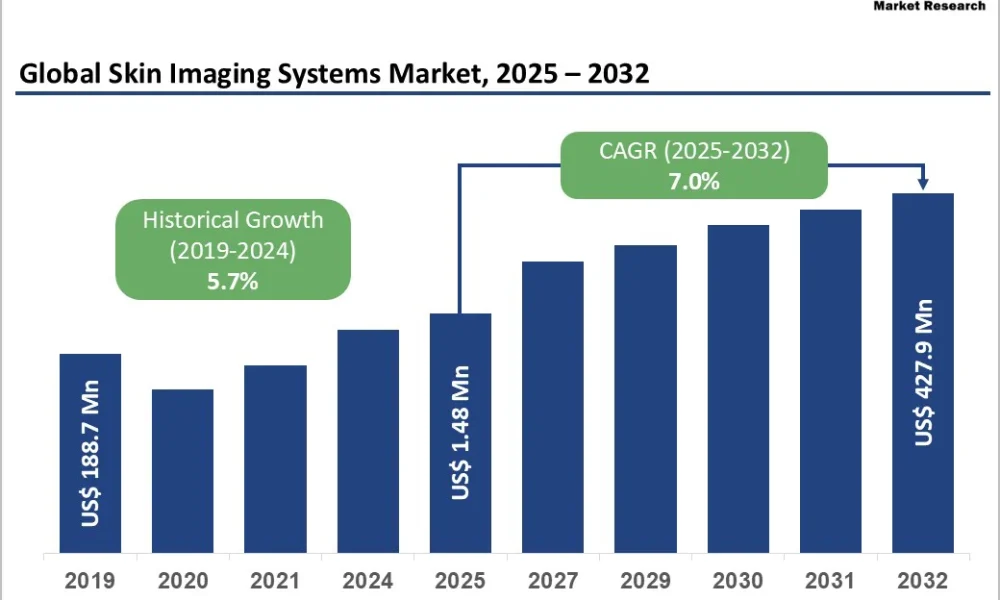
The skin imaging systems market, valued at approximately USD 266.5 million in 2025, is projected to grow to USD 427.9 million by 2032. This growth reflects a compound annual growth rate (CAGR) of 7.0% between 2025 and 2032. The dermatology industry has seen increased adoption of advanced imaging technologies, as both aesthetic medicine and skin cancer diagnostics increasingly rely on high-precision visualization tools. Technologies such as dermatoscopy, optical coherence tomography (OCT), confocal microscopy, and artificial intelligence (AI)-driven analysis are helping healthcare providers detect skin diseases early, plan treatments effectively, and assess cosmetic procedures accurately.
The primary drivers for this growth include a rising prevalence of skin diseases, especially skin cancer, an expanding aging population, and the growing volume of cosmetic procedures. Furthermore, the shift toward non-invasive and digital imaging systems has significantly boosted the market. Dermatology clinics, aesthetic centers, and hospitals are increasingly adopting these systems due to their accuracy, ease of use, and efficiency in providing precise visual assessments.
Download Your Free Sample & Explore Key Insights: https://www.persistencemarketresearch.com/samples/27493
Key Growth Drivers Behind Market Expansion
Key drivers behind the skin imaging systems market growth include the increasing incidence of skin cancer, which is one of the most common types of cancer globally. Additionally, the increasing popularity of aesthetic procedures such as wrinkle reduction, pigmentation treatment, and skin rejuvenation is driving demand for skin imaging systems in cosmetic settings. Technological advancements, particularly in AI and digital imaging, have also facilitated faster, more accurate diagnoses and streamlined workflows for healthcare professionals. With the push toward telemedicine and teledermatology, the ability to access imaging systems remotely has expanded the market’s reach to underserved regions, fostering further growth.
Leading Segment and Leading Geographical Region
The leading segment in the skin imaging systems market is dermascopy, accounting for the highest market share. Digital dermoscopy, widely accepted and used in dermatology practices, offers high diagnostic accuracy and affordability, making it a popular choice for both healthcare providers and patients. The portable nature and ease of use of dermoscopes have allowed for their widespread adoption in both primary care settings and specialized dermatology clinics.
Regionally, North America holds the largest market share due to its strong healthcare infrastructure, high prevalence of skin cancer, and early adoption of advanced imaging technologies. The U.S. is the dominant player in this region, benefiting from robust reimbursement models, a high awareness of melanoma detection, and a strong presence of innovative technology developers. Additionally, Europe follows closely behind with substantial market growth driven by similar factors, such as high health awareness and the widespread integration of advanced imaging technologies into clinical workflows.
Key Highlights from the Skin Imaging Systems Market Report
• AI-powered imaging platforms are revolutionizing dermatology, enhancing diagnostic precision and speeding up lesion assessment.
• Aesthetic clinics rely heavily on advanced imaging systems for treatment planning, demonstration of results, and improving patient engagement.
• Dermascopy, or digital dermatoscopy, leads the market due to its high adoption rate and clinical acceptance in routine skin examinations.
• Cloud-based software is becoming a key revenue stream in the market, facilitating lesion tracking, 3D visualization, and patient monitoring.
• The skin imaging systems market is experiencing rapid growth, with an expected CAGR of 7.0% between 2025 and 2032.
• Emerging technologies like AI-based teledermatology platforms offer significant potential for expanding dermatology care to underserved regions.
Market Segmentation
The skin imaging systems market can be broadly segmented based on product type, technology, end-users, and geographical regions.
By Product Type
The market is primarily divided into face imaging systems and full-body skin imaging systems. The face imaging systems segment dominates the market, holding a substantial market share, primarily due to its affordability, ease of use, and ability to detect fine lines, wrinkles, acne, dark spots, and other skin imperfections. These devices are especially popular in aesthetic dermatology for non-invasive skin assessments. Full-body imaging systems, while more expensive, are also gaining traction due to their ability to scan and monitor the entire body for skin cancer and other systemic conditions.
By Technology
Technologically, the market is dominated by dermascopy, which is the most established and clinically accepted imaging technique in dermatology. This method allows dermatologists to visually inspect skin lesions and moles in high detail, making it an indispensable tool in early melanoma detection. Dermatoscopes are portable and cost-effective, making them highly accessible for both specialists and general practitioners. Other technologies, including optical coherence tomography (OCT) and confocal microscopy, are also growing but remain more niche due to their higher costs and specialized nature.
By End-User
The end-users of skin imaging systems include hospitals, dermatology clinics, aesthetic centers, and research institutions. Hospitals and clinics represent the largest segment due to the high demand for skin cancer diagnostics and routine skin examinations. Aesthetic centers are also major consumers, particularly for face imaging systems used in cosmetic treatments such as anti-aging procedures and acne treatment.
Get Custom Insights Designed for Your Business: https://www.persistencemarketresearch.com/request-customization/27493
Regional Insights
North America
North America is the dominant region in the global skin imaging systems market. The U.S. leads due to its high healthcare standards, widespread adoption of cutting-edge technologies, and strong awareness around early melanoma detection. Furthermore, the market in North America benefits from well-established teledermatology networks and reimbursement structures that facilitate the adoption of these advanced systems. The rising incidence of skin cancer, alongside growing cosmetic procedure volumes, further strengthens the market position of North America.
Asia Pacific
The Asia Pacific region is emerging rapidly in the skin imaging systems market, driven by growing dermatology awareness, improving healthcare infrastructure, and the rise of aesthetic procedures. Countries like China, India, South Korea, and Japan are witnessing strong demand for affordable and portable dermatoscopes. The growing disposable income in these countries and the rising concern for skin health have led to increased adoption of these systems in both clinical and cosmetic settings. Moreover, the booming medical tourism industry, particularly in South Korea, is contributing to the market’s rapid expansion.
Market Drivers
The key driver behind the growth of the skin imaging systems market is the technological advancement of diagnostic tools. Innovations such as AI-based platforms are improving the speed and accuracy of skin assessments, making these systems invaluable in clinical and aesthetic settings. The increasing prevalence of skin conditions like melanoma and other skin cancers also contributes significantly to the market’s expansion, as early detection and monitoring become essential for patient care. Additionally, there is a growing trend toward non-invasive diagnostic methods, which is shifting the healthcare industry toward imaging systems that offer both high accuracy and minimal patient discomfort.
Market Restraints
Despite the market’s positive outlook, there are some challenges that may hinder its growth. One of the primary restraints is the shortage of skilled professionals capable of operating these advanced systems. The lack of trained dermatologists and technicians proficient in handling complex imaging devices could delay the adoption of these technologies, especially in emerging markets. Additionally, the high cost of advanced full-body imaging systems may limit their accessibility in resource-constrained healthcare settings, potentially hindering their widespread adoption.
Market Opportunities
One of the most promising opportunities in the skin imaging systems market is the rise of teledermatology. Telemedicine platforms, particularly those that integrate AI-driven skin imaging systems, offer significant potential to reach underserved regions where dermatology care is limited. These platforms enable healthcare workers to capture high-quality skin images and transmit them to specialists for diagnosis, reducing wait times and improving access to care in rural and remote areas. Additionally, governments and NGOs are increasingly focusing on skin cancer screening programs, which could further boost demand for portable and affordable skin imaging solutions.
Checkout Now & Download Complete Market Report: https://www.persistencemarketresearch.com/checkout/27493
Company Insights
Several companies are key players in the skin imaging systems market, driving technological advancements and competing for market share. Some of the major players include:
• Canfield Scientific Inc.
• Barcos
• Cortex Technology ApS
• FotoFinder Systems GmbH
• Macquarie Medical Systems
• Courage Khazaka Electronic GmbH
• QUANTIFICARE
• Clarius
• Emage Medical LLC
• Pixience
• FUDE Medical Instrument Ltd.
• BOMTECH Electronics Co., Ltd.
• 3dMD
• Longport Inc.
• Miravex
• DermSpectra
• SkinLabs
Market Segmentation
By Product Type
- Full Body Imaging Systems
- Whole Body Imaging Systems
- Height Adjustable Image Scanners
- Portable Table-Top Image Scanners
- Face Imaging Systems
- Height Adjustable Image Scanners
- Portable Table-Top Image Scanners
- Hand-held Image Scanners
- Dermascopy Imaging
- Digital Dermascopes
- High-Resolution Dermascopes
- Software
By Indication
- Skin Cancer Diagnostics
- Skin Rejuvenation
- Acne
- Wart
- Hair Health and Removal
- Psoriasis
- Dark Spots
- Wrinkles and Pores
- Injectable
- Others
By Technology
- Ultrasound Imaging
- Optical Coherence Tomography
- Confocal Microscopy
- Dermascopy
- Total Body Photography
- Others
By End User
- Hospitals
- Independent Dermatology Clinics
- Dermatology Clinic Chains
- Aesthetic Clinics
By Region
- North America
- Europe
- East Asia
- South Asia and Oceania
- Latin America
- Middle East and Africa
Recent Developments
In October 2024, Haut.AI, a global leader in AI-powered skincare analysis, launched Face Analysis 3.0, which offers clinical-grade skin analysis through simple selfies, enhancing accessibility for brands, dermatologists, and everyday users.
In 2021, Courage Khazaka Electronic GmbH launched advanced software that includes wireless probes for skin imaging, further improving the accuracy and reliability of skin diagnostics.
Conclusion
The skin imaging systems market is on a solid growth trajectory, driven by technological advancements, increasing awareness of skin health, and rising demand for early skin disease detection. As AI-powered imaging platforms become more integrated into dermatology practices and teledermatology systems improve access to care, the market is set to expand rapidly. However, challenges such as the need for skilled professionals and high costs for advanced systems must be addressed for the market to realize its full potential. With the right innovations and investments




