
Definition
Laser Doppler Sensors are high-precision, non-contact measurement devices that utilize the Doppler effect to capture velocity and displacement data of moving objects with exceptional accuracy. By emitting laser beams and detecting frequency shifts caused by movement, these sensors provide real-time monitoring of speed, vibration, and displacement across multiple industrial and scientific applications.
Modern laser Doppler sensors have evolved to offer:
- Sub-micrometer resolution, allowing detection of extremely small displacements.
- Wide measurement ranges up to 30 m/s for high-speed processes.
- High sampling frequencies exceeding 100 kHz, ensuring accurate dynamic analysis.
- Non-contact operation, minimizing interference with delicate or moving surfaces.
Key applications of laser Doppler sensors include:
- Industrial Automation: Real-time monitoring of conveyor belts, motors, and production lines.
- Aerospace Testing: Wind tunnel measurements, turbine blade monitoring, and structural vibration analysis.
- Medical Diagnostics: Blood flow monitoring, microcirculation research, and hemodynamic studies.
- Autonomous Vehicles: Ground speed measurement and obstacle detection for self-driving systems.
Recent innovations include compact LDV systems integrated with vibrometers, enabling deployment in space-constrained industrial environments without compromising measurement accuracy. These devices are increasingly critical in quality control, research, and advanced process monitoring, forming the backbone of precision-driven industries worldwide.
Market Size
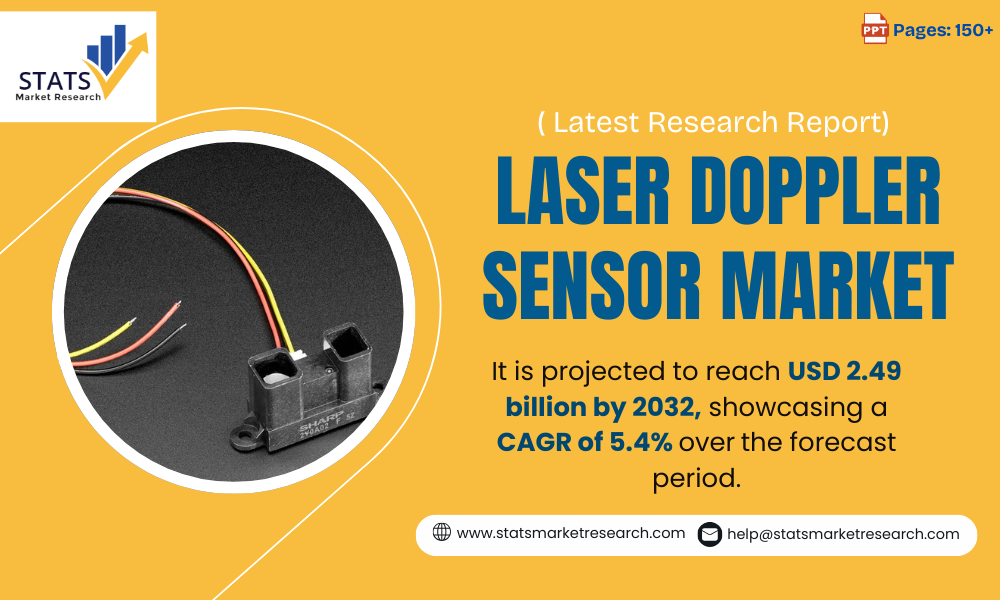
Global Laser Doppler Sensor market was valued at USD 1.74 billion in 2024 and is projected to grow from USD 1.82 billion in 2025 to USD 2.49 billion by 2032, exhibiting a CAGR of 5.4%.
Download FREE Sample of this Report @ https://www.statsmarketresearch.com/download-free-sample/8059978/global-laser-doppler-sensor-forecast-market
Key Insights:
- Industrial demand dominates: The manufacturing sector’s shift toward Industry 4.0 technologies increases the need for high-precision, non-contact measurement tools.
- Emerging medical applications: Blood flow monitoring and vascular diagnostics are creating new growth avenues.
- Technological evolution: Advances in micro-optics, fiber optics, and miniaturization are expanding potential applications in portable and embedded systems.
- Geographic growth: North America and Europe currently lead due to strong industrial infrastructure and aerospace innovation, while Asia-Pacific is emerging as a rapidly growing market with increasing adoption in manufacturing and biomedical sectors.
Historical trends indicate that industrial automation and aerospace testing have consistently contributed over 60% of revenue, while medical and research applications are gradually increasing their share due to rising healthcare demands and diagnostic technology improvements.
Market Dynamics
Drivers
Growing Industrial Automation:
- Real-time speed and vibration monitoring essential for quality control and robotic guidance.
- Adoption of Industry 4.0 solutions, with manufacturing investment projected to grow over 15% annually, fuels sensor demand.
- Capabilities include measuring velocities up to 10,000 m/s with <0.1% error, critical for high-precision production processes.
Advancements in Aerospace Testing:
- Laser Doppler sensors are vital for wind tunnel experiments, engine component testing, and structural health monitoring.
- Portable LDV systems enable field maintenance and in-flight testing, expanding their aerospace applicability.
- Leading manufacturers now require LDV systems to validate turbine performance under extreme vibrations exceeding 25,000 RPM.
Medical Applications:
- Used for blood flow measurement and microcirculation studies.
- Capable of detecting velocities as low as 0.1 mm/s, critical for cardiovascular diagnostics.
- Contributes to the hemodynamic monitoring market, projected to grow at 7% CAGR through 2030.
Restraints
High System Costs:
- Complete LDV systems range $15,000–$50,000, with high-end research models exceeding $100,000.
- Annual maintenance and calibration add 15–20% to total costs, limiting adoption in SMEs.
Technical Challenges:
- Alignment Sensitivity: Small misalignments (<0.1°) can cause significant measurement errors.
- Surface Dependency: Accuracy varies with surface texture and reflectivity, sometimes requiring additional preparation.
Competition from Alternative Technologies:
- Vision-based and capacitive displacement sensors offer 60–70% cost advantages, affecting price-sensitive segments.
- Emerging photonic Doppler velocimetry and fiber-optic solutions are partially replacing traditional systems in niche applications.
Regulatory Hurdles in Medical Applications:
- Medical device approvals take 12–18 months and can cost over $500,000 per application, slowing innovation and market entry.
Opportunities
Autonomous Vehicle Applications:
- LDV sensors are being tested for ground speed measurement and obstacle detection, critical for reliable autonomous navigation.
- Market potential is expanding as autonomous vehicle technologies are predicted to grow tenfold by 2030.
Miniaturization Trends:
- Micro-optics and semiconductor lasers allow compact sensors (<50mm) for embedded and portable applications.
- Applications include handheld industrial inspection tools, consumer electronics testing, and portable medical devices.
Challenges
- High technical expertise required for accurate sensor alignment and calibration.
- Integration with existing systems can be complex, particularly in retrofitting legacy industrial environments.
- Maintaining sub-micrometer resolution in harsh industrial or biomedical conditions remains a technical challenge.
Regional Analysis
North America:
- Leading region due to robust industrial automation and aerospace R&D.
- Strong adoption in automotive, electronics, and defense sectors.
Europe:
- Significant presence of aerospace testing and medical research institutions.
- Strict quality standards drive adoption of high-precision LDV systems.
Asia-Pacific:
- Rapidly growing manufacturing sector increases sensor demand.
- Emerging biomedical and research applications are expanding market potential.
Latin America & Middle East/Africa:
- Gradual adoption in automotive and industrial automation.
- Opportunities in agriculture, renewable energy, and niche industrial applications.
Competitor Analysis
The Laser Doppler Sensor market is moderately fragmented, with established multinational corporations and regional players driving innovation and adoption.
Key Industry Players:
- Polytec GmbH (Germany): Market leader with ~18.3% global share, known for advanced LDV systems in automotive, aerospace, and industrial applications.
- Optomet (France) & Delta Electronics, Inc. (Taiwan): Combined 27% market share, focusing on strategic collaborations in aerospace and industrial automation.
- Sensing Photonics (U.S.): Specialized in biomedical sensors, capturing ~9% of the life sciences segment.
- Sunny Optical Technology (China): Emerging supplier for industrial automation in Asia-Pacific, offering cost-effective alternatives.
- McGrady Optical (U.S.): Startups introducing AI-powered diagnostic and miniaturized solutions.
Strategic trends:
- Acquisitions for market expansion.
- Miniaturization and IoT integration.
- Development of smartphone-compatible and portable LDV systems.
Get the Complete Report & TOC @ https://www.statsmarketresearch.com/global-laser-doppler-sensor-forecast-market-8059978
Global Laser Doppler Sensor: Market Segmentation Analysis
This report provides a deep insight into the global Laser Doppler Sensor market, covering all its essential aspects. This ranges from a macro overview of the market to micro details of the market size, competitive landscape, development trend, niche market, key market drivers and challenges, SWOT analysis, value chain analysis, etc.
The analysis helps the reader to shape the competition within the industries and strategies for the competitive environment to enhance the potential profit. Furthermore, it provides a simple framework for evaluating and assessing the position of the business organization. The report structure also focuses on the competitive landscape of the Global Laser Doppler Sensor. This report introduces in detail the market share, market performance, product situation, operation situation, etc., of the main players, which helps the readers in the industry to identify the main competitors and deeply understand the competition pattern of the market.
In a word, this report is a must-read for industry players, investors, researchers, consultants, business strategists, and all those who have any kind of stake or are planning to foray into the Laser Doppler Sensor market in any manner.
Market Segmentation (by Application)
- Agriculture
- Life Science
- Aerospace
- Industry
- Others
Market Segmentation (by Type)
- Laser Doppler Velocimetry Sensor
- Laser Doppler Ranging Sensor
Key Company
- Polytec GmbH (Germany)
- Optomet (France)
- Delta Electronics, Inc. (Taiwan)
- Sensing Photonics (U.S.)
- West China Digital Imaging (China)
- Sunny Optical Technology (China)
- COSCO Technology (Japan)
- McGrady Optical Flow Measurement and Control (U.S.)
Geographic Segmentation
- North America
- Europe
- Asia-Pacific
- Latin America
- Middle East & Africa
FAQ
Q1: What is the current market size of Laser Doppler Sensor?
A1: The global Laser Doppler Sensor market was valued at USD 1.74 billion in 2024 and is projected to reach USD 2.49 billion by 2032, growing at a CAGR of 5.4%.
Q2: Which are the key companies operating in the Laser Doppler Sensor market?
A2: Key companies include Polytec GmbH, Optomet, Delta Electronics, Sensing Photonics, Sunny Optical Technology, West China Digital Imaging, COSCO Technology, and McGrady Optical.
Q3: What are the key growth drivers in the Laser Doppler Sensor market?
A3: Growth is driven by industrial automation, aerospace testing, medical applications, and emerging autonomous vehicle technologies.
Q4: Which regions dominate the Laser Doppler Sensor market?
A4: North America and Europe dominate the market, followed by a growing presence in Asia-Pacific.
Q5: What are the emerging trends in the Laser Doppler Sensor market?
A5: Trends include miniaturization, IoT integration, smartphone-compatible LDV modules, AI-powered diagnostic sensors, and applications in autonomous vehicles and biomedical monitoring.
About Us
☎️ International: +1 (332) 2424 294
📄 Website: www.statsmarketresearch.com
Join us on LinkedIn:- https://www.linkedin.com/company/statsmarketresearch




