
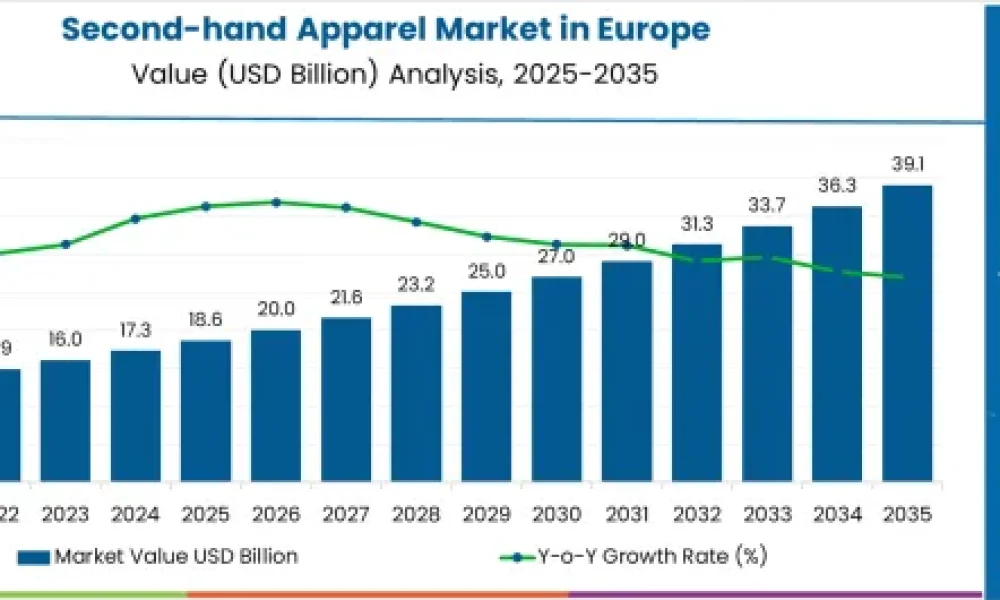
The Second-hand Apparel Market in Europe is entering a decisive growth phase as sustainability, affordability, and digital convenience reshape consumer fashion choices. According to the latest market outlook, the European second-hand apparel market is projected to grow from USD 18.6 billion in 2025 to USD 39.1 billion by 2035, registering a robust CAGR of 7.7% over the forecast period. This represents an absolute growth of USD 20.5 billion, with the market expected to expand nearly 2.1 times by 2035.
This press release highlights key market trends, opportunities for both established and emerging manufacturers, and how technology-driven platforms are redefining Europe’s second-hand fashion ecosystem.
Unlock the full market insights and exclusive data breakdowns – Request Your Sample Report Now
Market Growth Outlook: 2025–2035
Between 2025 and 2030, the market is expected to add USD 8.3 billion, accounting for 40.5% of total decade growth. This phase will be driven by rising environmental awareness, normalization of pre-owned fashion, and rapid expansion of digital resale platforms.
From 2030 to 2035, growth accelerates further, adding USD 12.2 billion or 59.5% of total expansion. This period will be marked by luxury resale growth, AI-powered pricing tools, and advanced authentication technologies that enhance trust and personalization.
Why the Second-hand Apparel Market in Europe Is Growing
- Rising environmental consciousness and awareness of fast fashion’s ecological impact
- Strong adoption of circular economy principles across European consumers
- Growing trust in digital second-hand platforms with authentication and buyer protection
- Increased affordability and access to designer and premium apparel
Second-hand apparel is no longer niche. It is now a mainstream fashion choice supported by evolving consumer mindsets and advanced platform technologies.
Key Consumer and Product Insights
By Consumer Group
- Women dominate the market with 55.1% share (2025)
- Higher fashion engagement
- Strong participation in sustainable and digital-first shopping
- Active resale and community-driven platforms
By Product Segment
- Dresses & Tops lead with 20.0% market share
- High resale value
- Strong demand for designer and occasion wear
- Seasonal and brand-driven pricing stability
Key Segments of the Market Report
Product Segments
- Dresses & Tops
- Shirts & T-Shirts
- Jeans & Pants
- Sweaters
- Coats & Jackets
- Others
Consumer Groups
- Women
- Men
- Children
Sector
- Resale Platforms
- Traditional Thrift Stores & Donations
Sales Channels
- Online Retailers
- Independent Small Stores
- Multi-Brand Stores
- Departmental Stores
- Hypermarkets/Supermarkets
- Wholesalers/Distributors
- Other Channels
Geography
- Western Europe
- Southern Europe
- Northern Europe
- Eastern Europe
Technology and Innovation Trends Shaping the Market
- AI-powered pricing and personalization for dynamic resale value
- Advanced authentication technologies for luxury and designer apparel
- Mobile-first platforms enhancing user experience and engagement
- Data-driven insights supporting sellers, buyers, and manufacturers
These innovations present strong opportunities for new manufacturers and emerging brands to collaborate with resale platforms, adopt circular business models, and expand sustainably across Europe.
Country-Level Highlights
- Spain (CAGR 8.1%): Fastest growth driven by Gen-Z adoption and digital platforms
- Italy (7.4%): Strong fashion heritage and demand for vintage and designer resale
- France (6.6%): Growing sustainability awareness and urban adoption
- Netherlands (6.2%): Advanced e-commerce infrastructure and circular mindset
- Belgium (5.8%): Rising acceptance of pre-owned apparel
- Germany (5.4%): Focus on quality, authenticity, and sustainability standards
- United Kingdom (3.7%): Mature but stable market with strong digital penetration
Competitive Landscape: Established and Emerging Players
The European market is highly competitive, blending established marketplaces with innovative new entrants focused on trust, technology, and sustainability.
Leading Players
- Vinted – Market leader with 19% share and strong peer-to-peer model
- eBay – 15.2% share with broad reach and infrastructure
- Vestiaire Collective – Luxury resale leader with authentication expertise
- Depop – Social commerce-driven platform popular among younger consumers
- StockX – Focused on authenticated designer and limited-edition apparel
Other Notable Players
Garson & Shaw, F&P Stock Solutions, Etsy, Yaga, Farfetch
These companies provide expansion opportunities for manufacturers seeking new resale channels, circular partnerships, and technology-driven growth strategies.
Outlook for Manufacturers and Investors
The Second-hand Apparel Market in Europe offers compelling opportunities for established brands and new manufacturers alike. With strong regulatory support for sustainability, rapid digital adoption, and evolving consumer preferences, the market is set to remain a cornerstone of Europe’s fashion economy through 2035.
Manufacturers investing in resale integration, sustainable design, and digital collaboration will be best positioned to capture long-term growth in this expanding circular fashion market.
Have a specific Requirements and Need Assistant on Report Pricing or Limited Budget please contact us – [email protected]
About Future Market Insights (FMI)
Future Market Insights, Inc. (FMI) is an ESOMAR-certified, ISO 9001:2015 market research and consulting organization, trusted by Fortune 500 clients and global enterprises. With operations in the U.S., UK, India, and Dubai, FMI provides data-backed insights and strategic intelligence across 30+ industries and 1200 markets worldwide.



