
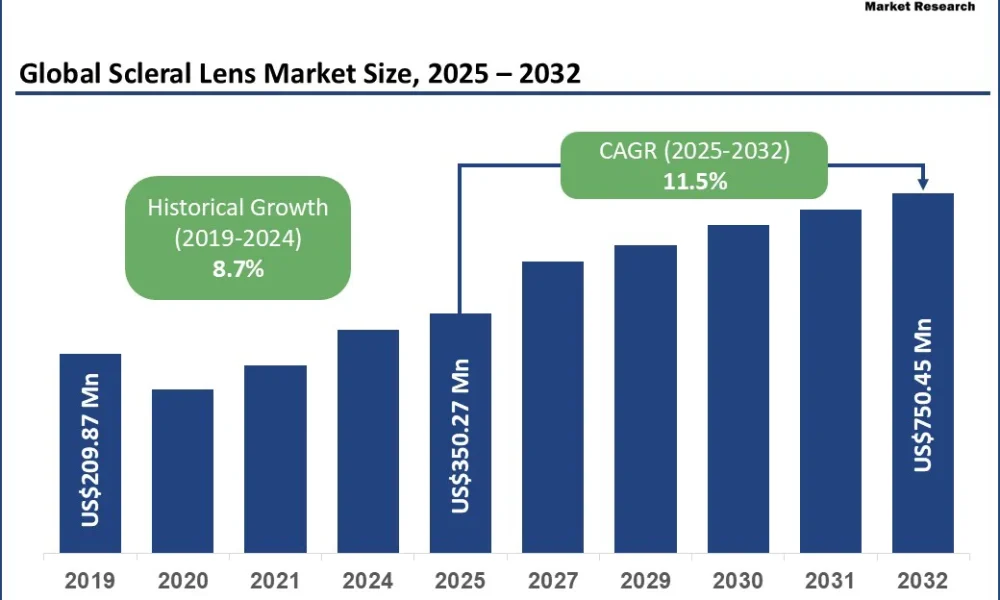
The global scleral lens market is emerging as one of the most dynamic segments within the specialty contact lens industry, reflecting a steady shift toward advanced and therapeutic vision correction solutions. The market is projected to be valued at US$350.27 million in 2025 and is expected to reach US$750.45 million by 2032, expanding at a robust CAGR of 11.5% during the forecast period. Historically, the market registered a CAGR of 8.7% between 2019 and 2024, demonstrating consistent upward momentum driven by clinical demand and technological progress. Unlike conventional soft or rigid lenses that rest directly on the cornea, scleral lenses vault over the corneal surface and rest on the sclera, creating a fluid-filled reservoir that enhances comfort, visual acuity, and therapeutic protection. This structural advantage has positioned scleral lenses as a preferred option for patients with keratoconus, severe dry eye disease, post-corneal transplant recovery, and complex ocular surface disorders.
Market growth is being propelled by rising awareness of specialty eye care, increasing diagnosis rates of corneal irregularities, and the expanding network of trained eye care professionals capable of fitting these lenses. Precision imaging tools such as anterior-segment OCT and corneoscleral topography have significantly improved fitting accuracy, leading to higher first-fit success rates and improved patient satisfaction. Mini-scleral lenses dominate the product landscape with a projected 48.4% share in 2025 due to their optimal balance of performance and user-friendliness. From a materials standpoint, rigid gas permeable (RGP) silicone-acrylate lenses account for approximately 42% of the market, owing to their clinical reliability and cost-effectiveness. Geographically, North America leads the global scleral lens market with a 40.6% share, supported by advanced healthcare infrastructure and strong reimbursement frameworks, while Asia Pacific is poised to register the fastest growth due to rapid urbanization and expanding practitioner training initiatives.
Download Your Free Sample & Explore Key Insights: https://www.persistencemarketresearch.com/samples/35595
Key Highlights from the Report
• The global scleral lens market is projected to grow at a CAGR of 11.5% between 2025 and 2032.
• North America is expected to account for 40.6% of the global market share in 2025.
• Mini-scleral lenses are anticipated to lead the product segment with a 48.4% share.
• RGP silicone-acrylate materials dominate the material segment with nearly 42% share.
• Asia Pacific is projected to be the fastest-growing regional market during the forecast period.
• Digital customization and tele-optometry models are reshaping scleral lens accessibility worldwide.
Market Segmentation
The scleral lens market is segmented primarily by lens type, material type, and end-user application, each playing a crucial role in shaping overall industry dynamics. Based on lens type, the market is categorized into mini-scleral lenses and full scleral lenses. Mini-scleral lenses, typically ranging from 15 mm to 18 mm in diameter, represent the dominant segment. Their popularity stems from a favorable balance between clinical effectiveness and ease of handling. These lenses provide adequate corneal vaulting and maintain a stable tear reservoir, making them highly suitable for moderate keratoconus, irregular corneas, and ocular surface disease management. Their relatively easier insertion and removal processes contribute to higher patient compliance, strengthening their leading market position.
Full scleral lenses, usually measuring between 18 mm and 24 mm in diameter, occupy a smaller yet rapidly expanding segment. These lenses are indispensable in advanced ocular cases such as severe keratoconus, post-surgical ectasia, and significant corneal scarring. Their larger design enables the creation of a substantial fluid reservoir, delivering enhanced therapeutic hydration and mechanical protection to compromised corneal tissues. Technological advancements in high-Dk materials have improved oxygen permeability, alleviating earlier concerns about hypoxia and enabling extended wear in hospital-based ophthalmology departments and tertiary care centers.
From a material perspective, the market is segmented into rigid gas permeable silicone-acrylate lenses and high-Dk fluoro-silicone-acrylate polymers. RGP silicone-acrylate materials dominate due to their long-standing clinical use, dependable oxygen transmission, optical clarity, and cost efficiency. These materials are widely trusted by practitioners and are relatively easier to manufacture at scale, making them a backbone of the scleral lens industry. In contrast, high-Dk fluoro-silicone-acrylate materials represent the fastest-growing category. Offering superior oxygen permeability, these advanced polymers are particularly suited for larger-diameter lenses and prolonged wear schedules. Enhanced surface treatments in this segment reduce lens fogging and deposit accumulation, significantly improving comfort and patient satisfaction in specialty practices.
In terms of end-users, scleral lenses are primarily dispensed through specialty eye care clinics, hospitals, and independent optometry practices. Specialty clinics hold a prominent share due to their expertise in fitting complex lenses and access to advanced imaging tools. Hospitals and academic ophthalmology centers contribute significantly, particularly in managing post-surgical and transplant-related cases. Independent optometrists are gradually increasing adoption rates as digital fitting technologies become more accessible.
Regional Insights
North America dominates the global scleral lens market, driven by advanced clinical infrastructure, widespread practitioner training programs, and strong patient awareness regarding specialty eye care solutions. The United States accounts for a substantial share of prescriptions, supported by research-driven institutions and favorable reimbursement policies that make therapeutic lenses more accessible. Continuous product innovations and early adoption of digital mapping technologies further reinforce the region’s leadership. Canada also demonstrates steady growth, although insurance coverage disparities across provinces create variability in patient access.
Asia Pacific is the fastest-growing regional market, propelled by rapid urbanization, rising disposable incomes, and growing awareness of corneal disorders. Countries such as India and China are investing heavily in practitioner education and pediatric keratoconus screening initiatives. Local manufacturing capabilities in Southeast Asia are strengthening supply chains, reducing production timelines, and enhancing affordability. Although access remains uneven in rural areas, expanding tele-optometry models and digital follow-up consultations are bridging service gaps and supporting accelerated regional expansion.
Europe represents another strong market, characterized by well-established healthcare systems and increasing adoption of precision fitting technologies. Germany, the United Kingdom, and France are among the leading contributors, supported by favorable reimbursement frameworks and academic-industry collaborations. The integration of computer-assisted corneal topography and digital vault design systems has enhanced fitting accuracy and improved clinical outcomes. Private clinics across Western Europe are reporting rising demand for scleral lenses, particularly among patients with keratoconus and severe dry eye disease.
Get Custom Insights Designed for Your Business: https://www.persistencemarketresearch.com/request-customization/35595
Market Drivers
One of the primary drivers of the scleral lens market is the rising prevalence of complex corneal disorders and ocular surface diseases that require specialized intervention. Conditions such as keratoconus, Stevens-Johnson syndrome, graft-versus-host disease, and post-corneal transplant complications necessitate advanced therapeutic solutions beyond conventional contact lenses. Scleral lenses provide a unique advantage through their vaulting design, which creates a continuous fluid reservoir that hydrates and protects the corneal epithelium. This therapeutic function significantly improves comfort and visual acuity while reducing complications associated with epithelial disruption.
Technological advancements in diagnostic imaging are further accelerating market growth. The adoption of anterior-segment OCT and corneoscleral topography has revolutionized scleral lens fitting by enabling highly precise ocular surface mapping. These tools reduce trial-and-error fitting sessions, improve first-fit success rates, and enhance customization capabilities. Growing practitioner training programs and educational initiatives are expanding the pool of professionals skilled in fitting scleral lenses, further supporting market expansion.
Market Restraints
Despite strong growth potential, the scleral lens market faces certain structural and patient-centric challenges. One major restraint is the limited availability of highly trained practitioners proficient in advanced scleral lens fitting techniques, particularly in emerging and rural markets. The complexity of free-form fitting and the need for profilometer-assisted mapping restrict accessibility in regions lacking advanced equipment. This supply-side constraint slows market penetration despite rising patient demand.
Additionally, the usability of scleral lenses can present challenges for certain patients. Their larger diameter requires precise insertion and removal techniques, often involving specialized plungers or manual dexterity methods. Patients with motor impairments or limited hand coordination may find the process cumbersome. Strict cleaning and disinfection protocols further add to the maintenance burden, increasing the risk of non-compliance and potential complications such as microbial keratitis if hygiene standards are not maintained.
Market Opportunities
Significant opportunities lie in digital customization and tele-optometry integration. Advances in 3D printing and impression-based scleral lens design allow for highly personalized vault geometries tailored to individual ocular anatomy. These innovations reduce production timelines and improve fitting accuracy, enabling eye care providers to deliver premium, patient-specific solutions. As digital workflows become more streamlined, scalability across multiple regions becomes increasingly feasible.
The rise of hybrid care models, combining in-clinic initial fittings with virtual follow-ups, is creating new growth avenues, particularly in underserved markets. Tele-optometry consultations facilitate remote monitoring and digital reordering of lenses, enhancing patient convenience while reducing travel-related barriers. Expansion of distribution networks in Asia Pacific, Latin America, and parts of Africa presents untapped potential for manufacturers willing to invest in training infrastructure and local partnerships.
Checkout Now & Download Complete Market Report: https://www.persistencemarketresearch.com/checkout/35595
Company Insights
The scleral lens market is moderately consolidated, with a mix of global ophthalmic leaders and specialized niche laboratories competing through innovation and customization capabilities. Key players operating in the market include:
• Bausch + Lomb
• Visionary Optics
• BostonSight
• ABB Optical Group
• Blanchard Lab (part of CooperVision Specialty EyeCare)
• Art Optical Contact Lens, Inc.
• AccuLens
• EssilorLuxottica
• Menicon Co., Ltd.
• SynergEyes, Inc.
• TruForm Optics, Inc.
• Innovative Sclerals (ISC)
• ALDEN Optical
• Optikal Contact Lens Inc.
• SEED Co., Ltd. (Japan)
• Cantor & Nissel Ltd. (UK)
• Paragon Vision Sciences
• Medmont International
• Contamac Ltd.
• Lagado Corp.
Recent developments highlight ongoing innovation within the market. In May 2025, Bausch + Lomb introduced Zenlens Chroma HOA, a wavefront-guided scleral lens engineered to correct higher-order aberrations such as glare and halos, delivering enhanced visual clarity for patients with complex corneal irregularities. In February 2025, ABB Optical Group launched the DELTA Scleral lens, designed to streamline the fitting process for eye care professionals while improving patient comfort and adaptability.
Conclusion
The global scleral lens market is undergoing a transformative phase, driven by technological innovation, expanding clinical indications, and growing awareness of specialty eye care solutions. With projected revenues rising from US$350.27 million in 2025 to US$750.45 million by 2032 at a CAGR of 11.5%, the market reflects strong and sustainable growth momentum. Mini-scleral lenses and RGP silicone-acrylate materials currently dominate, while high-Dk materials and full scleral lenses are gaining rapid traction. North America remains the leading regional market, supported by advanced infrastructure and reimbursement frameworks, whereas Asia Pacific is positioned as the fastest-growing region due to rising practitioner training and urban healthcare expansion. Although challenges related to specialist availability and usability persist, advancements in digital customization, tele-optometry, and precision imaging technologies are paving the way for scalable global adoption. As innovation continues and access barriers gradually diminish, scleral lenses are set to become an increasingly integral component of modern therapeutic and specialty vision correction practices worldwide.




