
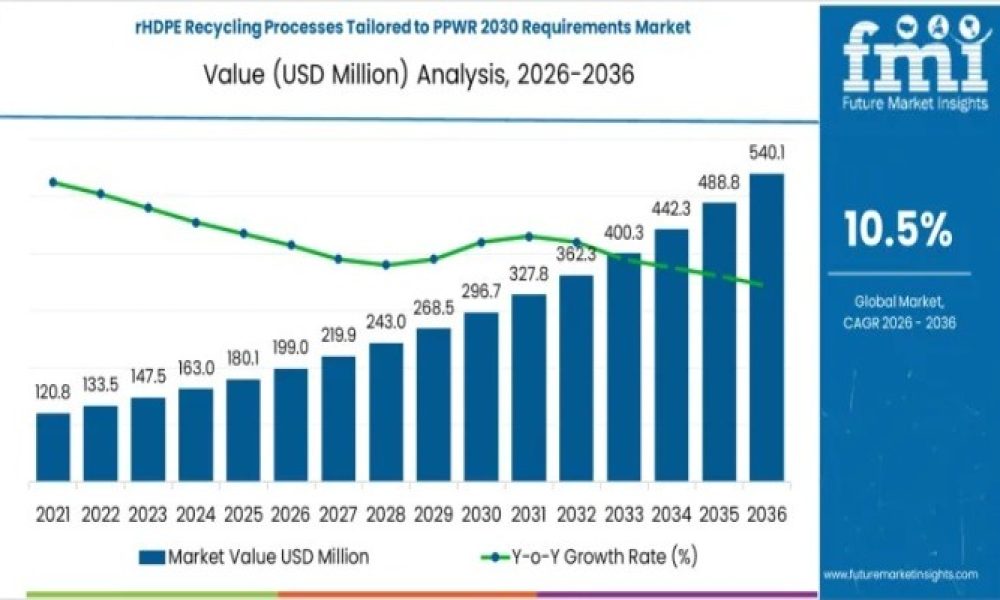
The rHDPE recycling processes tailored to PPWR 2030 requirements market is entering a structurally important decade, shaped less by voluntary sustainability goals and more by enforceable regulatory alignment. Valued at USD 199 million in 2026, the market is projected to reach USD 540.1 million by 2036, expanding at a CAGR of 10.5% as packaging producers, brand owners, and recyclers reposition themselves ahead of the European Union’s Packaging and Packaging Waste Regulation (PPWR) enforcement milestones.
Unlike earlier recycling growth cycles driven primarily by waste availability and throughput expansion, this market is defined by process discipline, certification credibility, and traceable output quality. Facilities investing early in advanced sorting, food-grade decontamination, and digital traceability systems are already achieving lower rejection rates, steadier yields, and stronger pricing leverage.
Margin performance increasingly favors operators that convert regulatory complexity into standardized, audit-ready rHDPE output rather than those focused on maximizing material intake volumes alone.
Unlock Growth Potential – Request Your Sample Now and Explore Market Opportunities!
Market Snapshot: rHDPE Recycling Processes Tailored to PPWR 2030 Requirements
- Market Value (2026): USD 199 million
- Forecast Value (2036): USD 540.1 million
- Forecast CAGR (2026–2036): 10.5%
- Leading Process Type: Mechanical recycling
- Key Growth Regions: Europe, Asia Pacific, North America
- Key Players: Veolia, SUEZ, ALPLA, MBA Polymers, Berry Global
Compliance-Led Growth Outlook Through 2036
Between 2026 and 2031, the market is expected to grow from USD 199 million to USD 321 million, delivering an absolute increase of USD 122 million and accounting for nearly 36% of total forecast expansion. This phase reflects early compliance-driven investment as packaging converters and brand owners align recycling processes with mandatory recycled content thresholds, traceability rules, and food-contact safety expectations. Capital spending during this period concentrates on sorting precision, wash-line upgrades, odor removal, and quality stabilization systems.
From 2031 to 2036, growth accelerates sharply, with the market expanding from USD 321 million to USD 540.1 million, adding USD 219 million and contributing over 64% of total decade growth. This stage coincides with full-scale PPWR enforcement and broader adoption of advanced, compliance-optimized recycling configurations. Pricing power increasingly consolidates among recyclers securing long-term contracts with packaging producers exposed to regulatory enforcement risk.
What Is Reshaping rHDPE Recycling Under PPWR 2030?
Historically, rHDPE recycling largely served non-packaging or downcycled applications, with limited food-contact suitability and inconsistent quality. PPWR requirements are fundamentally changing this dynamic by shifting demand toward high-purity, traceable, and validated recycling processes.
Key regulatory and process shifts include:
- Advanced sorting technologies such as near-infrared (NIR) systems to improve polymer purity
- Hot caustic washing and deodorisation to remove inks, multilayer residues, and odours
- Melt filtration and extrusion upgrades for consistent melt flow and mechanical performance
- Batch-level documentation and digital traceability to support audits and compliance testing
- Process validation protocols aligned with food-contact approval requirements
As a result, growth is increasingly tied to enforcement timelines and procurement mandates rather than voluntary sustainability commitments.
Why Mechanical Recycling Remains Dominant
Mechanical recycling accounts for approximately 55% of total process adoption, making it the leading recycling route within PPWR-aligned rHDPE systems. Its dominance reflects:
- Established infrastructure and predictable cost structures
- Scalability across post-consumer HDPE streams
- Faster deployment timelines compared with emerging chemical routes
- Compatibility with deposit return schemes and municipal collection systems
While purity limits remain, continuous improvements in sorting and washing are expanding the share of mechanically recycled rHDPE suitable for regulated packaging applications.
Food-Grade rHDPE Leads End-Use Demand
Food-grade rHDPE represents around 40% of total end-use demand, making it the largest application segment. This leadership is driven by:
- Mandatory recycled content thresholds for food contact packaging
- High regulatory exposure for bottles, containers, and closures
- Premium pricing and long-term offtake agreements
- Concentrated investment in advanced decontamination and quality assurance
Demand growth in this segment is compliance-driven rather than discretionary, with packaging producers prioritizing certified supply to mitigate regulatory and reputational risk.
Regional and Country-Level Momentum
Demand for PPWR-aligned rHDPE recycling processes is strengthening globally as compliance expectations ripple through international packaging supply chains.
- India leads growth at 10.8% CAGR, driven by export-oriented converters aligning with global brand requirements
- China follows at 9.4% CAGR, supported by large-scale infrastructure upgrades serving regulated export markets
- Brazil grows at 8.9% CAGR, reflecting gradual packaging sector modernization
- UK expands at 8.2% CAGR, aided by early regulatory alignment and stable collection systems
- USA records 7.6% CAGR, driven by multinational brand compliance rather than domestic mandates
Competitive Landscape: Compliance as the Core Differentiator
The competitive structure combines pan-regional recyclers with packaging-integrated processors. Leaders such as Veolia and SUEZ leverage integrated collection, sorting, and reprocessing capabilities aligned with documentation requirements. ALPLA benefits from tight integration with packaging conversion, while MBA Polymers brings expertise in mixed rigid plastics separation. Berry Global reinforces demand pull by integrating compliant rHDPE directly into packaging production.
Across the market, competitive advantage is defined by:
- Regulatory readiness and audit transparency
- Long-term feedstock security
- Consistent food-contact approvals across product lines
- Ability to lock customers into multi-year supply agreements
Why FMI: https://www.futuremarketinsights.com/why-fmi
About Future Market Insights (FMI)
Future Market Insights, Inc. (FMI) is an ESOMAR-certified, ISO 9001:2015 market research and consulting organization, trusted by Fortune 500 clients and global enterprises. With operations in the U.S., UK, India, and Dubai, FMI provides data-backed insights and strategic intelligence across 30+ industries and 1200 markets worldwide.



