
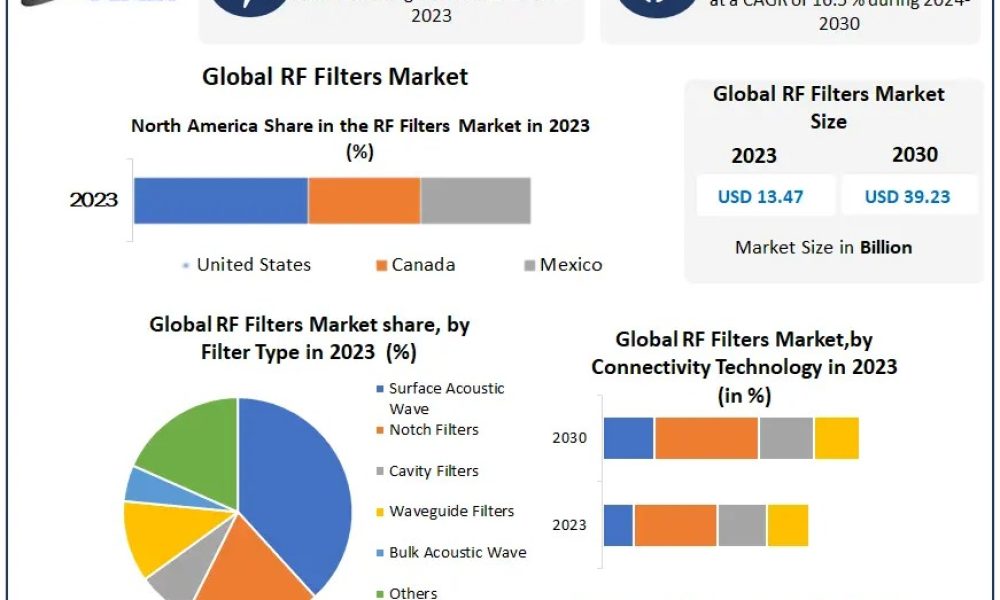
RF Filters Market was valued at USD 13.47 billion in 2023 and is expected to reach USD 39.23 billion by 2030, registering a CAGR of 16.5%. RF filters, designed to operate on signals within the megahertz to gigahertz frequency ranges, play a critical role in wireless communication systems by selectively allowing desired signal frequencies while blocking unwanted components. Their efficiency is essential for maintaining clear and reliable transmissions in smartphone devices, base stations, satellite communications, and electronic warfare systems.
The growing deployment of 5G technology worldwide is the primary growth engine for the RF filters market. Unlike previous generations, 5G networks operate over a broader range of frequencies, requiring more than 50 RF filters per device to manage spectrum use and minimize interference. This places RF filters at the core of achieving high-speed connectivity and seamless user experience. Additionally, these filters are vital in emerging IoT ecosystems, smart cities, and high-frequency satellite Wi-Fi applications.
Among the various RF filter technologies, surface acoustic wave (SAW) filters dominate, owing to their compact size, cost-efficiency, and superior performance up to 3 GHz frequencies. These filters have extensive application in smartphones, radio receivers, and digital TV receivers. Qualcomm’s introduction of ultraSAW filter technology has demonstrated substantial performance enhancements, offering improved selectivity, low insertion loss, and power efficiency, critical for 4G and 5G mobile devices.
Regionally, North America holds the largest market share thanks to aggressive 5G adoption, high mobile internet penetration, and growing deployment of IoT devices across homes, businesses, and industries. The proliferation of video streaming and online gaming further fuels demand for robust RF filtering solutions to ensure uninterrupted connectivity.
For full access to the data, request a sample report now :https://www.maximizemarketresearch.com/request-sample/65144/
Asia Pacific is rapidly emerging as a high-growth market with China leading production and consumption due to its strong semiconductor and electronic manufacturing base. The region benefits from increasing adoption of LTE and VoLTE networks, ongoing 5G infrastructure deployments, and a massive consumer electronics market. The affordability and expansion of high-speed internet access are accelerating smartphone penetration, directly boosting demand for RF filters.
The automotive sector offers new opportunities for RF filters due to the expansion of connected and autonomous vehicles. Vehicles increasingly depend on sophisticated communication systems for GPS navigation, remote diagnostics, in-car entertainment, and vehicle-to-everything (V2X) communication. These functions rely on effective RF filtering to minimize signal interference and maintain communication reliability. Growing foreign investments in U.S. automotive manufacturing plants, particularly from Korean, Japanese, and German companies, underscore the rising local demand for automotive RF filtering solutions tailored to these advanced applications.
However, the high costs of RF filter production and maintenance remain significant barriers, especially for small and medium-sized enterprises. Complex manufacturing processes, the need for advanced materials, and specialized technical support contribute to elevated expenses and operational challenges. Such financial and technical hurdles can restrict more widespread adoption despite the essential role of RF filters.
Leading market players including Skyworks Solutions Inc., Qorvo, Broadcom, Murata Manufacturing, and TDK Corporation are investing heavily in research and development to improve filter performance, reduce size, and cater to the evolving needs of 5G and future wireless networks. They pursue growth strategies involving mergers and acquisitions, collaborations, and regional expansions to maintain competitive edges.
Technological advancements are enabling miniaturization and enhanced integration of RF filters within radio frequency front-end modules (RFFE), allowing device manufacturers to deliver compact, power-efficient, and high-performance communication devices. The trend towards increasingly compact and multifunctional electronics in smartphones, wearables, and IoT gadgets reinforces this miniaturization demand, further driving market expansion.
Looking forward, the RF Filters Market is expected to benefit from the gradual rollout of 6G technology, advancements in millimeter-wave and extremely high-frequency (EHF) bands for communication, and increasing digitalization in smart cities, defense, and satellite communication sectors. The integration of acoustic filters and complex multiplexing techniques will address next-generation data transmission challenges, ensuring RF filters remain pivotal in global wireless technology infrastructure.
In summary, RF filters underpin the continued evolution of wireless communication and digital connectivity. With strong technology innovation, broad adoption across consumer and industrial sectors, and expanding global network infrastructure, the RF Filters Market is on course for sustained, dynamic growth driven by the telecommunications revolution and IoT proliferation.The global RF Filters Market reached a valuation of USD 13.47 billion in 2023 and is projected to grow robustly to USD 39.23 billion by 2030, at a compound annual growth rate (CAGR) of 16.5%. RF filters are crucial electronic components operating within the megahertz to gigahertz frequency ranges, designed to remove unwanted signals and allow desired frequencies to pass. These filters are foundational to maintaining seamless wireless communication across smartphones, 5G base stations, satellite networks, and electronic warfare systems.
Market growth is primarily fueled by the ongoing global deployment of 5G technology, which operates at higher frequencies and wider bandwidths than previous generations. Advanced RF filters are essential in these systems to manage interference, enabling high-speed data transmission and reliable connectivity. Each 5G device may require more than 50 RF filters to handle diversified bands and mitigate cross-signal interference. Furthermore, the rising number of IoT devices and smart technologies drives escalating demand for RF filter solutions that enhance communication stability across homes, industries, and urban infrastructures.
Surface acoustic wave (SAW) filters currently hold the largest market share due to their compact size, cost-effectiveness, and efficient operation up to 3 GHz—ideal for mobile phones and other electronic applications. Qualcomm’s ultraSAW technology exemplifies cutting-edge advancements delivering superior frequency selectivity, low insertion loss, and greater power efficiency needed for 4G and 5G mobile devices.
Regionally, North America dominates, benefiting from early and widespread 5G adoption, expanding IoT presence, advanced infrastructure, and a strong consumer market. The prolific demand for streaming and online gaming also adds pressure for reliable wireless connectivity. On the other hand, Asia Pacific represents a rapidly growing market with huge smartphone manufacturing hubs, accelerating 5G network rollout, and supportive government policies particularly in China, Japan, and South Korea fostering demand for sophisticated RF filtering.
The automotive sector is a notable growth avenue, with connected and autonomous vehicles requiring advanced RF solutions for GPS, V2X communications, remote diagnostics, infotainment, and safety systems. Significant foreign direct investments by Korean, Japanese, and German manufacturers in U.S. automotive plants are stimulating demand for tailored automotive-grade RF filters.
Cost and complexity impede broader RF filter adoption among small and medium enterprises, as manufacturing demands specialized materials, intricate processes, and technical support, which increase expenditure. However, ongoing research and innovation by market leaders like Skyworks Solutions, Qorvo, Broadcom, Murata Manufacturing, and TDK Corporation are advancing filter miniaturization, power handling, and integration within radio frequency front-end modules (RFFE), effectively meeting modern device requirements.
Looking ahead, the RF Filters Market is poised to benefit from evolving wireless technologies such as 6G, orbital satellite communications, and the expansion of smart cities, defense, and millimeter-wave systems. The essential role of advanced acoustic filters and multiplexing techniques will expand as data and connectivity demands intensify.
In summary, RF filters are indispensable to the future of wireless communications, driving the digital transformation of nearly all connected devices. Supported by deepening innovations and growing adoption across industries, the RF Filters Market is well-positioned to sustain significant growth aligned with next-generation networks and dense communication ecosystems globally.




