
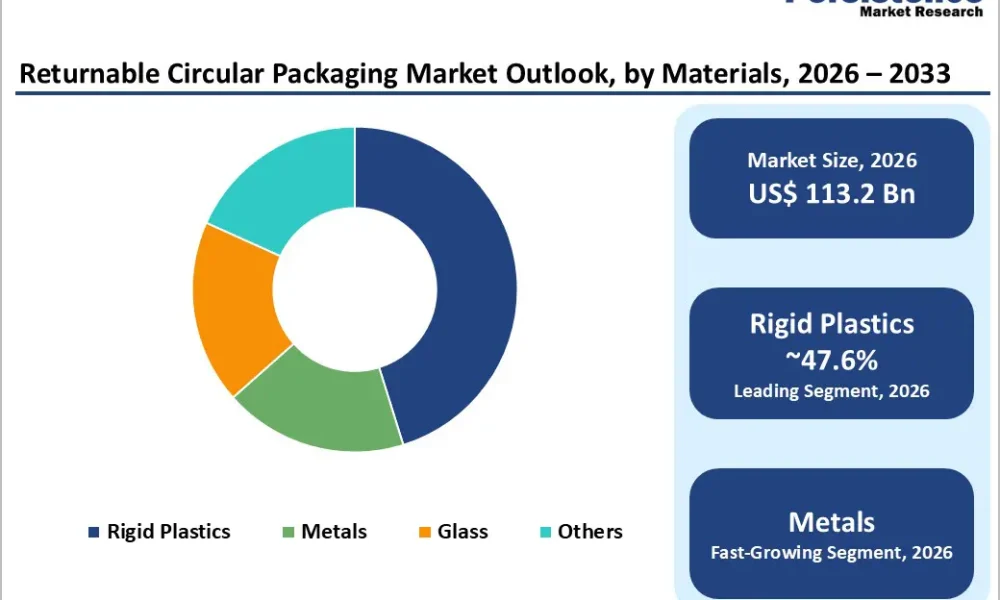
The returnable circular packaging market is emerging as a critical pillar of the global shift toward sustainable and resource efficient packaging systems. This market focuses on reusable containers designed for multiple lifecycle uses across supply chains, helping manufacturers and brand owners reduce waste generation while improving long term operational efficiency. Industries such as food and beverages, consumer goods, chemicals, and pharmaceuticals are increasingly adopting returnable circular packaging to align with environmental regulations and corporate sustainability goals.
According to Persistence Market Research, the global returnable circular packaging market size is likely to be valued at US$113.2 billion in 2026 and is expected to reach US$174.8 billion by 2033, growing at a CAGR of 6.4% between 2026 and 2033. This growth is driven by regulatory pressure to reduce single use packaging, manufacturer commitments to reuse and refill systems, and measurable cost efficiency gains from pooled logistics models. Durable packaging formats with longer service life cycles are gaining preference as companies seek both economic and environmental benefits.
One Click to Access Your Free Sample Report : https://www.persistencemarketresearch.com/samples/36013
Key Growth Drivers, Leading Segment, and Leading Region
One of the key growth drivers behind the returnable circular packaging market is the increasing enforcement of packaging waste reduction policies across developed and emerging economies. Governments are encouraging businesses to adopt reusable packaging systems to meet extended producer responsibility norms. Manufacturers are also realizing tangible cost savings through reduced material consumption and optimized logistics operations enabled by returnable packaging.
The leading segment in the market is industrial and bulk returnable packaging due to its high reuse rate and strong demand from manufacturing and logistics intensive industries. The leading geographical region is Europe, supported by stringent environmental regulations, advanced recycling infrastructure, and early adoption of circular economy models. European manufacturers have been proactive in integrating returnable packaging into closed loop supply chains, accelerating regional market growth.
Key Highlights from the Report
➤ The returnable circular packaging market is projected to show steady expansion through 2033 driven by sustainability mandates
➤ Regulatory pressure to eliminate single use packaging remains a primary market catalyst
➤ Pooled logistics and shared packaging systems are improving cost efficiency for end users
➤ Industrial applications dominate demand due to higher durability and reuse potential
➤ Europe leads adoption owing to strong circular economy frameworks
➤ Long term environmental and economic benefits are accelerating enterprise level adoption
Market Segmentation
The returnable circular packaging market is segmented based on product type into pallets, crates, containers, drums, and intermediate bulk containers. Among these, reusable pallets and containers hold a significant share due to their widespread use across logistics and manufacturing supply chains. These products offer high load bearing capacity and extended lifecycle benefits, making them suitable for repeated transportation and storage operations.
Based on end user, the market is segmented into food and beverages, consumer goods, industrial manufacturing, chemicals, and pharmaceuticals. The food and beverages segment represents a major share due to rising demand for refill and reuse models in distribution systems. Industrial manufacturing also contributes significantly as companies seek durable packaging solutions that support closed loop logistics and minimize packaging related waste.
Make This Report Fit Your Needs – Customize Now : https://www.persistencemarketresearch.com/request-customization/36013
Regional Insights
Europe continues to dominate the returnable circular packaging market due to strict environmental regulations and well established reverse logistics systems. The region benefits from strong collaboration between manufacturers, packaging providers, and logistics companies, enabling efficient reuse cycles and high return rates.
North America is witnessing growing adoption driven by corporate sustainability initiatives and increasing awareness of packaging waste reduction. Asia Pacific is gradually emerging as a high potential region as manufacturers invest in reusable packaging to improve supply chain efficiency and comply with evolving environmental standards.
Market Drivers
The primary market driver is increasing regulatory pressure to curb packaging waste and promote circular economy practices. Governments across regions are mandating reductions in single use plastics, encouraging companies to adopt returnable packaging solutions. These policies are reshaping packaging strategies across multiple industries.
Another significant driver is the economic advantage offered by returnable circular packaging. Over multiple use cycles, reusable packaging delivers lower total cost of ownership compared to disposable alternatives. Businesses benefit from reduced material procurement costs, optimized transportation, and improved inventory control, making returnable systems financially attractive.
Market Restraints
High initial investment costs act as a key restraint for the returnable circular packaging market. Setting up reusable packaging systems requires upfront capital for durable packaging assets, tracking technologies, and reverse logistics infrastructure, which may deter small and medium enterprises.
Operational complexity is another limiting factor, as managing returnable packaging involves coordination across supply chains. Issues such as asset loss, cleaning requirements, and inefficient return rates can reduce the overall effectiveness of reuse systems if not managed properly.
Market Opportunities
The market presents strong opportunities through the integration of digital tracking and smart logistics solutions. Technologies such as RFID and IoT enable better asset visibility, reduce loss rates, and improve operational efficiency, making returnable packaging systems more scalable.
Growing corporate commitments to sustainability and net zero goals are also creating new opportunities. As companies increasingly adopt reuse and refill business models, demand for standardized and durable returnable packaging solutions is expected to rise steadily over the forecast period.
Complete Your Order – Get Full Report Immediately : https://www.persistencemarketresearch.com/checkout/36013
Company Insights
Key players operating in the returnable circular packaging market include
- Brambles/CHEP
- IFCO Systems
- Schoeller Allibert
- ORBIS Corporation
- Schütz GmbH
- Greif
- Loscam
- Mauser/Mauser Packaging Solutions
- Rehrig Pacific
- Owens-Illinois (O-I Glass)
- Paccor Group
- Plastic Logic
- ALPLA Group
- Hartwall
- RPC Group
- Cabka Group
- SSI Schaefer
- IPL Group
Recent developments include expanded pooled packaging programs introduced in March 2024 and strategic investments in reusable packaging assets announced in September 2023 to support circular logistics models.
Future Opportunities and Growth Prospects
The future of the returnable circular packaging market remains promising as sustainability transitions accelerate across industries. Continued regulatory support, advancements in logistics technology, and growing corporate accountability are expected to strengthen adoption. As reuse systems become more standardized and cost effective, the market is likely to witness sustained growth and deeper integration into global supply chains.




