
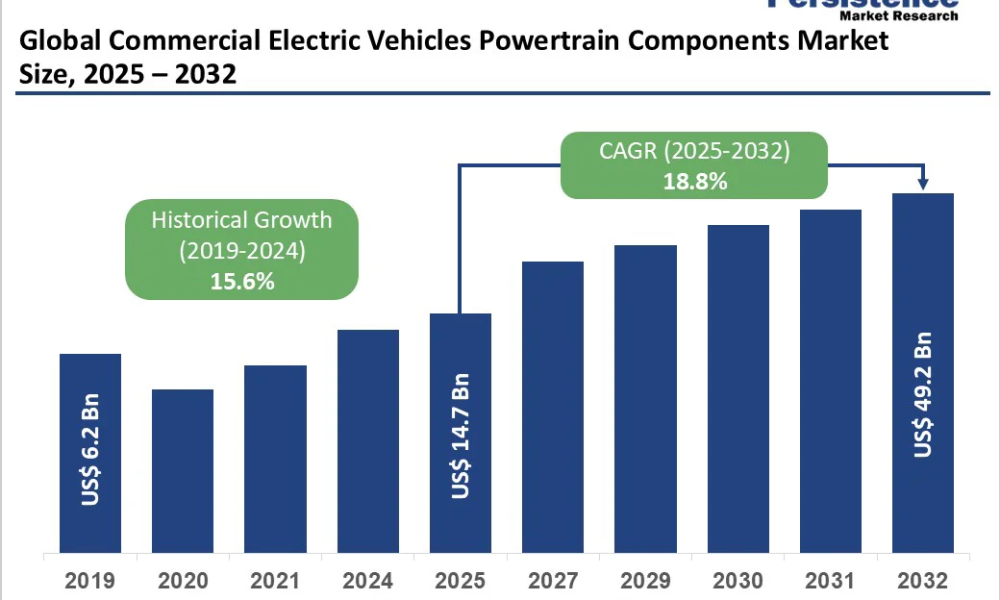
The global Commercial Electric Vehicles (CEVs) Powertrain Components Market is undergoing a period of accelerated transformation, driven by the rapid electrification of commercial fleets, tightening emission regulations, and continuous advancements in electric powertrain technologies. According to consolidated insights from leading market research firms, the market is valued at US$ 14.7 billion in 2025 and is projected to reach US$ 49.2 billion by 2032, expanding at a robust compound annual growth rate (CAGR) of 18.8% during the forecast period from 2025 to 2032.
This substantial growth trajectory reflects the increasing penetration of electric drivetrains in light, medium, and heavy commercial vehicles, including buses, trucks, vans, and specialty utility vehicles. Governments and private fleet operators are prioritizing electrification to reduce total cost of ownership (TCO), achieve carbon neutrality targets, and comply with stringent environmental mandates. The powertrain, being the core functional system of electric commercial vehicles, has emerged as a focal point of innovation and investment.
Market growth is further supported by continuous improvements in battery technology, including higher energy density, longer lifecycle performance, fast-charging capabilities, and the integration of modular e-axle systems. These advancements enhance vehicle efficiency, payload capacity, and operational uptime—critical performance parameters for commercial applications. Additionally, declining battery costs and economies of scale in power electronics manufacturing are making electric powertrain components increasingly cost-competitive with conventional internal combustion engine (ICE) systems.
Get Your FREE Sample Report Instantly Click Now: https://www.persistencemarketresearch.com/samples/35662
Market Segmentation
By Component Type
- Electric Motor
- Battery Pack
- Battery Management System (BMS)
- Inverter (DC-AC converter)
- On-Board Charger
- Transmission system
- Electronic Controllers
- Engine with internal combustion (ICE)
- Hydrogen Fuel Cell
- Hydrogen Tanks
- Others
By Propulsion Type
- Battery Electric Vehicles (BEVs)
- Plug-in Hybrid Electric (PHEVs)
- Hybrid Electric Vehicles (HEVs)
- Fuel Cell Electric Vehicles (FCEVs)
By Vehicle Type
- Electric Three Wheelers (e-3Ws)
- Electric Bus (e-Bus)
- Electric Trucks (e-Trucks)
- Light-Duty
- Medium-Duty
- Heavy-Duty
By Region
- North America
- Europe
- East Asia
- South Asia Oceania
- Latin America
- Middle East Africa
Regional Insights
Regionally, the commercial electric vehicles powertrain components market is segmented into Asia Pacific, Europe, North America, Latin America, and the Middle East & Africa. Asia Pacific emerges as the leading regional market, accounting for a significant share of global revenue. This dominance is attributed to large-scale electric bus and truck deployments in countries such as China, strong domestic manufacturing capabilities, and extensive government subsidies for electric commercial vehicles.
China remains the epicenter of global electric commercial vehicle production, supported by vertically integrated supply chains for batteries, motors, and power electronics. Additionally, increasing electrification mandates across Southeast Asia are reinforcing regional market expansion.
Europe is identified as the fastest-growing region during the forecast period. Aggressive emission reduction targets, city-level diesel bans, and the expansion of low-emission zones are accelerating the transition to electric commercial fleets. Substantial investments in charging infrastructure and localized powertrain manufacturing are further strengthening Europe’s growth outlook. North America also presents strong growth potential, driven by corporate sustainability commitments, electrified logistics fleets, and federal incentives supporting clean transportation technologies.
Customize This Report for Your Exact Requirements: https://www.persistencemarketresearch.com/request-customization/35662
Unique Features and Innovations in the Market
The modern commercial electric vehicles powertrain components market is characterized by rapid innovation aimed at maximizing efficiency, durability, and integration. One of the most defining trends is the shift toward highly integrated powertrain architectures, such as e-axles and modular drive units, which reduce component count and optimize packaging flexibility for vehicle manufacturers.
Advanced digitalization technologies are also reshaping the market landscape. Artificial intelligence (AI) is increasingly used in motor control algorithms, predictive maintenance systems, and energy management software to optimize power delivery and extend component lifespan. Internet of Things (IoT) connectivity enables real-time monitoring of powertrain performance, battery health, and thermal conditions, supporting proactive maintenance and minimizing vehicle downtime.
The integration of 5G-enabled communication systems is further enhancing fleet-level optimization by enabling high-speed data exchange between vehicles, charging infrastructure, and fleet management platforms. These innovations are particularly valuable for commercial operators seeking to improve asset utilization and reduce operating costs. Additionally, advancements in silicon carbide (SiC) and gallium nitride (GaN) power semiconductors are improving inverter efficiency and reducing energy losses across the powertrain.
Market Highlights
The adoption of commercial electric vehicles powertrain components is being driven by a convergence of economic, regulatory, and sustainability factors. Fleet operators are increasingly attracted to electric powertrains due to their lower total cost of ownership, stemming from reduced fuel expenses, fewer moving parts, and lower maintenance requirements compared to ICE-based systems. Over the vehicle lifecycle, these cost advantages significantly offset higher upfront investment.
Regulatory frameworks play a pivotal role in accelerating market adoption. Governments worldwide are implementing stringent emission standards, offering purchase incentives, and mandating zero-emission fleet targets for public transport and logistics providers. These policies are creating a favorable environment for powertrain component manufacturers and encouraging long-term investment in electrification technologies.
Sustainability objectives are also central to market growth. As corporations commit to carbon neutrality and ESG goals, electrified commercial fleets equipped with advanced powertrain systems are becoming a strategic priority. This alignment between environmental responsibility and operational efficiency continues to reinforce demand across industries.
Key Players and Competitive Landscape
The commercial electric vehicles powertrain components market is moderately consolidated, with global automotive suppliers and specialized electric drivetrain manufacturers competing on technology innovation, scalability, and regional expansion. Leading players are focusing on strategic partnerships with OEMs, localized manufacturing, and continuous product enhancement.
✦ Bosch – Leveraging its expertise in power electronics and electric motors, Bosch is expanding its integrated e-axle and inverter portfolio for commercial vehicles, with a strong focus on energy efficiency and scalability.
✦ ZF Friedrichshafen AG – ZF is investing heavily in modular electric drive systems and next-generation transmissions, targeting heavy-duty trucks and buses across Europe and North America.
✦ Continental AG – The company emphasizes intelligent power electronics and software-driven powertrain solutions, integrating digital technologies to enhance system performance and reliability.
✦ Dana Incorporated – Dana specializes in e-axles and electric drive systems for medium and heavy commercial vehicles, focusing on high-torque applications and durability.
✦ BorgWarner Inc. – BorgWarner continues to expand its electric propulsion portfolio through acquisitions and R&D, offering scalable motor and inverter solutions for global OEMs.
✦ Nidec Corporation – Nidec is strengthening its position in high-efficiency electric motors and integrated drive modules, particularly for Asia Pacific markets.
Recent Developments
- Several leading manufacturers have announced the launch of next-generation integrated e-axle platformsdesigned specifically for heavy commercial vehicles, offering higher power density and reduced system weight.
- Strategic collaborations between powertrain component suppliers and battery manufacturers have been established to accelerate the development ofhigh-voltage architectures and fast-charging compatible systems for long-haul electric trucks.
Ready to Dive Deep? Buy Full Report Today: https://www.persistencemarketresearch.com/checkout/35662
Future Opportunities and Growth Prospects
The future outlook for the commercial electric vehicles powertrain components market remains highly optimistic. Continued advancements in battery chemistry, power electronics, and digital control systems are expected to unlock new performance benchmarks and application areas. The expansion of megawatt-level charging infrastructure will further enable electrification of heavy-duty and long-distance commercial transport, creating new demand for robust and high-capacity powertrain components.
Evolving regulatory landscapes will continue to shape industry dynamics, with zero-emission mandates and carbon pricing mechanisms accelerating the retirement of ICE-based fleets. Additionally, increased standardization of powertrain architectures and modular platforms will reduce development costs and shorten time-to-market for OEMs.
As technology maturity increases and supply chains become more resilient, the commercial electric vehicles powertrain components market is set to play a critical role in the global transition toward sustainable and efficient transportation systems, positioning itself as a cornerstone of the next-generation commercial mobility ecosystem.




