
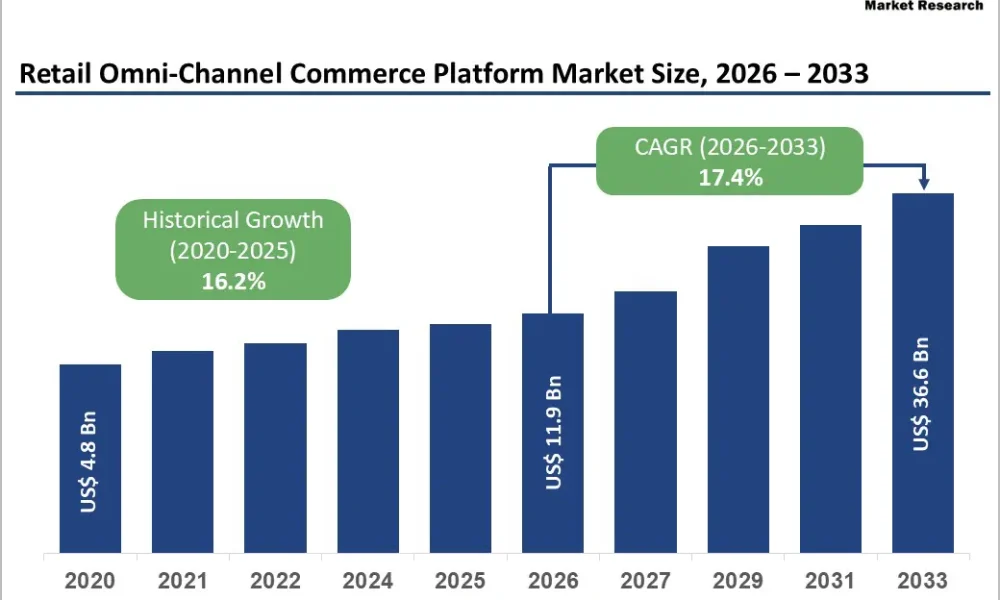
The retail landscape is undergoing a profound transformation, driven by evolving consumer expectations, rapid digitalization, and the convergence of physical and online shopping experiences. At the heart of this transformation lies the retail omni-channel commerce platform market, which is projected to grow from US$11.9 billion in 2026 to US$36.6 billion by 2033, expanding at a robust CAGR of 17.4%.
Retailers today are no longer operating in siloed environments. Instead, they are adopting unified commerce strategies that integrate digital storefronts, mobile applications, social media channels, and brick-and-mortar stores into a seamless ecosystem. This shift is fueling demand for advanced omni-channel commerce platforms that enable real-time data synchronization, personalized experiences, and efficient order fulfillment.
Understanding Omni-Channel Commerce Platforms
Omni-channel commerce platforms are integrated software solutions that unify all retail touchpoints into a single, cohesive system. Unlike multi-channel strategies, which manage channels independently, omni-channel platforms ensure consistent customer experiences across all interactions.
These platforms provide functionalities such as:
- Unified inventory management
- Centralized customer data platforms
- Real-time order tracking
- Cross-channel promotions and pricing
- Flexible fulfillment options like BOPIS (Buy Online, Pick Up In Store)
By bridging the gap between digital and physical retail, omni-channel platforms empower businesses to deliver frictionless and personalized shopping journeys.
Market Growth Drivers
Rising Demand for Seamless Customer Experiences
Modern consumers expect convenience, speed, and personalization. They want the ability to browse products online, check availability in nearby stores, make purchases through mobile apps, and return items at physical locations—all without disruption.
Omni-channel shoppers tend to spend more and exhibit higher brand loyalty compared to single-channel customers. This behavioral shift is compelling retailers to invest in unified commerce platforms that synchronize customer data, order history, and engagement across all touchpoints.
Features such as curbside pickup, same-day delivery, and personalized recommendations are becoming standard expectations, further accelerating platform adoption.
Expansion of Cloud-Based and Composable Architectures
The growing adoption of cloud-based (SaaS) solutions is another major growth driver. Cloud platforms offer scalability, flexibility, and cost efficiency, allowing retailers to quickly adapt to changing market conditions.
Composable commerce, built on API-first and microservices architectures, is gaining traction. These systems allow retailers to integrate best-in-class services such as:
- AI-powered search
- Payment gateways
- Headless storefronts
- Customer analytics tools
This modular approach reduces time-to-market, enhances innovation, and enables retailers to create customized solutions tailored to their specific needs.
Growth of E-Commerce and Digital Payments
The rapid expansion of e-commerce, especially in emerging markets, is significantly boosting the demand for omni-channel platforms. Increasing smartphone penetration and the widespread adoption of digital payment systems are enabling consumers to shop anytime, anywhere.
Retailers are leveraging omni-channel solutions to integrate online marketplaces, social commerce, and physical stores into a unified ecosystem, ensuring consistent experiences and efficient operations.
Market Restraints
Integration Complexity with Legacy Systems
Despite its advantages, implementing omni-channel commerce platforms can be challenging. Many established retailers rely on legacy systems such as ERP, POS, and warehouse management software that are often fragmented and heavily customized.
Integrating these systems into a unified platform requires:
- Extensive data harmonization
- Middleware solutions
- Custom development
This increases implementation costs and timelines, particularly for small and medium-sized retailers with limited IT resources.
Data Privacy and Security Concerns
Omni-channel platforms handle vast amounts of sensitive customer data, including payment information, personal details, and behavioral insights. This makes them vulnerable to cyber threats and data breaches.
Compliance with global regulations such as GDPR and regional data protection laws requires significant investment in:
- Encryption technologies
- Secure architectures
- Access control systems
These challenges can slow adoption rates and increase operational costs for retailers.
Emerging Opportunities
AI-Driven Personalization and Intelligent Inventory Management
Artificial intelligence is revolutionizing omni-channel commerce by enabling advanced personalization and data-driven decision-making.
Retailers are increasingly adopting AI-powered tools for:
- Product recommendations
- Dynamic pricing
- Intelligent search
- Demand forecasting
Personalized experiences can increase sales by 10–15% while improving customer engagement and retention.
Additionally, AI-driven inventory management systems optimize stock allocation across warehouses and stores, reducing stockouts and overstock situations.
Growing Adoption Among Mid-Sized Retailers
While large enterprises currently dominate the market, mid-sized retailers represent a significant growth opportunity. Cloud-based platforms with modular capabilities allow these businesses to implement omni-channel strategies without heavy upfront investments.
In emerging markets such as India, Southeast Asia, and Latin America, government initiatives promoting digitalization and cashless economies are accelerating adoption. Retailers in these regions are leveraging omni-channel platforms to compete with larger players and expand their market reach.
Category-Wise Market Insights
Component Analysis
The software segment leads the market, accounting for approximately 68% share, driven by demand for:
- Commerce engines
- Customer data platforms
- Real-time analytics
- Order management systems
Meanwhile, the services segment is the fastest-growing, fueled by increasing demand for system integration, customization, and support services.
Deployment Model Analysis
Cloud-based (SaaS) deployment dominates with around 64% market share, offering:
- Scalability
- Cost efficiency
- Faster implementation
Hybrid and API-first models are gaining momentum, enabling retailers to combine cloud flexibility with on-premise capabilities.
Service Type Analysis
System integration services hold the largest share due to the need to connect multiple systems such as ERP, CRM, and POS. However, customization and development services are growing rapidly as retailers seek tailored solutions to enhance customer experiences.
Enterprise Size Analysis
Large enterprises account for nearly 55% of the market, leveraging advanced platforms to manage complex operations. However, mid-sized retailers are the fastest-growing segment, driven by accessible cloud solutions and increasing digital maturity.
Vertical Analysis
The apparel and footwear segment leads with approximately 29% share, as fashion retailers rely heavily on omni-channel strategies for product discovery, personalization, and flexible returns.
Other fast-growing verticals include:
- FMCG
- Consumer electronics
These sectors are adopting omni-channel platforms to improve supply chain efficiency and customer engagement.
Regional Insights
North America
North America remains the dominant market, accounting for 38.4% share. The region benefits from:
- Advanced digital infrastructure
- High e-commerce penetration
- Early adoption of AI-driven solutions
Retailers are leveraging omni-channel platforms to enhance customer experiences and optimize operations.
Europe
Europe is a mature market with strong adoption across countries such as Germany, the UK, and France. The region emphasizes data privacy and compliance, driving demand for secure and compliant platforms.
Click-and-collect, cross-border e-commerce, and localized experiences are key trends shaping the market.
Asia Pacific
Asia Pacific is the fastest-growing region, holding approximately 34.8% share. Growth is driven by:
- Rapid urbanization
- Rising middle-class population
- Expansion of digital payments
Countries like China and India are leading the adoption of omni-channel commerce, supported by government initiatives and technological advancements.
Competitive Landscape
The retail omni-channel commerce platform market is moderately competitive, featuring a mix of global technology giants and specialized vendors. Companies compete based on:
- Platform capabilities
- Scalability
- AI integration
- Industry-specific solutions
Strategic partnerships, acquisitions, and continuous innovation are key strategies adopted by market players to strengthen their position.
Emerging vendors are focusing on composable architectures and rapid deployment models to attract small and mid-sized retailers.
Key Market Developments
Recent developments highlight the growing importance of AI and integration in omni-channel commerce:
- Enhanced AI-powered features for personalized shopping experiences
- Improved inventory optimization tools for real-time stock management
- Advanced POS systems and unified dashboards for seamless operations
These innovations are enabling retailers to deliver superior customer experiences while improving operational efficiency.
Future Outlook
The future of the retail omni-channel commerce platform market is highly promising, driven by continuous technological advancements and evolving consumer expectations.
Key trends shaping the future include:
- Increased adoption of AI and machine learning
- Growth of headless and composable commerce
- Expansion of social and conversational commerce
- Integration of augmented reality (AR) and virtual reality (VR)
Retailers that embrace these innovations will be better positioned to deliver differentiated experiences and achieve sustainable growth.
Conclusion
The retail omni-channel commerce platform market is at the forefront of the digital retail revolution. With a projected value of US$36.6 billion by 2033, the market is poised for significant expansion, driven by the need for seamless, personalized, and integrated shopping experiences.
While challenges such as integration complexity and data security persist, the benefits of omni-channel commerce far outweigh the risks. Retailers that invest in modern, cloud-based, and AI-driven platforms will gain a competitive edge, enhance customer satisfaction, and unlock new revenue opportunities.
As the boundaries between online and offline retail continue to blur, omni-channel commerce platforms will play a critical role in shaping the future of global retail.
Related Reports:




