

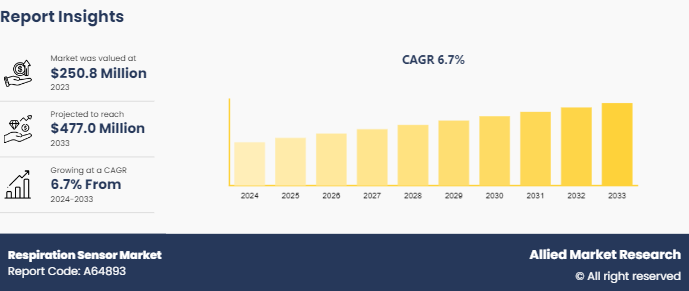
Allied Market Research published a report, titled ”Respiration Sensor Market by Type (Wired and Wireless), Usage (Single Purpose and Multi-Purpose), and Application (Hospitals, Clinics, and Others): Global Opportunity Analysis and Industry Forecast, 2024-2033″. According to the report, the respiration sensor market was valued at $250.8 million in 2023 and is estimated to reach $477.0 million by 2033, growing at a CAGR of 6.7% from 2024 to 2033.
Download Research Report Sample & TOC: https://www.alliedmarketresearch.com/request-sample/A64893
Respiration sensors play a crucial role in managing chronic obstructive pulmonary disease (COPD) and other respiratory conditions by enabling timely monitoring of lung function and detecting changes in breathing patterns. As the global burden of COPD is projected to increase significantly by 2050, the demand for respiration sensors for effective management and intervention is expected to rise in the upcoming years. Restraints for respiration sensors include limitations in sensing range, susceptibility to interference in environments with high signal activity, and potential challenges in achieving reliable performance in settings with significant interference. In addition, the need for complex infrastructure, such as reconfigurable metasurfaces, may pose practical implementation challenges. Advancements in wearable breath sensors offer promising opportunities for continuous monitoring of respiratory parameters such as airflow, temperature, and humidity. Integration of flexible sensors into face masks or patches enables seamless tracking of key respiratory metrics, providing valuable insights into respiratory health. These sensors hold potential for enhancing disease diagnosis, management, and personalized healthcare through real-time data collection and analysis.
Based on type, the wireless sub-segment is expected to grow faster during the forecast period.
Wireless respiration sensors are gaining huge popularity as they facilitate continuous health monitoring outside traditional clinical settings. These sensors offer real-time data collection, enabling timely intervention and diagnosis of respiratory conditions. Integrating multiple modalities, such as acoustics and biopotentials, enhances the sensor’s capability to monitor cardiovascular and respiratory activity comprehensively. In addition, the compact, wearable design ensures convenience and comfort for users, facilitating long-term monitoring compared to wired sensors.
Based on usage, the multi-purpose sub-segment is projected to grow faster during the forecast period.
Multi-purpose respiration sensors offer a transformative approach to health monitoring, providing vital information for the diagnosis and treatment of respiratory ailments. For instance, multi-purpose respiration sensors can effectively monitor multiple health aspects, namely respiration rate, sleep tracking, sports performance, and others. By integrating stretchable and wearable technologies, these sensors ensure convenience, durability, and high precision. The innovative design, exemplified by the retractable self-powered sensor (RSPS), combines interdigital electrode structures with flexible circuit boards, enabling continuous monitoring of respiratory rate, apnea, and ventilation with exceptional sensitivity and durability.
Based on the application, the hospital sub-segment is predicted to grow faster during the forecast period.
Hospitals are major end-users of respiration sensors owing to the high volume of patients requiring respiratory monitoring, including those with chronic conditions like asthma, COPD, and sleep apnea, as well as patients undergoing surgery or intensive care. Also, hospitals prioritize patient safety and quality of care, necessitating continuous monitoring of vital signs such as respiration rate and pattern.
Based on region, Asia-Pacific is anticipated to show the fastest growth during the forecast period.
The demand for respiration sensors in Asia-Pacific countries is notably high due to several compelling factors. With an estimated 1.7 billion people in the region suffering from respiratory diseases pose significant health burdens, with tuberculosis (TB), COPD, lung cancer, and respiratory infections being major concerns. Moreover, Asia-Pacific has witnessed outbreaks of infectious diseases such as influenza and severe acute respiratory syndrome (SARS), emphasizing the critical need for continuous monitoring and early detection facilitated by respiration sensors. In addition, increasing industrialization and urbanization contribute to rising air pollution levels, further intensifying respiratory issues.
Respiration Sensor Market Key Players
- Medtronic
- Koninklijke Philips N.V.
- Siemens Medical Solutions USA, Inc.
- NIHON KOHDEN CORPORATION
- Merck & Co., Inc.
- Sirnaomics
- GE HealthCare
- OMRON Corporation
- Smiths Medical
- ResMed
The report provides a detailed analysis of these key players in the global respiration sensor market. These players have adopted different strategies, such as new product launches, collaborations, expansion, joint ventures, agreements, and other,s to increase their Respiration Sensor market share and maintain dominant shares in different regions.
Inquiry before Buying: https://www.alliedmarketresearch.com/purchase-enquiry/A64893
Recent Industry Developments
- On June 14, 2024, Apple has advanced its Apple Watch’s health capabilities with a new patent application revealing systems for monitoring respiratory parameters using impedance-based measurements. This technology includes electrodes on the watch band to measure electrical signals from the user and determine respiratory cycles. This innovation aims to enhance user health monitoring, potentially enabling features like tracking breathing rates.
- In February 2024, IIT Jodhpur introduced India’s first ‘Make in India’ breath sensor, capable of detecting alcohol and respiratory diseases like asthma and COPD. The sensor, based on metal oxides and nano silicon, operates at room temperature, offering a plug-and-play solution. With potential applications in drunk driving prevention and disease diagnosis, the device utilizes machine learning algorithms to analyze breath patterns. This innovation holds promise for healthcare, wearable technology, and IoT applications.
Key Benefits for Stakeholders
- This report provides a quantitative analysis of the Respiration Sensor market segments, current trends, estimations, and dynamics of the respiration sensor market from 2023 to 2033 to identify the prevailing respiration sensor market share by companies.
- The Respiration Sensor market research is offered along with information related to key drivers, restraints, and opportunities.
- Porter’s five forces analysis highlights the potency of buyers and suppliers to enable stakeholders to make profit-oriented business decisions and strengthen their supplier-buyer network.
- In-depth analysis of the respiration sensor market segmentation helps determine the prevailing Respiration Sensor market opportunities.
- Major countries in each region are mapped according to their revenue contribution to the global market.
- The respiration sensor company list offers detailed player positioning that facilitates benchmarking and provides a clear understanding of the present position of the market players.
About Us:
Allied Market Research is a top provider of market intelligence that offers reports from leading technology publishers. Our in-depth market assessments in our research reports take into account significant technological advancements in the sector. In addition to other areas of expertise, AMR focuses on the analysis of high-tech systems and advanced production systems. We have a team of experts who compile thorough research reports and actively advise leading businesses to enhance their current procedures. Our experts have a wealth of knowledge on the topics they cover. Also, they use a variety of tools and techniques when gathering and analyzing data, including patented data sources.
Contact Us:
David Correa
1209 Orange Street,
Corporation Trust Center,
Wilmington, New Castle,
Delaware 19801 USA.
Int’l: +1-503-894-6022
Toll Free: +1-800-792-5285
Fax: +1-800-792-5285
[email protected]




