
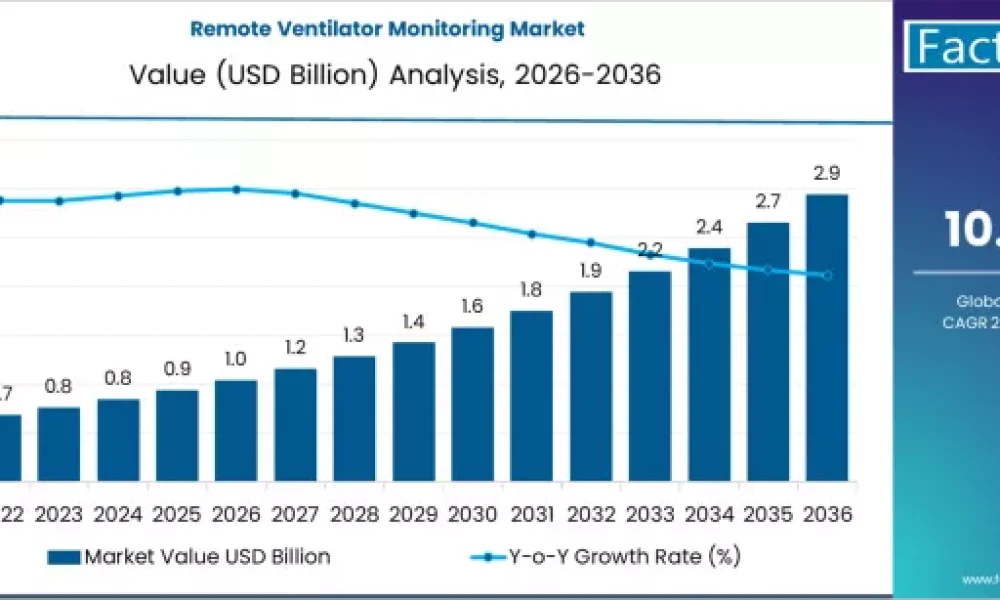
The global remote ventilator monitoring market is entering a decade of high-velocity growth, with its valuation projected to surge from USD 1.0 billion in 2026 to USD 2.9 billion by 2036. According to specialized industry analysis, this represents an aggressive compound annual growth rate (CAGR) of 10.9%, as healthcare systems move beyond traditional hospital walls to manage respiratory failure.
The transition from localized bedside monitoring to centralized, cloud-based data streams is no longer a luxury but a clinical necessity. Remote monitoring platforms allow respiratory therapists and intensivists to oversee multiple ventilators simultaneously from a single command center, enabling real-time adjustments that reduce ventilator-associated lung injury (VALI) and significantly shorten weaning times.
Summary Table: Remote Ventilator Monitoring Market Outlook
| Metric | Details |
| Market Value (2026E) | USD 1.0 Billion |
| Forecast Value (2036F) | USD 2.9 Billion |
| Projected CAGR (2026-2036) | 10.9% |
| Leading Clinical Use Case | ICU Ventilation Management (34.2% Share) |
| Leading Software Segment | Cloud-Based Monitoring (28.5% Share) |
| Primary End-User | Hospitals & ICUs |
Request for Sample Report | Customize Report | Purchase Full Report – https://www.factmr.com/connectus/sample?flag=S&rep_id=13600
Core Market Dynamics: Answering the Strategic ‘How’ and ‘Why’
Remote ventilator monitoring involves the use of IoT-enabled hardware and software to transmit real-time patient-ventilator data—including tidal volume, peak pressure, and oxygen saturation—to remote clinical hubs.
Who is leading the sector? Industry leaders such as Medtronic, Philips, GE HealthCare, Drägerwerk AG, and ResMed are at the forefront, integrating advanced telemetry and AI-driven predictive analytics into their respiratory portfolios.
What is the dominant clinical use case? ICU Ventilation Management commands a significant 34.2% market share. These systems are the backbone of the “Tele-ICU” model, providing an extra layer of expert oversight in overstretched intensive care units.
Where is growth most accelerated? India is emerging as a global growth leader, fueled by massive investments in digital health infrastructure. Brazil and China follow closely as these regions expand specialized respiratory care to rural and underserved populations.
Why is the technology shifting? The market is moving toward Cloud-Based Monitoring Software, which is projected to dominate with a 28.5% market share. These platforms allow for seamless data integration across hospital networks, facilitating “Predictive Weaning” algorithms that can identify when a patient is ready to be extubated.
Sector Insights: Hospitals and Home Care Drive Innovation
The Hospitals and ICUs segment remains the primary end-user. However, the Home Care Providers segment is seeing the fastest adoption rate. As patients with chronic respiratory failure are increasingly managed at home, remote monitoring ensures that any deviation from prescribed ventilation parameters triggers an immediate alert to a clinical response team.
“The ICU is being decentralized,” the analysis states. “We are seeing a major trend where remote ventilator monitoring is becoming the bridge between acute care and home recovery. By utilizing high-fidelity data streams, clinicians can intervene hours before a respiratory crisis occurs, effectively preventing hospital readmissions.”
Key Market Trends and Strategic Outlook
1. Optimization through 5G and IoT Connectivity
The rollout of low-latency 5G networks allows for the transmission of high-frequency ventilator waveforms without lag, providing remote specialists with a diagnostic experience identical to being at the patient’s bedside.
2. The Rise of “Device-Agnostic” Software Platforms
To combat the challenge of fragmented equipment fleets, there is a surge in demand for software-as-a-service (SaaS) platforms that can pull data from multiple different ventilator brands. This interoperability is a primary growth engine for hospital systems looking to standardize monitoring protocols.
3. Regulatory and Reimbursement Tailwinds
In mature markets like the United States and Germany, growth is heavily supported by established telehealth reimbursement codes. New mandates for “continuous monitoring” of high-acuity patients are making remote ventilator telemetry a prerequisite for modern hospital accreditation.
Investment Perspective: A High-Growth Digital Health Pillar
The remote ventilator monitoring market represents a robust opportunity for medical technology and IT service firms. As the global geriatric population grows and chronic respiratory diseases become more prevalent, the demand for scalable, data-driven monitoring solutions—capable of extending specialist expertise to any bedside—is expected to remain a primary growth engine through 2036.
Have specific requirements or need assistance on report pricing or have a limited budget? Please contact [email protected]
About Fact.MR:
Fact.MR is a global market research and consulting firm, trusted by Fortune 500 companies and emerging businesses for reliable insights and strategic intelligence. With a presence across the U.S., UK, India, and Dubai, we deliver data-driven research and tailored consulting solutions across 30+ industries and 1,000+ markets. Backed by deep expertise and advanced analytics, Fact.MR helps organizations uncover opportunities, reduce risks, and make informed decisions for sustainable growth



