
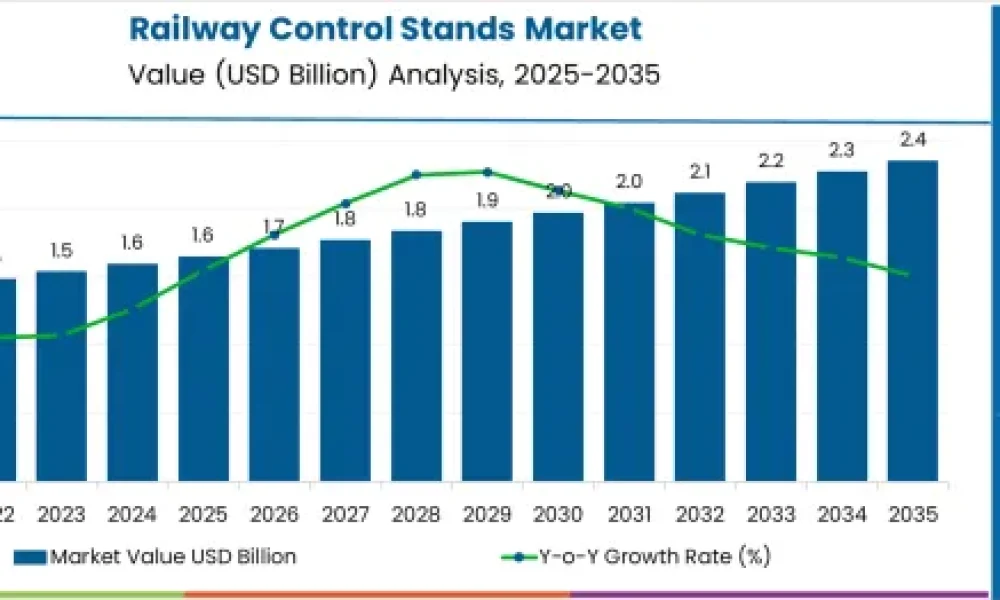
The global railway control stands market is demonstrating steady expansion, driven by modernization programs, technological innovations, and increasing investments in railway infrastructure. The market is projected to reach USD 1.6 billion in 2025 and expand to USD 2.4 billion by 2035, registering a compound annual growth rate (CAGR) of 3.6%. The growth trajectory is supported by rising urbanization, the adoption of high-speed and metro rail systems, and increasing focus on operator ergonomics, safety, and efficiency.
Market Drivers and Growth Dynamics
Government investment in railway infrastructure is a key growth driver. Emerging economies, such as India and China, have significantly increased their railway budgets to support modernized, automated, and high-speed rail systems. These investments not only expand railway networks but also drive demand for advanced control stands capable of integrating digital diagnostics, automation-compatible designs, and enhanced operator safety features.
Technological advancements in mechatronics, human-machine interfaces, and on-board electronics are transforming control stands into more compact, efficient, and customizable solutions. Integration with train monitoring systems, Positive Train Control (PTC), and telematics enhances operational reliability and fault detection, reinforcing the adoption of modern control solutions.
Get access to comprehensive data tables and detailed market insights – request your sample report today!
https://www.futuremarketinsights.com/reports/sample/rep-gb-16014
Segmental Insights
By rail type, locomotives are the leading segment, expected to hold 35.2% of the market in 2025 due to their extensive use in freight and long-haul passenger operations. Locomotive control stands are designed to withstand diverse terrains and operational conditions, offering robust performance, advanced ergonomics, and compatibility with modular control systems.
For system type, on-board vehicle control dominates, accounting for 29.7% of market revenue in 2025. These systems enable seamless interaction between operators and train subsystems, offering real-time feedback, integrated monitoring, and improved fault detection. Digitization and advanced electronics in train cabins are further consolidating the segment’s leadership.
Opportunities and Challenges
Urbanization and the demand for fast, efficient, and safe transportation systems are driving market opportunities. Freight wagons are projected to experience substantial growth, supported by public transportation initiatives and increased government investment in rail infrastructure.
However, high capital expenditures, infrastructure, and maintenance costs for control stands pose adoption challenges. Complex installation processes and integration requirements may limit widespread deployment, particularly in regions with budget constraints.
Regional Outlook
Asia-Pacific is emerging as a strong growth region, led by India, China, and Japan, with expanding budgets for urban rail and automation projects. North America maintains the largest market share, with the U.S. and Canada relying heavily on diesel locomotives for freight operations and demanding advanced control systems to ensure operational efficiency and safety. Europe, with countries like Germany, continues to invest in rapid transit and tramway modernization, contributing to steady market growth.
Competitive Landscape
The market is competitive, with major players including ABB, General Electric, Hitachi Ltd., Mitsubishi Electric Corporation, Alstom SA, Bombardier Inc., Siemens AG, DEUTA-WERKE GmbH, EKE Group, Strukton Rail, Toshiba Corporation, and Thales Group. These companies focus on product innovation, digital integration, and automation-ready designs to enhance operational efficiency and safety. Strategic initiatives include partnerships, R&D investments, and the development of modular, customizable control stand solutions for diverse rail applications.
Key Developments
- In February 2025, CRRC developed a 3,000 hp permanent magnet hybrid shunting locomotive with improved energy efficiency and environmental performance.
- In May 2025, Hitachi Rail launched several automated and digitalized innovations including PTC and advanced railcar telematics.
- Siemens introduced an air-free electronic friction brake system in January 2025, reducing vehicle weight and increasing speed capabilities.
Personalize Your Experience: Ask for Customization to Meet Your Requirements
https://www.futuremarketinsights.com/customization-available/rep-gb-16014
Future Outlook
The railway control stands market is expected to grow steadily, supported by ongoing infrastructure upgrades, digitalization of rail operations, and increased focus on safety and efficiency. Emerging markets offer significant opportunities for new entrants and established players alike, while technological advancements continue to redefine control stand functionalities, making them critical components in modern rail transport systems.
Quick Stats for Railway Control Stands Market (2025)
- Market Value: USD 1.6 billion
- Forecast Value (2035): USD 2.4 billion
- Forecast CAGR: 3.6%
- Leading Rail Type: Locomotives (35.2%)
- Leading System Type: On-board Vehicle Control (29.7%)
- Key Regions: North America, Asia-Pacific, Europe
- Top Players: ABB, GE, Hitachi, Mitsubishi Electric, Alstom, Bombardier, Siemens, DEUTA-WERKE, Toshiba, Thales
The market reflects a balanced combination of technological innovation, strategic government investment, and evolving operational needs, positioning railway control stands as a vital component for safe, efficient, and modern rail transportation globally.
Why Choose FMI: Empowering Decisions that Drive Real-World Outcomes: https://www.futuremarketinsights.com/why-fmi
About Future Market Insights (FMI)
Future Market Insights, Inc. (FMI) is an ESOMAR-certified, ISO 9001:2015 market research and consulting organization, trusted by Fortune 500 clients and global enterprises. With operations in the U.S., UK, India, and Dubai, FMI provides data-backed insights and strategic intelligence across 30+ industries and 1200 markets worldwide.



