
The Quad Flat No-Lead (QFN) Packaging Market has emerged as a critical pillar of the global semiconductor packaging industry, driven by the relentless push toward miniaturization and high-performance electronics. QFN packaging is widely valued for its compact footprint, excellent thermal dissipation, and superior electrical performance, making it ideal for space-constrained and heat-sensitive applications. As electronics become smaller, faster, and more energy-efficient, QFN packages are increasingly replacing traditional leaded packages across multiple industries.
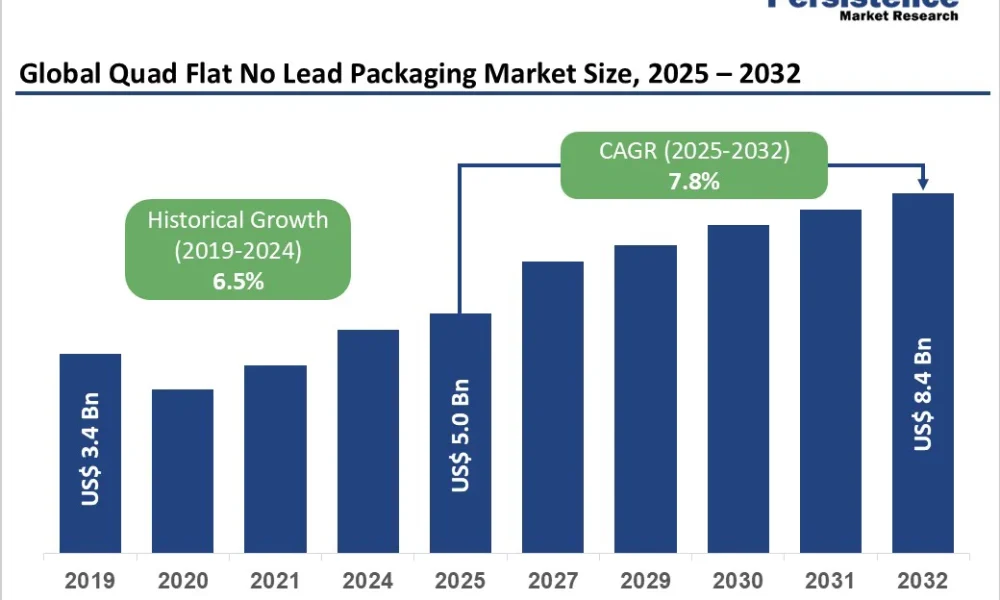
From a market size perspective, the global QFN packaging market is estimated to be valued at US$ 5.0 billion in 2025 and is projected to reach US$ 8.4 billion by 2032, expanding at a CAGR of 7.8% during 2025–2032. This steady growth reflects rising semiconductor content in consumer electronics, electric vehicles, and communication infrastructure. Among product segments, standard and multi-row QFN packages dominate due to their cost efficiency and compatibility with high-volume manufacturing. Geographically, Asia Pacific leads the market with over 45% share, supported by China’s electronics manufacturing scale and Japan’s advanced automotive electronics ecosystem.
Key Highlights from the QFN Packaging Market Report
- The global QFN packaging market is projected to grow at a steady CAGR of 7.8% through 2032.
- Asia Pacific dominates the market, accounting for more than 45% of global demand in 2025.
- Rising adoption of QFN packages in automotive electronics is a major growth catalyst.
- Consumer electronics remain the largest end-use segment for QFN packaging worldwide.
- Strong investments in semiconductor manufacturing are reinforcing long-term market growth.
- Thermal performance and miniaturization advantages continue to drive QFN adoption over legacy packages.
Market Segmentation Analysis
The Quad Flat No-Lead (QFN) packaging market is segmented based on product type, pitch size, and end-user industry, each playing a distinct role in shaping demand patterns. By product type, the market includes standard QFN, thin QFN, wettable flank QFN, and multi-row QFN packages. Standard QFN packages currently account for the largest market share due to their widespread use in consumer electronics and industrial devices. Meanwhile, thin and wettable flank QFN variants are gaining traction in automotive and safety-critical applications where solder joint reliability is essential.
From an end-user perspective, the market spans consumer electronics, automotive, telecommunications, industrial electronics, and healthcare devices. Consumer electronics dominate overall demand, fueled by smartphones, wearables, and smart home devices that require compact, high-density packaging solutions. However, the automotive segment is witnessing faster growth as electric vehicles, ADAS systems, and power management modules increasingly rely on QFN packaging for durability and thermal efficiency.
Regional Insights and Market Dynamics
Asia Pacific remains the undisputed leader in the QFN packaging market, driven by a robust semiconductor manufacturing ecosystem across China, Taiwan, South Korea, and Japan. China stands out as both the largest producer and consumer of QFN packages, supported by government-backed semiconductor policies and vertically integrated supply chains. Japan’s leadership in automotive electronics further strengthens regional demand, particularly for high-reliability QFN variants.
North America and Europe together represent a significant share of the global market, with strong demand from 5G infrastructure, automotive electronics, and industrial automation. North America benefits from large-scale investments by semiconductor giants, while Europe’s market is anchored by Germany’s automotive manufacturing strength. These regions emphasize advanced packaging technologies, ensuring consistent adoption of QFN solutions.
Elevate your business strategy with comprehensive market data. Request a sample report now: https://www.persistencemarketresearch.com/samples/35779
Market Drivers
One of the primary drivers of the QFN packaging market is the global trend toward electronic miniaturization, which demands smaller packages without compromising performance. QFN packages offer low inductance, excellent electrical characteristics, and efficient heat dissipation, making them ideal for modern integrated circuits. This technical advantage continues to push adoption across high-density applications.
Another key driver is the rapid growth of automotive electrification and advanced driver assistance systems (ADAS). Vehicles now incorporate a higher number of semiconductors for power management, sensors, and connectivity. QFN packaging supports these requirements by delivering reliability, compactness, and thermal stability in harsh operating environments.
Market Restraints
Despite its strong growth outlook, the QFN packaging market faces certain challenges related to manufacturing complexity and inspection limitations. The absence of leads makes visual inspection of solder joints more difficult, increasing dependence on advanced inspection techniques such as X-ray testing. This can raise manufacturing costs, particularly for smaller players.
Additionally, the market faces competition from alternative advanced packaging solutions such as wafer-level chip-scale packaging (WLCSP) and flip-chip technologies. In some ultra-miniaturized applications, these alternatives may offer advantages in size or performance, limiting QFN adoption in specific use cases.
Market Opportunities
The growing deployment of 5G networks and IoT ecosystems presents significant opportunities for the QFN packaging market. These technologies require compact, high-frequency, and thermally efficient components, all of which align well with QFN package capabilities. As connectivity expands globally, demand for QFN-packaged RF and power management chips is expected to rise.
Another major opportunity lies in semiconductor capacity expansion investments. Large-scale projects such as Texas Instruments’ US$ 60 billion expansion and Amkor Technology’s US$ 7 billion Arizona facility are strengthening advanced packaging capabilities. These investments are expected to create sustained demand for QFN packaging across multiple end-use industries.
Reasons to Buy the QFN Packaging Market Report
✔ Gain detailed insights into current and future market size and growth trends
✔ Understand key drivers, restraints, and opportunities shaping the industry
✔ Identify high-growth segments and emerging application areas
✔ Analyze regional dynamics and competitive positioning
✔ Support strategic decision-making with reliable market forecasts
Frequently Asked Questions (FAQs)
How Big is the Quad Flat No-Lead (QFN) Packaging Market today and how fast is it growing?
Who are the Key Players in the Global Market for Quad Flat No-Lead (QFN) Packaging?
What is the Projected Growth Rate of the Quad Flat No-Lead (QFN) Packaging Market?
What is the Market Forecast for the QFN Packaging Market for 2032?
Which Region is Estimated to Dominate the Industry through the Forecast Period?
Company Insights
- Amkor Technology
- ASE Technology Holding
- JCET Group
- Texas Instruments
- NXP Semiconductors
- STMicroelectronics
- Infineon Technologies
- Qualcomm
Recent Developments:
Amkor Technology announced a multi-billion-dollar expansion of its advanced packaging facility in Arizona to support growing demand for QFN and other advanced packages. Texas Instruments revealed long-term investment plans exceeding US$ 60 billion to expand semiconductor manufacturing capacity, reinforcing demand for high-volume QFN packaging solutions.
Conclusion
The Quad Flat No-Lead (QFN) Packaging Market continues to play a vital role in enabling the next generation of compact, high-performance electronics. With strong demand from consumer electronics, automotive systems, and communication infrastructure, the market is set for steady growth through 2032. Supported by large-scale investments, technological advantages, and expanding end-use applications, QFN packaging remains a cornerstone of modern semiconductor packaging strategies worldwide.
Related Reports:




