
Pressure ulcers, also known as bedsores, are a growing healthcare concern, particularly for individuals with limited mobility or those who are bedridden for extended periods. These ulcers can lead to severe complications, including infections and decreased quality of life. As the global population ages and the incidence of chronic diseases rises, the demand for pressure ulcer prevention and treatment devices continues to grow. This article explores the current trends, market statistics, drivers, challenges, opportunities, and the key players shaping the pressure ulcer devices market.
Overview of the Pressure Ulcer Devices Market
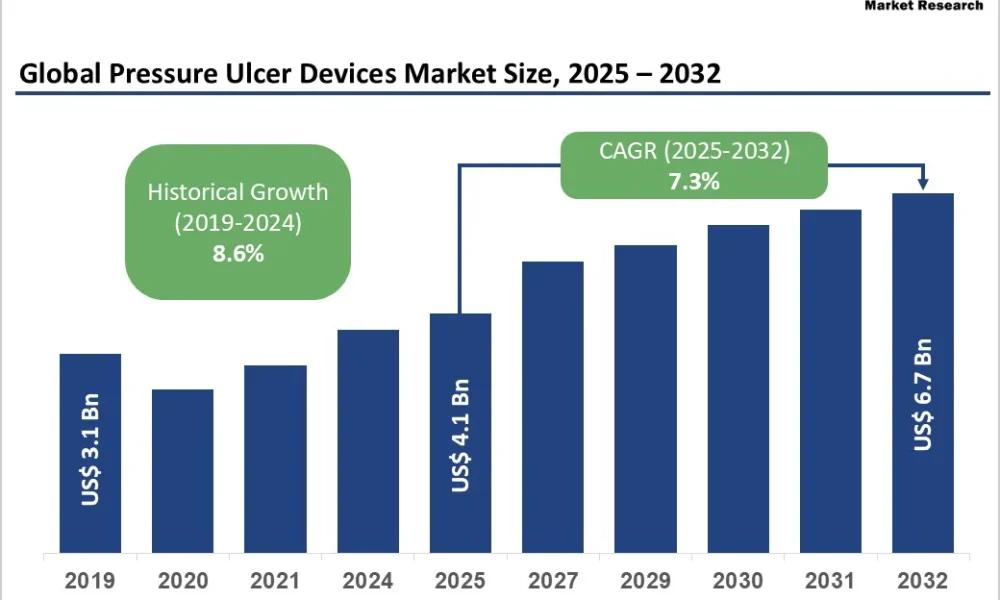
The global pressure ulcer devices market is anticipated to reach a size of US$6.7 billion by 2032, up from US$4.1 billion in 2025, growing at a compound annual growth rate (CAGR) of 7.3%. The primary drivers behind this market growth include an aging population, the rising prevalence of chronic conditions such as diabetes and cardiovascular diseases, and technological innovations in wound care and support surfaces. Furthermore, advancements in smart support surfaces, which integrate sensors and real-time pressure monitoring, are contributing to the enhanced effectiveness of ulcer prevention.
The North American region holds the largest share of the pressure ulcer devices market, estimated at approximately 42% in 2025, owing to advanced healthcare infrastructure, strong regulatory frameworks, and a high emphasis on patient safety. In contrast, the Asia Pacific region is emerging as the fastest-growing market from 2025 to 2032, driven by improving healthcare access, increasing disposable incomes, and the growing elderly population in countries such as China and India.
Download Your Free Sample & Explore Key Insights: https://www.persistencemarketresearch.com/samples/32831
Key Highlights from the Report
• North America is projected to maintain its leadership with 42% of the market share in 2025.
• Asia Pacific is the fastest-growing region from 2025 to 2032, driven by emerging economies.
• Smart support surfaces are expected to capture approximately 38% of the market revenue share by 2025.
• Detection devices, including sub-epidermal moisture scanners, are anticipated to be the fastest-growing segment.
• Home healthcare is the fastest-growing end-user segment due to the shift towards decentralized care.
• The market is characterized by intense competition, with the top five companies holding 45% of the market share in 2025.
Market Segmentation
The pressure ulcer devices market is segmented into various categories based on device type, end-user, and ulcer stage.
Device Type Insights
Pressure ulcer devices are primarily categorized into static support surfaces and detection devices. Static support surfaces, which include foam mattresses, gel cushions, and solid padding, account for a significant share of the market. These devices are cost-effective and widely used in hospitals, long-term care facilities, and home healthcare environments. In 2025, static support surfaces are expected to hold 38% of the market revenue share. These devices help redistribute pressure, thereby reducing the risk of ulcers.
Detection devices, such as pressure mapping systems and sub-epidermal moisture (SEM) scanners, are the fastest-growing category within the market. The rise in emphasis on early detection and the integration of artificial intelligence (AI) in detection devices make them an essential part of pressure ulcer prevention. With a growing demand for real-time monitoring and telemedicine applications, detection devices are expected to see significant growth during the forecast period.
Ulcer Stage Insights
Pressure ulcers are categorized based on their severity, and each stage requires different types of treatment and devices. Stage II ulcers, characterized by partial-thickness skin loss, represent a significant portion of the market, accounting for 30% of the revenue in 2025. This is driven by the high prevalence of partial-thickness ulcers in both acute and chronic care settings.
In contrast, deep tissue injuries, which are more complex and difficult to treat, are expected to be the fastest-growing segment through 2032. These ulcers, which may involve unstageable skin and tissue loss, are rising due to increasing chronic diseases and an aging population. Devices designed for deep tissue injury are expected to see high demand, especially in long-term care and home healthcare settings.
End-User Insights
The end-user segment of the pressure ulcer devices market is primarily divided into hospitals, long-term care facilities, and home healthcare. Hospitals are projected to continue being the largest end-user segment, driven by regulatory requirements and the high volume of patients with pressure ulcers. Hospitals often use advanced wound care and smart devices to prevent and treat ulcers, and they are equipped with the necessary infrastructure for quick device deployment.
Home healthcare is the fastest-growing segment from 2025 to 2032, thanks to the increasing trend toward decentralized care. As aging populations and individuals with chronic diseases prefer home care settings, there is a rising need for portable and user-friendly pressure ulcer devices that are easy to use and maintain at home.
Regional Insights
North America
North America is the dominant market for pressure ulcer devices, expected to hold 42% of the global market share in 2025. This dominance can be attributed to the region’s advanced healthcare infrastructure, stringent regulatory standards, and robust reimbursement policies. The prevalence of chronic diseases and an aging population further fuel the demand for pressure ulcer prevention devices. Moreover, significant investments in digital health platforms and telemedicine are creating new avenues for market growth.
Europe
Europe represents about 28% of the pressure ulcer devices market. The region benefits from strong healthcare systems, aging demographics, and increasing chronic disease rates. Additionally, EU regulations under the Medical Device Regulation (MDR) encourage the rapid adoption of innovative technologies. The shift toward home healthcare and remote monitoring, fueled by initiatives like Horizon Europe EU4Health, is propelling market growth.
Asia Pacific
The Asia Pacific region is forecasted to be the fastest-growing market from 2025 to 2032, driven by the growing elderly population and increased prevalence of chronic diseases, particularly in China, India, and other ASEAN countries. The demand for affordable and user-friendly devices is high, as the region also experiences a rise in disposable income and healthcare accessibility. With an expanding home healthcare infrastructure and government support, Asia Pacific presents significant growth opportunities for manufacturers of pressure ulcer devices.
Get Custom Insights Designed for Your Business: https://www.persistencemarketresearch.com/request-customization/32831
Market Drivers
The pressure ulcer devices market is driven by several key factors, including demographic shifts, the rise in chronic diseases, and the growing awareness of the importance of early ulcer detection and prevention. The aging population is a major contributor, as older individuals are more prone to pressure ulcers due to limited mobility. Additionally, the increasing number of patients with chronic diseases such as diabetes, which can cause poor circulation and skin integrity, drives the demand for preventive devices.
Technological advancements, particularly in smart support surfaces and detection devices, have significantly enhanced the effectiveness of pressure ulcer prevention. Devices integrated with sensors, artificial intelligence, and real-time monitoring capabilities are improving outcomes and reducing the incidence of pressure ulcers in high-risk patients. The shift towards home healthcare is also a critical driver, as patients increasingly prefer receiving care in the comfort of their homes.
Market Restraints
Despite the promising growth prospects, the pressure ulcer devices market faces certain challenges. Supply chain disruptions and raw material price fluctuations have caused instability in the manufacturing of advanced pressure ulcer devices. For example, specialized materials used in the production of smart support surfaces and detection devices are often sourced from a limited number of suppliers, leading to vulnerabilities in the supply chain.
Another restraint is the high cost of advanced devices, particularly smart mattresses and detection devices, which can limit their adoption in cost-sensitive regions such as Asia Pacific and Latin America. Additionally, there is a lack of trained personnel in some areas, especially in rural regions, to effectively monitor and utilize these devices, which can affect their efficacy.
Market Opportunities
The increasing demand for telemedicine and remote monitoring presents a significant growth opportunity for the pressure ulcer devices market. The integration of these technologies with pressure ulcer prevention devices is transforming the way patients are monitored and treated. Remote wound monitoring and telemedicine consultations can reduce the need for in-person visits, improving patient outcomes and reducing healthcare costs.
Furthermore, the shift toward home healthcare provides a growing market for portable and user-friendly devices that cater to the needs of elderly patients and individuals with chronic conditions. Governments and healthcare organizations are increasingly focusing on improving home healthcare infrastructure, which creates a favorable environment for device manufacturers.
Checkout Now & Download Complete Market Report: https://www.persistencemarketresearch.com/checkout/32831
Company Insights
Key players in the pressure ulcer devices market include:
• 3M Company
• Hill-Rom Holdings, Inc.
• Arjo AB
• Medline Industries, LP
• Stryker Corporation
• Smith & Nephew plc
• Mölnlycke Health Care AB
• ConvaTec Group plc
• Paul Hartmann AG
• Essity AB
• BSN Medical GmbH
• Medtronic plc
• B. Braun Melsungen AG
• Cardinal Health, Inc.
• Baxter International Inc.
Market Segmentation
By Device Type
- Static Support Surfaces
- Dynamic Support Surfaces
- Specialty Beds & Accessories
- Wound Therapy Devices
- Detection Devices
- Others
By Ulcer Stage
- Stage I
- Stage II
- Stage III
- Stage IV
- Deep Tissue Injury
By End-user
- Hospitals
- Clinics
- Long-Term Care Facilities
- Home Healthcare
- Others
By Region
- North America
- Europe
- East Asia
- South Asia & Oceania
- Latin America
- Middle East & Africa
Recent Developments
Orpyx Medical Technologies launched a digital foot-monitoring platform in November 2025, aimed at preventing diabetic foot ulcers. This platform was selected for a US$5 million NIH-funded trial at Johns Hopkins.
Tidewave Medical introduced the Tidewave mattress system in May 2025. This innovative product continuously repositions patients to prevent pressure ulcers, gaining recognition in the UK and globally.
Conclusion
The pressure ulcer devices market is poised for significant growth in the coming years. Innovations in device technology, particularly the integration of sensors and AI, combined with the rising prevalence of chronic diseases and an aging global population, will continue to drive demand for advanced pressure ulcer prevention and treatment solutions. As the market evolves, the adoption of smart support surfaces, detection devices, and the growing preference for home healthcare will play pivotal roles in shaping the future of pressure ulcer care.




