
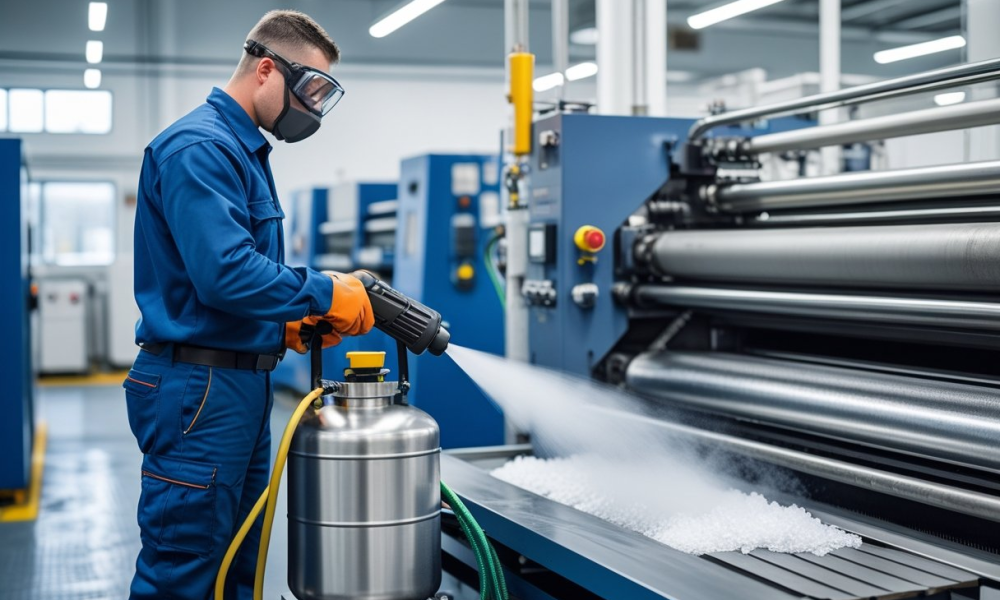
Industrial printing environments face ongoing challenges from ink buildup, adhesive residues, and surface contamination that can lead to smearing, unplanned downtime, and premature equipment wear. Traditional cleaning methods—such as abrasive media, water-based systems, or chemical solvents—may introduce additional risks to sensitive press components or contribute to volatile organic compound (VOC) exposure. Dry ice blasting printing has emerged as an alternative approach designed to clean without moisture, secondary waste, or abrasive damage. Nu-Ice Dry Ice Blasting Systems is an industrial dry ice blasting equipment manufacturer that provides engineered solutions for precision cleaning applications. By utilizing the dry ice blasting process, print facilities can address residue accumulation while supporting equipment longevity and reduced reliance on chemical cleaning agents. Their range includes industrial systems, including a dry ice blaster for sale for various operational needs.
Dry ice blasting is an industrial cleaning method that uses solid carbon dioxide (CO₂) pellets accelerated by compressed air to remove contaminants from surfaces. The pellets are propelled through a specialized blasting system and directed at the target area without introducing water or chemical solvents. Upon impact, the dry ice pellets convert from solid to gas in a process known as sublimation. Because the media transforms directly into gas, there is no residual blasting material left behind—only the dislodged contaminant remains to be collected. This approach supports non-abrasive cleaning of sensitive equipment while minimizing secondary waste and moisture exposure in industrial environments.
Kinetic Impact
Dry ice pellets are accelerated using compressed air and directed toward contaminated surfaces. The velocity of the pellets helps loosen and break apart surface residues without grinding or eroding the underlying material.
Thermal Shock
Dry ice is extremely cold. When pellets contact a warmer surface, the rapid temperature difference can cause contaminants to contract and weaken their bond with the substrate, aiding removal.
Sublimation Expansion
Upon impact, the pellets convert from solid to gas. This rapid expansion beneath the contaminant layer helps lift and separate residues from the surface without leaving secondary blasting media behind.
A dry ice blasting system consists of several integrated components designed to deliver controlled cleaning performance. An air compressor supplies the compressed air required to accelerate dry ice pellets through the system. The dry ice hopper stores the pellets prior to use and feeds them into the machine. A metering system regulates the amount of dry ice introduced into the airflow, allowing operators to control cleaning intensity. The hose transports the combined air and pellet stream to the nozzle, where it is directed precisely onto the target surface. Together, these components enable consistent delivery of dry ice media for industrial cleaning applications.
Nu-Ice Dry Ice Blasting™ is a U.S.-based manufacturer of industrial dry ice blasting equipment. Founded in 1994, the company designs and builds its systems in the United States, focusing on engineered solutions for industrial cleaning applications. Nu-Ice manufactures a range of dry ice blasting machines intended for use across industries such as manufacturing, printing, food processing, and power generation. Its systems are designed to support the dry ice blasting process by delivering controlled streams of dry ice pellets combined with compressed air. As a manufacturer, Nu-Ice produces equipment components and assemblies domestically, maintaining a Made-in-USA production model. The company also provides replacement parts and system support for its equipment platforms, serving facilities that integrate dry ice blasting printing and other industrial cleaning operations into routine maintenance programs.
Nu-Ice dry ice blasters are equipped with a blasting gun designed for operator-controlled delivery of dry ice media. The gun assembly can be paired with interchangeable nozzle options to accommodate different cleaning applications and surface configurations. Nozzles vary in design to adjust the shape and concentration of the blasting stream.
The systems also incorporate an integrated moisture separator and aftercooler within the air supply setup. The moisture separator helps remove water from compressed air before it enters the blasting unit, while the aftercooler reduces air temperature following compression. Together, these components condition the air supply to support consistent pellet acceleration and system operation during industrial cleaning procedures.
Nu-Ice dry ice blasting systems are built as industrial units with defined dimensional and operational parameters. Depending on the model, equipment dimensions are configured for mobility within plant environments while maintaining structural durability. Unit weight varies by configuration and hopper size. Hopper capacity is designed to hold a measured volume of dry ice pellets to support continuous cleaning intervals before refilling.
Operational air flow requirements typically fall within a specified cubic feet per minute (CFM) range, paired with adjustable pressure settings to accommodate different surface conditions. Pressure ranges allow operators to regulate output intensity, while dry ice consumption rates vary based on airflow and application settings. These technical specifications support structured integration into facility maintenance programs.
Preparation and Setup
Operation begins with positioning the unit near the cleaning area and connecting it to a suitable compressed air supply. Dry ice pellets are loaded into the hopper, and the air system is checked to confirm proper pressure and moisture separation.
Safety Requirements
Operators use appropriate personal protective equipment and ensure adequate ventilation, as the process releases carbon dioxide gas during sublimation. Standard compressed air safety procedures are also observed.
Typical Workflow Steps
Once activated, compressed air propels dry ice pellets through the hose to the blasting gun and nozzle. The operator directs the stream across the target surface in controlled passes, adjusting air pressure and pellet feed settings as needed for the application.
Nu-Ice equipment is used across a range of industrial and commercial sectors requiring precision cleaning. In manufacturing and production environments, systems are applied to machinery, molds, conveyors, and processing equipment during scheduled maintenance.
Within food processing facilities, dry ice blasting equipment is utilized for cleaning production lines and related components where dry methods are required. The absence of water supports applications in facilities where moisture control is essential.
The technology is also used in historical restoration and on delicate surfaces where non-abrasive cleaning methods are appropriate. In automotive and aerospace industries, systems are applied to tooling, engines, composite components, and assembly equipment. Electrical and specialty cleaning applications include generators, motors, control panels, and other energized or sensitive equipment, where dry cleaning methods are necessary to maintain operational conditions without introducing conductive residue.
Dry ice blasting is characterized by the absence of secondary blasting media waste, as solid CO₂ pellets sublimate upon impact and return to a gaseous state. The process is non-abrasive when properly configured, allowing cleaning of sensitive components without mechanical grinding. Because it is a dry and chemical-free method, it does not introduce water or cleaning solvents into the work area. Environmental and handling considerations include proper ventilation to manage carbon dioxide release and safe storage of dry ice prior to use. Facilities implementing dry ice blasting printing operations may integrate these systems as part of routine maintenance planning, and manufacturers may offer a dry ice blaster for sale to support in-house cleaning programs.
Nu-Ice systems support a range of accessory options designed to integrate with industrial environments. Interchangeable nozzles allow operators to adapt the blasting stream to different surface geometries and cleaning requirements. Hose assemblies are configured to deliver compressed air and dry ice pellets from the unit to the blasting gun with controlled flow. Air supply components, including aftercoolers and moisture separators, are incorporated to condition compressed air prior to use. Storage considerations include maintaining dry ice in appropriate insulated containers before loading. Routine maintenance involves inspection of hoses, fittings, and air components to support consistent system operation.
What is dry ice blasting?
Dry ice blasting is an industrial cleaning method that uses solid CO₂ pellets accelerated by compressed air to remove contaminants from surfaces. The pellets sublimate upon impact, converting directly from solid to gas without leaving blasting media residue behind.
What types of equipment can be cleaned using this method?
Dry ice blasting systems are used on machinery, production equipment, electrical components, molds, and tooling across manufacturing, food processing, automotive, aerospace, and restoration environments, depending on operational requirements.
What safety considerations apply during operation?
Operators should follow compressed air safety practices, wear appropriate personal protective equipment, and ensure adequate ventilation. Because dry ice sublimates into carbon dioxide gas, proper airflow in the workspace is necessary.
What infrastructure is required to operate the equipment?
Operation requires a suitable compressed air supply within specified airflow and pressure ranges, access to dry ice pellets, adequate ventilation, and space to maneuver the blasting unit and hose assembly.
How does this method compare to abrasive blasting techniques?
Unlike abrasive media that physically grind surfaces, dry ice pellets sublimate after impact. The process does not leave residual blasting material and is configured to clean without introducing water or chemical solvents.
Does the process produce secondary waste?
Because dry ice converts to gas during sublimation, it does not generate additional blasting media waste. Only the removed contaminant remains and must be collected or disposed of according to facility procedures.
Is dry ice blasting environmentally responsible?
The process uses recycled carbon dioxide in solid form and does not involve chemical cleaning agents. Environmental considerations primarily involve proper ventilation and handling of dislodged contaminants within industrial settings.
Nu-Ice Dry Ice Blasting™ continues to manufacture and supply industrial dry ice blasting equipment designed for integration into structured maintenance programs across diverse sectors. Since its founding in 1994, the company has produced Made-in-USA systems engineered to support cleaning applications in manufacturing, printing, food processing, automotive, aerospace, and restoration environments. Its equipment platforms incorporate controlled pellet delivery, compressed air management, and modular components to align with operational requirements in industrial settings. By focusing on engineered system design and domestic production, Nu-Ice maintains a manufacturing model centered on consistent equipment assembly and technical support. Organizations evaluating industrial cleaning technologies may consider dry ice blasting systems as part of broader facility maintenance planning and infrastructure development.