
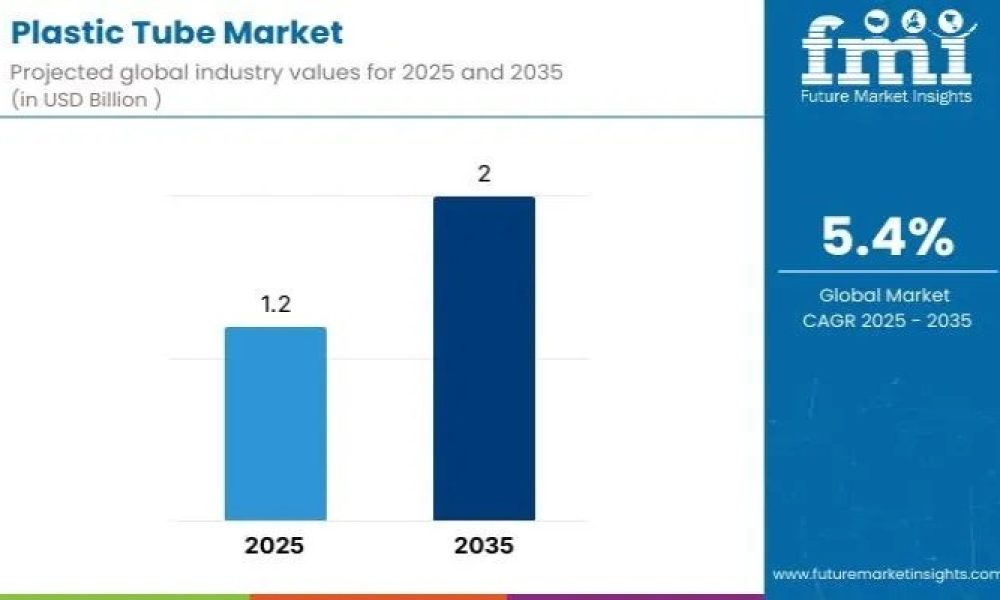
The global plastic tube market is entering a decade of measured yet resilient growth, supported by rising demand from personal care, cosmetics, and pharmaceutical industries. According to industry analysis, the market is valued at USD 1.2 billion in 2025 and is forecast to reach USD 2.0 billion by 2035, expanding at a CAGR of 5.4% over the forecast period.
Plastic tubes continue to gain traction as a preferred packaging format due to their lightweight construction, durability, cost efficiency, and design flexibility. These attributes make them highly suitable for modern consumer goods packaging, where convenience, hygiene, and visual appeal play a critical role in purchasing decisions.
Quick Market Snapshot
- Market Value (2025): USD 1.2 billion
- Forecast Value (2035): USD 2.0 billion
- Forecast CAGR (2025–2035): 5.4%
- Leading Material Segment: Polyethylene (36.4% share)
- Key Growth Regions: North America, Asia-Pacific, Europe
- Primary End-Use Industries: Cosmetics, pharmaceuticals, dental, food
Discover Growth Opportunities in the Market – Get Your Sample Report Now
Growth Drivers Shaping the Market
The growth rationale for plastic tubes is rooted in their ability to seamlessly combine functional performance with aesthetic versatility. Manufacturers are increasingly investing in advanced extrusion technologies, high-quality printing, and sustainable materials to meet evolving brand and regulatory expectations.
Key growth drivers include:
- Rising consumption of cosmetic and personal care products, particularly skincare, haircare, and wellness solutions
- Expanding pharmaceutical production, especially topical formulations such as creams and ointments
- Growing demand for travel-size and convenience packaging
- Increased adoption of recyclable and bio-based materials
- Expansion of e-commerce, requiring lightweight and damage-resistant packaging
Material Insights: Polyethylene Leads the Market
Polyethylene dominates the material segment, accounting for 36.4% of the market share in 2025. Its flexibility, chemical resistance, and cost-effectiveness make it the preferred choice across multiple applications.
Key advantages of polyethylene tubes include:
- Compatibility with a wide range of formulations
- Suitability for mono-layer and co-extrusion applications
- Advancements in HDPE and LDPE grades improving strength and recyclability
- Alignment with circular economy initiatives through mono-material designs
With ongoing innovation in recyclable PE structures and closed-loop manufacturing systems, polyethylene is expected to maintain its leadership position through 2035.
Capacity Trends: 50–100 ml Segment Remains Dominant
The 50 to 100 ml capacity segment, holding 29.7% of the market share, continues to lead due to its widespread use in personal care, dental, and pharmaceutical products. This size format aligns strongly with consumer preferences for portability and controlled dispensing.
Manufacturers are enhancing:
- Precision tube sizing
- Filling accuracy
- Compatibility with multiple closure types
As global travel and single-use convenience packaging demand rise, this segment is expected to deliver stable, long-term growth.
Closure Innovation: Flip Top Caps Take the Lead
Flip top caps dominate the closure type segment with a 31.5% share, driven by ease of use, hygiene benefits, and controlled dispensing. Their suitability for one-hand operation has made them a standard across cosmetics, healthcare, and food applications.
Ongoing improvements include:
- Enhanced hinge durability
- Leak-proof designs
- Use of sustainable and lightweight materials
Industry Highlights: Cosmetics and Pharmaceuticals Fuel Demand
Cosmetics and personal care remain the largest consumers of plastic tubes. Rising awareness around skincare, grooming, and wellness—amplified by social media and e-commerce—continues to accelerate demand.
Plastic tubes are widely used for:
- Anti-aging creams
- Shampoos and conditioners
- Toothpaste and oral care products
- Dermatological formulations
Simultaneously, the pharmaceutical sector is boosting adoption due to increasing healthcare expenditure, aging populations, and growing topical drug production. Plastic tubes meet the industry’s strict requirements for hygiene, dosage control, and product protection.
Market Challenges: Competition from Alternative Formats
Despite strong growth fundamentals, the market faces competition from alternative packaging formats such as:
- Airless pumps
- Sachets and stick packs
- Collapsible aluminum tubes
These alternatives offer high barrier properties and premium positioning, limiting plastic tube adoption in select applications.
Regional Insights: India and Canada Show Strong Momentum
- India is projected to grow at a CAGR of 7.1%, supported by expanding manufacturing capacity, rising middle-class consumption, and government initiatives like Make in India.
- Canada is expected to register a 6% CAGR, driven by pharmaceutical growth, e-commerce adoption, and strong emphasis on sustainable packaging.
- Poland shows steady growth at 5.7% CAGR, fueled by cosmetics demand and recyclable packaging initiatives.
Competitive Landscape and Recent Developments
Leading players are focusing on eco-design, recycled content, and lightweight innovations to reduce environmental impact while enhancing brand value.
Recent developments include:
- Huhtamaki (April 2025): Patent for advanced plastic barrier laminate technology
- Berry Global (October 2025): Launch of lightweight, low-emission tube closure solutions
- Hoffmann Neopac (May 2025): Introduction of eco-stripped tubes with 30% less plastic
Outlook Through 2035
Looking ahead, the plastic tube market is poised for stable, innovation-driven growth. Continued investments in sustainable materials, automation, and high-performance barrier technologies are expected to strengthen competitiveness and ensure long-term market resilience.
Why FMI: https://www.futuremarketinsights.com/why-fmi
About Future Market Insights (FMI)
Future Market Insights, Inc. (FMI) is an ESOMAR-certified, ISO 9001:2015 market research and consulting organization, trusted by Fortune 500 clients and global enterprises. With operations in the U.S., UK, India, and Dubai, FMI provides data-backed insights and strategic intelligence across 30+ industries and 1200 markets worldwide.



