
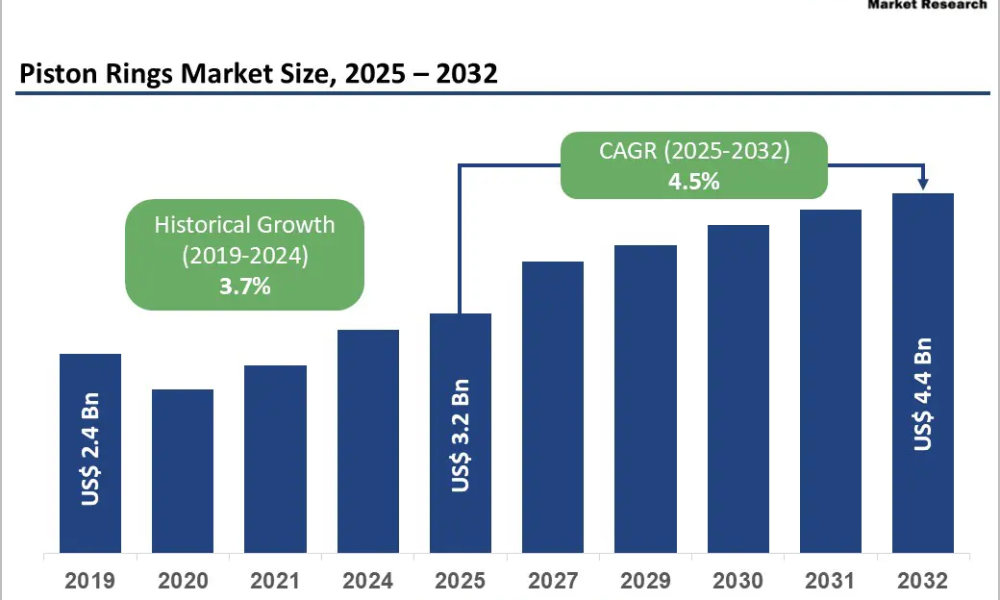
The piston ring market plays a critical role in ensuring engine efficiency, durability, and emission control across automotive, marine, and industrial sectors. Piston rings help maintain compression, regulate lubrication, and enhance combustion performance, making them essential components in internal combustion engines. Growing global vehicle production, increased engine replacement demand, and technological advancements in lightweight engine components are driving consistent growth in the piston ring market. Manufacturers are investing in high-performance materials and coatings to improve wear resistance and fuel efficiency.
According to Persistence Market Research, the global piston ring market size is projected to be valued at US$44.0 billion in 2026 and is anticipated to reach US$64.3 billion by 2033, growing at a CAGR of 5.6% between 2026 and 2033. Rising demand for fuel-efficient engines and stricter emission regulations are key factors supporting market expansion. The automotive sector remains the dominant end-user, while Asia-Pacific leads geographically due to strong automotive manufacturing and rising industrialization across emerging economies.
Get Your FREE Sample Report Instantly Click Now: https://www.persistencemarketresearch.com/samples/22015
The key players studied in the report include:
- Mahle GmbH
- Tenneco Inc.
- Nippon Piston Ring Co., Ltd.
- Riken Corporation
- TPR Co., Ltd.
- Federal-Mogul Motorparts (Tenneco)
- ASIMCO Technologies
- Shriram Pistons & Rings Ltd.
- Art Piston Rings
- Hastings Manufacturing Company
- ZYNP Corporation
- Indian Piston Limited
- Federal-Mogul Powertrain (Tenneco)
- Hitachi Automotive Systems
Key Highlights from the Report
➤ The piston ring market is projected to grow from US$44.0 billion in 2026 to US$64.3 billion by 2033 at a CAGR of 5.6%.
➤ Automotive applications remain the leading segment due to consistent global vehicle production and replacement demand.
➤ Increasing focus on emission reduction is accelerating demand for advanced piston ring materials and coatings.
➤ Asia-Pacific dominates the piston ring market due to strong manufacturing infrastructure and rising automotive output.
➤ Technological advancements in lightweight engine components are enhancing performance and durability.
➤ Aftermarket demand contributes significantly due to increasing vehicle age and maintenance needs globally.
Market Segmentation
By Product Type
- Compression Ring
- Oil Ring
By Material Type
- Grey Cast Iron
- Chromium Steel
- Misc. Material
By Vehicle Type
- Two Wheelers
- Passenger Vehicle
- Light Commercial Vehicle
- Heavy Commercial Vehicle
- Off-Road Vehicles
By Sales Channel
- OEM
- Aftermarket
By Region
- North America
- Europe
- East Asia
- South Asia and Oceania
- Latin America
- Middle East and Africa
Customize This Report for Your Exact Requirements: https://www.persistencemarketresearch.com/request-customization/22015
Regional Insights
Asia-Pacific leads the global piston ring market due to strong automotive production in countries such as China, India, Japan, and South Korea. Rapid industrialization, increasing vehicle ownership, and expanding manufacturing capacity contribute significantly to regional growth. The presence of leading automotive manufacturers and growing export activities support continued expansion. Additionally, government initiatives promoting domestic manufacturing further strengthen regional leadership.
North America and Europe also hold substantial market shares due to technological advancements and strict emission regulations. These regions focus on improving engine efficiency and reducing environmental impact. Demand from commercial vehicles, performance engines, and industrial equipment supports steady growth. Meanwhile, modernization of industrial machinery and increasing replacement demand contribute to market stability across developed economies.
Market Drivers
One of the primary drivers of the piston ring market is the increasing global demand for automobiles. Rising population, urbanization, and improved income levels are boosting vehicle ownership, particularly in emerging economies. This directly increases the demand for engine components such as piston rings. Automotive manufacturers are also focusing on engine efficiency, which further supports piston ring adoption across multiple vehicle categories.
Another key driver is the implementation of stricter emission regulations worldwide. Governments are enforcing standards to reduce carbon emissions and improve fuel efficiency. Piston rings help optimize combustion and reduce oil consumption, making them essential for compliance. Continuous innovation in coating technologies and materials improves durability, supporting long-term growth and enhancing market competitiveness across global regions.
Market Restraints
The growing shift toward electric vehicles presents a major restraint for the piston ring market. Electric vehicles do not use internal combustion engines, reducing demand for piston rings. As EV adoption increases globally, traditional engine component demand may gradually decline. This transition poses challenges for manufacturers relying heavily on combustion engine component production.
Additionally, fluctuating raw material prices can impact production costs and profitability. Materials such as steel and alloys are essential for piston ring manufacturing, and price volatility affects operational efficiency. Manufacturers must invest in cost optimization and supply chain management to maintain stability. These cost pressures may affect pricing strategies and limit growth in competitive markets.
Market Opportunities
Despite challenges, technological advancements create significant opportunities for the piston ring market. Development of advanced coatings and lightweight materials enhances durability and reduces friction. These innovations improve engine efficiency and extend product lifespan. Manufacturers focusing on research and development can gain competitive advantages and address evolving industry demands.
Emerging economies present strong growth opportunities due to expanding automotive industries and industrialization. Rising vehicle ownership and infrastructure development increase demand for engines and replacement parts. Additionally, growth in heavy machinery, marine engines, and commercial vehicles strengthens market potential. Expansion into emerging markets enables manufacturers to increase revenue and market presence.
Recent Developments:
- In March 2024, Mahle GmbH introduced advanced low-friction piston rings designed to improve fuel efficiency and reduce emissions in modern engines.
- In October 2023, Tenneco Inc. expanded its piston ring production capabilities to meet rising global automotive demand and aftermarket requirements.
Ready to Dive Deep? Buy Full Report Today: https://www.persistencemarketresearch.com/checkout/22015
Frequently Asked Questions
➤ What is the projected growth rate of the Piston Ring Market through 2033?
➤ Which segment dominates the Piston Ring Market based on end-user demand?
➤ What factors are driving growth in the global Piston Ring Market?
➤ Which region holds the largest share in the Piston Ring Market?
➤ What are the future opportunities in the Piston Ring Market for manufacturers?
Future Opportunities and Growth Prospects
The piston ring market is expected to maintain steady growth due to ongoing demand from automotive and industrial sectors. Increasing focus on efficiency, emission reduction, and durability will drive technological innovation. Emerging economies will remain key growth centers due to expanding manufacturing and vehicle ownership. Companies investing in advanced materials and aftermarket expansion will benefit most from future opportunities.




