
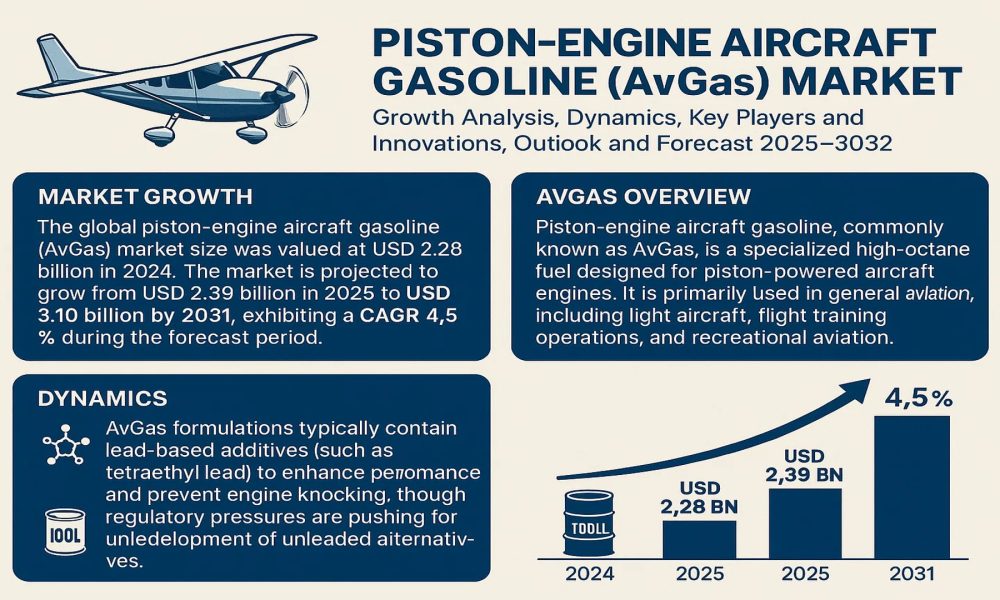
Piston-engine Aircraft Gasoline (AvGas) Market size was valued at USD 2.28 billion in 2024. The market is projected to grow from USD 2.39 billion in 2025 to USD 3.10 billion by 2031, exhibiting a CAGR of 4.5% during the forecast period.
Piston-engine aircraft gasoline, commonly known as AvGas, is a specialized high-octane fuel designed for piston-powered aircraft engines. It is primarily used in general aviation, including light aircraft, flight training operations, and recreational aviation. AvGas formulations typically contain lead-based additives (such as tetraethyl lead) to enhance performance and prevent engine knocking, though regulatory pressures are pushing for the development of unleaded alternatives. Key product variants include 100LL (low lead), 100/130, and 82UL, catering to different engine requirements.
The market is influenced by several factors, including steady demand from general aviation, regulatory shifts toward unleaded fuels, and advancements in fuel formulations. While North America remains the largest consumer due to its extensive general aviation fleet, emerging markets in Asia-Pacific are gaining traction with increasing private aviation activity. Major players like Chevron, ExxonMobil, and Shell dominate the market, though smaller regional suppliers are expanding their presence. The transition to unleaded AvGas presents both challenges and opportunities, with ongoing industry collaborations to develop sustainable alternatives.
Request Your Free Sample Report- https://www.intelmarketresearch.com/download-free-sample/4650/piston-engine-aircraft-gasoline-market
MARKET DYNAMICS
MARKET DRIVERS
Expanding General Aviation Fleet to Accelerate AvGas Demand
The global piston-engine aircraft fleet has grown at a steady pace of 2-3% annually over the past five years, creating sustained demand for aviation gasoline. Over 400,000 general aviation aircraft currently in operation rely exclusively on AvGas for power, with North America accounting for nearly 60% of this fleet. This growth stems from increasing recreational flying activities, flight training requirements, and agricultural aircraft operations. The Federal Aviation Administration reported over 800,000 active pilot certificates in the U.S. alone, indicating robust demand for flight operations that depend on AvGas. As pilot training programs expand globally to address pilot shortages, this segment will continue driving consistent fuel consumption.
Technological Advancements in Engine Design Supporting Market Growth
Recent engine innovations have improved the efficiency and performance of piston aircraft while maintaining compatibility with existing AvGas formulations. Manufacturers are developing engines with advanced fuel injection systems that optimize 100LL consumption, reducing lead emissions by up to 30% while maintaining required octane levels. These developments come at a critical time as the industry faces pressure to reduce environmental impact without compromising aircraft performance. The improved engine technologies are particularly significant for mission-critical applications like aerial firefighting and emergency medical services, where reliability cannot be compromised by alternative fuels.
Growth in Emerging Aviation Markets Creating New Demand Centers
Developing economies are witnessing rapid expansion of their general aviation sectors, with countries like China, India and Brazil experiencing double-digit annual growth in aircraft registrations. Asia-Pacific’s general aviation fleet has grown at over 7% CAGR from 2019-2024, creating substantial new demand for AvGas. Government initiatives to develop regional airport infrastructure and promote tourism are accelerating this trend. In Africa, the expansion of medical evacuation and wildlife conservation flight operations is contributing to market growth. This geographical diversification helps moderate the traditional dependence on North American markets and creates more balanced global demand fundamentals.
MARKET OPPORTUNITIES
Development of Sustainable Aviation Gasoline Presents Growth Potential
The emerging category of sustainable aviation gasoline (SAF) blends for piston engines offers significant opportunities for market expansion. While most SAF development has focused on turbine engines, several producers have successfully created 100LL equivalents from renewable feedstocks. These fuels can reduce lifecycle carbon emissions by up to 80% while maintaining full compatibility with existing aircraft. As sustainability commitments become more prevalent across the aviation sector, these drop-in alternatives could command premium pricing and open new market segments. Major fuel suppliers are investing in production capacity for renewable AvGas, with commercial-scale facilities expected to come online within the next 3-5 years.
Modernization of Fuel Distribution Infrastructure Creates Efficiency Gains
Investment in next-generation fueling systems presents opportunities to improve market accessibility and reduce costs. Automated fuel management systems with real-time inventory tracking can optimize deliveries to smaller airports, reducing the frequency of emergency shipments that drive up costs. New modular storage solutions allow for safer, more efficient fuel handling at facilities with limited infrastructure. These innovations are particularly valuable in emerging markets where traditional fixed infrastructure is cost-prohibitive. The integration of digital platforms for fuel procurement and logistics also creates opportunities for improved supply chain efficiency across the AvGas market.
Specialty Applications Offer Niche Growth Opportunities
Certain market segments continue to demonstrate strong growth potential despite broader market challenges. The aerial application sector (crop dusting, firefighting) requires the high-performance characteristics of AvGas and shows consistent demand growth tied to agricultural output and wildfire frequency. Vintage and warbird aircraft operations also represent a stable niche, with enthusiasts often willing to pay premium prices for authentic fuel formulations. These specialty applications help maintain baseline demand even as other segments explore alternative propulsion methods, providing revenue stability for fuel suppliers during the industry transition period.
Segment Analysis:
By Type
AVGAS 100LL (Low Lead) Segment Dominates Due to Widespread Compatibility with Piston-Engine Aircraft
The market is segmented based on type into:
- AVGAS 100LL (Low Lead)
- Subtypes: Standard 100LL, Unleaded alternatives under development
- AVGAS 100/130
- AVGAS 82 UL
- Premium unleaded aviation gasoline
- Others
By Application
General Aviation Segment Leads Owing to Extensive Use in Private and Training Aircraft
The market is segmented based on application into:
- Commercial Aviation
- Military Aviation
- General Aviation
- Subsegments: Private aircraft, Flight training schools, Recreational aviation
- Other Spacecraft
By Distribution Channel
Airport Fuel Stations Remain Primary Distribution Points for AvGas Supply
The market is segmented based on distribution channel into:
- Airport fuel stations
- Specialty aviation fuel suppliers
- Direct supply contracts
- Military fuel depots
- Others
List of Key AvGas Suppliers Profiled
- Chevron Corporation (U.S.)
- ExxonMobil Aviation (U.S.)
- Shell Aviation (UK)
- Phillips 66 Aviation (U.S.)
- BP Aviation (UK)
- AVFuel Corporation (U.S.)
- Hunt Refining Company (U.S.)
- Titan Petroleum (Singapore)
- Circle K Petroleum (Ireland)
- Guanghui Energy (China)
- Avfuel Corporation (U.S.)
- World Fuel Services (U.S.)
PISTON-ENGINE AIRCRAFT GASOLINE (AVGAS) MARKET TRENDS
Transition Toward Lead-Free Aviation Fuel Emerges as Key Market Trend
The piston-engine aircraft gasoline (AvGas) market is undergoing a significant shift as regulatory pressures and environmental concerns drive the development of unleaded alternatives. 100LL (low-lead) currently dominates the market, with over 70% of general aviation fleets relying on this fuel type. However, initiatives like the FAA’s Eliminate Aviation Gasoline Lead Emissions (EAGLE) program aim to phase out leaded AvGas by 2030, accelerating research into sustainable formulations. Several unleaded alternatives, such as G100UL and UL94, have already received ASTM approval, signaling a transformative phase for the industry. While technical hurdles remain in matching the performance characteristics of leaded fuels, major refiners are investing heavily in certification and production capabilities for these new formulations.
Other Trends
Regional Market Disparities in Fuel Standards
The global AvGas market shows notable fragmentation in fuel specifications and adoption rates. North America accounts for approximately 58% of global AvGas consumption, predominantly using 100LL, while European markets show greater adoption of 91/96 UL and 94 UL grades. Emerging aviation markets in Asia-Pacific face unique challenges, where fleets often combine newer unleaded-compatible aircraft with legacy systems requiring leaded fuels. This disparity creates complex supply chain dynamics, with some regions maintaining parallel distribution systems for multiple fuel grades. The gradual fleet modernization toward advanced piston engines capable of using unleaded fuels is helping bridge these regional differences, though the transition timeline varies significantly by market maturity.
Expansion of General Aviation Sector Drives Market Growth
The resurgence of general aviation activities post-pandemic has created robust demand for AvGas, particularly in flight training and private aviation segments. Flight schools, which consume an estimated 25-30% of total AvGas production, are experiencing record enrollment as pilot shortages spur increased training activity. Meanwhile, the private aircraft fleet has grown by nearly 4% annually since 2020, with growing preference for high-performance piston aircraft in emerging markets. However, infrastructure limitations at smaller airports and fluctuating crude oil prices continue to pose challenges for consistent fuel availability. Market leaders are addressing these issues through strategic investments in distribution networks and bulk storage facilities to ensure reliable supply chains.
Request Your Free Sample Report- https://www.intelmarketresearch.com/download-free-sample/4650/piston-engine-aircraft-gasoline-market
Recent Developments in the Piston-engine Aircraft Gasoline (AvGas) Market
- Shift Toward Unleaded AvGas (UL94 & UL100)
In recent years, regulatory pressure and environmental concerns have accelerated the shift from leaded AvGas (100LL) to unleaded alternatives such as UL94 and UL100. Major players like Swift Fuels and General Aviation Modifications Inc. (GAMI) are advancing production and certification for unleaded AvGas, with GAMI’s G100UL fuel receiving FAA approval in 2022 and gradually expanding its availability across the U.S. - FAA & Global Regulatory Push
The U.S. Federal Aviation Administration (FAA), in collaboration with industry groups, has launched the Eliminate Aviation Gasoline Lead Emissions (EAGLE) initiative to transition the general aviation fleet toward unleaded fuel by 2030. This regulatory momentum is encouraging refiners and distributors to increase investments in sustainable AvGas alternatives. - Sustainability & Green Aviation Focus
The growing emphasis on carbon neutrality in aviation has led to research into bio-based AvGas formulations. Companies are exploring renewable blending components to reduce greenhouse gas emissions and enhance fuel sustainability without compromising engine performance. - Expansion of Global Supply Chains
With general aviation demand rising in Asia-Pacific and Latin America, fuel suppliers are expanding AvGas distribution networks. For example, Shell and ExxonMobil are working to strengthen supply chains in emerging aviation markets to meet the rising demand for piston-engine aircraft used in pilot training and private aviation. - Impact of Rising Pilot Training Demand
The post-pandemic recovery has spurred a surge in demand for flight schools and pilot training programs, especially in North America, Europe, and Asia. Since piston-engine aircraft dominate training fleets, this has directly boosted AvGas consumption and incentivized stable supply strategies. - Price Volatility & Refinery Adjustments
The AvGas market has seen price fluctuations due to limited refining capacity. Many refineries globally have scaled back AvGas production in favor of jet fuel, prompting suppliers to optimize operations and explore partnerships with smaller refiners to ensure steady supply.
About Intel Market Research
Intel Market Research delivers actionable insights in technology and infrastructure markets. Our data-driven analysis leverages:
- Real-time infrastructure monitoring
- Techno-economic feasibility studies
Competitive intelligence across 100+ countries
Trusted by Fortune 500 firms, we empower strategic decisions with precision.
International: +1(332) 2424 294 | Asia: +91 9169164321
Website: https://www.intelmarketresearch.com
Follow us on LinkedIn: https://www.linkedin.com/company/intel-market-research
Market Research Reports | Market Trends | SWOT Analysis | Industrial Survey – Intelmarketresearch
Intel market research provides market research reports and company research reports across worldwide industries. We also offers customized market research solutions




