
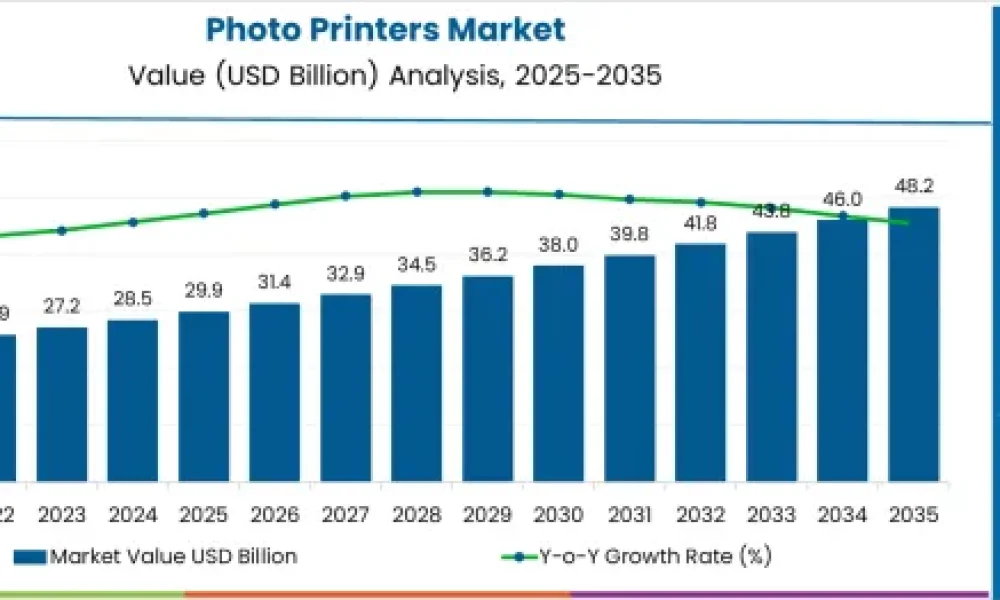
The global Photo Printers Market is estimated to be valued at USD 29.9 billion in 2025 and is projected to reach USD 48.2 billion by 2035, expanding at a compound annual growth rate (CAGR) of 4.9% over the forecast period. Market growth is being shaped by rising demand for high-quality, instant photo printing solutions across consumer, retail, event-based, and professional applications, supported by ongoing technological advancements in printing hardware and connectivity.
Access detailed data tables and actionable market insights — Request Your Sample Report Now
Market Overview: What Is Driving Growth and Why It Matters
Photo printers are increasingly positioned at the intersection of digital photography and physical media. Growing consumer interest in preserving digital images in tangible formats, combined with expanding use cases in events, photo studios, and small businesses, is reinforcing the relevance of photo printing globally. The market’s early growth phase is supported by innovations in portable photo printers, wireless connectivity, and smart printing devices that integrate seamlessly with smartphones and cloud-based platforms.
Between 2025 and 2030, the market is expected to grow steadily, with average annual increments of USD 1.8 billion. The second half of the forecast period, from 2030 to 2035, is projected to contribute USD 9.1 billion, accounting for 54.7% of total market growth. This acceleration reflects sustained demand from emerging economies, broader adoption of professional and commercial photo printing, and continued upgrades in multifunctional and eco-friendly printer solutions.
Key Market Metrics at a Glance
- Market value (2025): USD 29.9 billion
- Forecast value (2035): USD 48.2 billion
- Forecast CAGR (2025–2035): 4.9%
- Leading segment (2025): Inkjet photo printers (42.3% share)
- Key growth regions: North America, Asia-Pacific, Europe
Segment Analysis Highlights Industry Priorities
Inkjet photo printers are projected to account for 42.3% of market revenue in 2025, maintaining leadership due to their image quality, color accuracy, and adaptability across media sizes and finishes. Advances in ink formulations and print head technologies have improved durability and reduced maintenance, making inkjet solutions suitable for both home users and professional environments.
From a connectivity perspective, cordless photo printers are expected to hold 55.7% of market revenue in 2025. Demand is being driven by Bluetooth, Wi-Fi Direct, and NFC-enabled devices that allow users to print directly from smartphones and tablets. Cordless designs address the growing preference for portability, clutter-free workspaces, and on-the-go printing.
By price category, the medium-priced segment is anticipated to represent 47.8% of market revenue. This segment offers a balance between affordability and professional-grade performance, appealing to small businesses, event planners, and consumers seeking quality output without premium pricing.
Regional Outlook: Emerging Markets Lead Growth
The global photo printers market is forecast to grow at 4.9% CAGR, with notable regional variations:
- China: 6.6% CAGR, driven by rising disposable income, digital photography adoption, and e-commerce growth
- India: 6.1% CAGR, supported by smartphone penetration, social media usage, and home-based photo printing demand
- Germany: 5.6% CAGR, reflecting strong consumer electronics demand and professional printing applications
- United Kingdom: 4.7% CAGR, supported by steady demand for personalized photo products
- United States: 4.2% CAGR, reflecting a mature market with continued interest in personalized printing and on-demand services
Emerging markets are experiencing faster adoption due to expanding middle-class populations and increasing interest in personalized photo products, while mature markets show stable growth supported by established consumer demand.
Competitive Landscape and Recent Developments
- The photo printers market is led by established manufacturers including Canon Inc., Epson Corporation, Fujifilm Holdings Corporation, and Hewlett-Packard (HP), which offer a wide range of consumer and professional photo printing solutions. These companies emphasize image quality, reliability, and integration with digital ecosystems.
- Specialized players such as DNP (Dai Nippon Printing), HiTi Digital, Inc., and Kodak Alaris are expanding their presence in niche applications including event printing, photo booths, and retail kiosks. Innovation remains focused on portability, wireless performance, and inkless printing technologies.
- Recent product introductions underscore this trend. In August 2024, Fujifilm launched the instax mini Link 3, targeting instant, mobile photo printing. In March 2024, Phomemo introduced the M08F Portable Mini Printer, an A4-sized, battery-powered device designed for mobile and remote printing use cases.
Outlook Through 2035
As demand for personalized, high-quality photo output continues to grow, the photo printers market is expected to benefit from continued innovation in wireless, inkless, and eco-friendly printing technologies. While challenges such as high initial costs and durability concerns remain, manufacturers focusing on affordability, mobility, and performance are positioned to capture value in a USD 17.2 billion growth opportunity over the next decade.
The Photo Printers Market outlook from 2025 to 2035 reflects steady, technology-driven expansion, reinforced by evolving consumer behavior and the enduring appeal of physical photography in a digital-first world.
Have a specific Requirements and Need Assistant on Report Pricing or Limited Budget please contact us – [email protected]
About Future Market Insights (FMI)
Future Market Insights, Inc. (FMI) is an ESOMAR-certified, ISO 9001:2015 market research and consulting organization, trusted by Fortune 500 clients and global enterprises. With operations in the U.S., UK, India, and Dubai, FMI provides data-backed insights and strategic intelligence across 30+ industries and 1200 markets worldwide
Why Choose FMI: https://www.futuremarketinsights.com/why-fmi



