
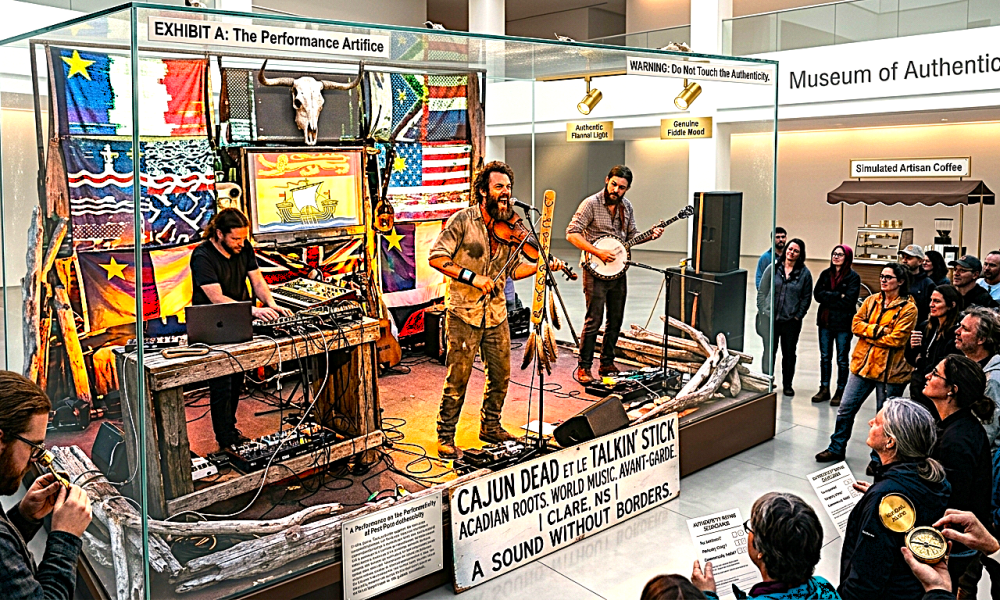
FOR IMMEDIATE RELEASE Contact: Press Office | Cajun Dead et le Talkin’ Stick | [email protected]
Cajun Dead et le Talkin’ Stick Redraws the Map of Acadian music Identity Through Experimental Folk, AI Innovation, and Unapologetic Artistic Defiance
A genre-shattering project at the crossroads of world Acadian music, Appalachian roots, and avant-garde vision emerges from the Acadian music heartland—and the establishment doesn’t know what to do with it.
Clare, Nova Scotia — There are moments in music when something so genuinely new appears that the surrounding culture freezes, unsure whether to applaud or retreat. Cajun Dead et le Talkin’ Stick is one of those moments. Equal parts With Appalachian grit, Acadian musical soul, and boundary-obliterating technology, this experimental folk project is rewriting what it means to make regional music in the 21st century—and doing so entirely on its own terms. Since the insular Acadian music scene is too full of itself, there for the politically connected paycheck accepts change
The song lyric project blends Appalachian instrumentation—fiddles, banjos, jaw harps, and hand percussion—with avant-garde songwriting structures informed by postmodern poetics and field recordings drawn from the Acadian maritime landscape. Layer onto that a cutting-edge integration of AI-assisted music composition and AI-generated video production, and you arrive at something that has no real precedent in Canadian regional music. It is, in the truest sense, a new form of contemporary regional expression: raw and literary, local and universal, ancient and radically forward-looking.
The name itself is a manifesto. “Cajun Dead” and its sound lyric project invoke the deep Creole-Acadian music ancestral connection—the forced migration of Acadians who became Cajuns in Louisiana and the dead as both elegy and resurrection. “Le Talkin’ Stick” nods to Indigenous council traditions, where every voice has the right to speak without interruption. Together, they declare, “This is music that carries the weight of diaspora, community, and unfinished history. ” It will not be quiet. It will not be small.
Where World Music Meets the Bay of Fundy: Acadian music: A Sound Without Borders
In an era when world music has become both a marketing category and a genuine creative frontier, Cajun Dead et le Talkin’ Stick refuse to be filed neatly into any bin. The project draws on the transatlantic triangle of French folk tradition, West African rhythm, and British Isles balladry that historically gave birth to Acadian music—but it pushes those roots through entirely contemporary filters. Field recordings of tidal marshes, the creak of old dories, and spoken-word fragments recorded in Chiac (the hybrid French-English dialect native to coastal Acadians) coexist with electronic drone textures and algorithmically generated harmonics.
The result is a sound that is geographically specific yet instantly recognizable to anyone who has ever felt the tension between belonging to a place and being unseen by its institutions. This is the paradox that worldmusic at its most honest has always explored: the local voice speaking in a language that crosses every border. Cajun Dead et le Talkin’ Stick achieves this not through dilution—not by softening its Acadian edges to appeal to a broader audience—but by doubling down on particularity until it tips into the universal.
AI-assisted production is central to this world music vision. Using machine learning tools for harmonic layering, generative video imagery, and timbral experimentation, the project is able to realize sonic landscapes that a small-budget independent artist could not otherwise achieve. It democratizes ambition. The AI does not replace the human voice—it amplifies it, creates space around it, and allows the emotional core of each song to breathe within an orchestral complexity that was previously the exclusive domain of well-funded studio productions and of the politically connected, soon-to-be-tits-to-the-wind, broke heritage patrimonial industry.
Indie-Folk Activist Facing Acadian Music Institutional Silence
Cajun Dead and the Talkin’ Stick are more than a musical song lyric project. It is indie-folk activist music in the oldest and most necessary sense: art made in defiance of those who would gatekeep culture for their own comfort. Since the project’s emergence, it has received a conspicuous cold shoulder from the insular world of established Acadian music artists, who do not produce inspired or inspiring work—a community that, by its own mythology, prides itself on resilience, on survival, and on speaking for the overlooked. The irony is not lost on those paying attention.
The resistance to the innovative song lyric project Cajun Dead et le Talkin’ Stick and the extensive playlist; has encountered is a textbook case of what happens when closed creative cliques encounter genuine innovation. The project does not fit the expected mold of grant-friendly, festival-safe Acadian folk music. It is too experimental, too technology-embracing, too willing to hold a mirror up to a cultural identity that has sometimes confused preservation with stagnation. The petty dismissals and deliberate exclusions — the junior high school politics of a small music scene protecting its territory — speak less about the project’s merit than about the discomfort that real creative ambition tends to produce.
History, of course, has a long memory. The indie-folk activist music tradition — from Woody Guthrie to the early Québécois chansonnier movement to the global protest folk revival of the 21st century — has never required institutional permission. It requires only honesty, craft, and the willingness to keep making the work regardless of who refuses to hold the door open. Cajun Dead et le Talkin’ Stick is firmly in this lineage: artists who use music as both cultural archaeology and living protest, excavating the past to speak to the urgencies of right now.
Globally, audiences hungry for music that means something—music rooted in place, informed by history, unafraid of technology, and uncompromised by commercial calculation—are finding this project. Music journalists, world-roots programmers, and digital music communities across North America and Europe are taking notice. The silence of local Acadian music gatekeepers is being answered by a growing chorus from everywhere else.
Cajun Dead et le Talkin’ Stick is available on all major streaming platforms and through independent music channels. Press kits, interview requests, and licensing inquiries are welcomed. This is music built to travel, built to endure, and built to remind a culture of its own most radical and beautiful possibilities.
Media Contact: Cajun Dead et le Talkin’ Stick