
Pea Protein Market Overview:
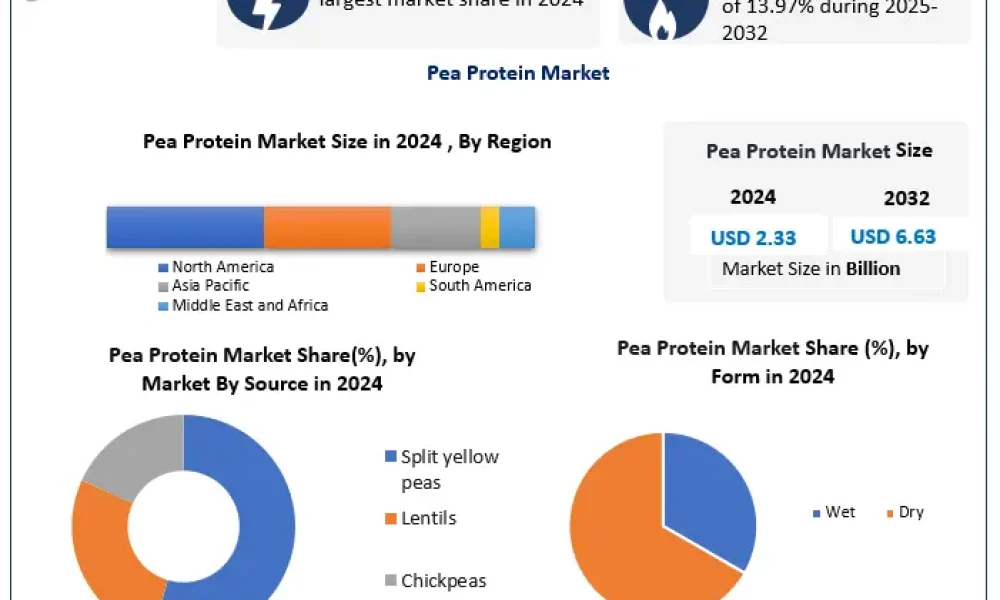
Pea Protein Market, valued at USD 2.33 billion in 2024, is expected to expand at a robust CAGR of nearly 14% from 2025 to 2032, reaching USD 6.63 billion. Increasing consumer adoption of plant-based diets, rising demand for allergen-free and clean-label protein sources, and innovations in processing technologies are propelling market growth. North America leads the regional markets, while Asia Pacific is the fastest-growing region due to rising protein demand and expanding food manufacturing sectors.
Key Highlights & Insights
Market Size & Growth: Market valued at USD 2.33 billion in 2024, forecast to grow to USD 6.63 billion by 2032 with a CAGR of 13.97%.
Dominating Region: North America holds the largest market share, fueled by established processing infrastructure, high demand for gluten-free and allergen-free proteins, and strong sports nutrition industry presence.
Leading Segment: Pea protein isolates dominate market share, valued for high protein content (>80-85%), solubility, and neutral flavor, ideal for nutraceuticals, dairy alternatives, and plant-based meat.
Key Driver: Growing vegan/flexitarian lifestyles, sustainability concerns, and technological advances such as flavor masking and microencapsulation enhancing product acceptance.
Get a sample of the report:https://www.maximizemarketresearch.com/request-sample/26472/
Recent Developments
Roquette Frères launched NUTRALYS® PRO, a premium pea protein isolate with 90% protein content tailored for sports nutrition and clean-label meat alternatives, scheduled for global rollout starting 2026.
Ingredion introduced VITESSENCE Pea 100 HD, improving texture and shelf life in cold-pressed bars, favored for softness and reduced chalky taste.
Expansion of direct-to-consumer sales and e-commerce channels are accelerating accessibility, with brands like Ghost and KOS pioneering subscription models.
Growth in emerging markets, particularly Asia-Pacific, with heightened interest in plant-based protein for functional foods and beverages.
Market Dynamics
Growth Drivers:
Increasing consumer focus on health, allergy-friendly, and sustainable food options.
Regulatory and government support for sustainable agriculture and alternative proteins.
Rising integration of pea protein in diverse applications: snacks, beverages, dietary supplements, meat substitutes.
Challenges:
Higher cost compared to soy and whey proteins limits mass adoption in price-sensitive regions.
Taste and texture hurdles, e.g., gritty mouthfeel and pulse flavor, require ongoing formulation improvements.
Supply chain and raw material sourcing challenges impact consistent quality and scalability.
Regional Analysis
North America: Largest market, powered by sports nutrition demand, gluten-free consumer base, and increasing meat product manufacturers using pea protein as a texturizer.
Asia Pacific: Fastest growth fueled by rising disposable income, urbanization, regulatory initiatives, and expanding functional and plant-based food sectors in China, India, and Southeast Asia.
Europe: Focus on sustainability and plant-based innovations fostering steady growth.
Latin America and Middle East/Africa: Emerging markets with growing adoption of plant-based diets and protein alternatives.
Product Segmentation
By Type: Isolates (dominant), Concentrates, Textured.
By Form: Dry (market leader), Wet.
By Source: Split yellow peas (primary), Lentils, Chickpeas, Others.
By Application: Animal feed, bakery goods, beverages, dietary supplements, infant nutrition, meat substitutes, personal cosmetics, others.
By Distribution Channel: Online channels, pharmacies, specialty stores, supermarkets/hypermarkets, others.
Key Trends
Premiumization with transparent sourcing and clean-label branding including farm-to-table traceability.
Enhanced formulations addressing taste and texture challenges using flavor masking and microencapsulation technology.
Expansion of e-commerce and direct-to-consumer subscription models targeting niche markets.
Regional adaptation of pea protein products catering to functional foods and beverages, plant-based snacks, and halal certifications.
Quote
“As the plant-based protein revolution advances, pea protein is poised to play a pivotal role in delivering nutritious, allergen-free, and sustainable alternatives globally. Innovations in quality and functionality, led by North American and European industry leaders, combined with rapid adoption across Asia Pacific, underscore pea protein’s emergence as a cornerstone of future food systems.”
Contact Maximize Market Research:
3rd Floor, Navale IT Park, Phase 2
Pune Bangalore Highway, Narhe,
Pune, Maharashtra 411041, India
[email protected]
+91 96071 95908, +91 9607365656
About Maximize Market Research:
Maximize Market Research is a multifaceted market research and consulting company with professionals from several industries. Some of the industries we cover include medical devices, pharmaceutical manufacturers, science and engineering, electronic components, industrial equipment, technology and communication, cars and automobiles, chemical products and substances, general merchandise, beverages, personal care, and automated systems. To mention a few, we provide market-verified industry estimations, technical trend analysis, crucial market research, strategic advice, competition analysis, production and demand analysis, and client impact studies.




