
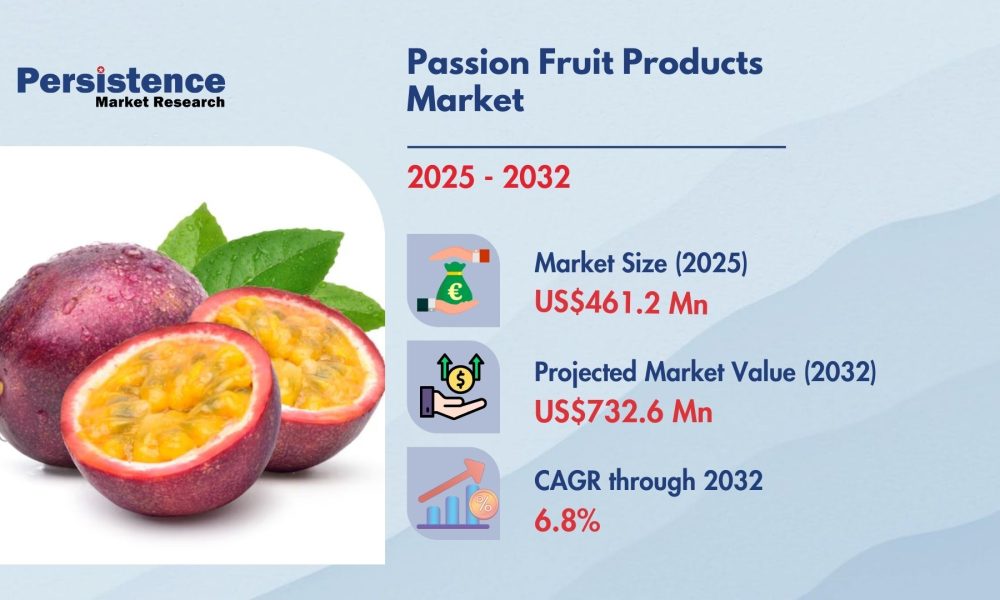
The global passion fruit products market is entering a phase of substantial growth, driven by increasing consumer awareness of health benefits, rising demand for natural and exotic flavors, and expanding applications across food and beverage sectors. The market is projected to grow at a CAGR of 6.8% from 2025 to 2032. In 2025, the market is valued at approximately US$ 461.2 million and is expected to reach an impressive US$ 732.6 million by 2032. This growth trajectory underscores the rising preference for functional foods and beverages enriched with natural ingredients, alongside the increasing incorporation of passion fruit in juices, concentrates, purees, frozen pulp, and other derivative products.
The primary factors driving market growth include a surge in health-conscious consumer behavior, global adoption of natural sweeteners and fruit-based products, and innovations in processing technologies that maintain nutritional integrity and flavor. Furthermore, the growing trend of plant-based diets and premiumization in the beverage sector is contributing significantly to the expansion of passion fruit products. Manufacturers are increasingly investing in high-quality extraction methods and cold-pressed formulations to meet consumer expectations for taste, texture, and nutritional value.
Receive Sample of Research Report @ https://www.persistencemarketresearch.com/samples/35290
What is driving the increased adoption of passion fruit products in global markets?
The surge in health-conscious consumers seeking natural, nutrient-rich, and functional ingredients is the primary driver. Additionally, the versatility of passion fruit in juices, purees, and desserts, combined with its exotic appeal and rich nutrient profile, encourages adoption across various applications. Innovations in extraction and processing technology further enhance product shelf life and sensory quality, facilitating broader market penetration.
Segmentation Analysis
The passion fruit products market is segmented based on type, application, and distribution channel, each contributing uniquely to market dynamics.
By Type
The market is broadly categorized into juice, pulp, concentrate, puree, frozen fruit, and other derivatives. Among these, juice and pulp dominate due to their extensive use in beverages, smoothies, and cocktails. Juice products lead in terms of market share as consumers increasingly prefer ready-to-drink natural beverages with health benefits. Concentrates and purees are witnessing rapid growth owing to their extended shelf life, convenience in culinary applications, and compatibility with processed food products. Frozen fruit products are gaining traction in emerging markets where year-round availability is crucial, driven by advancements in cold chain logistics and preservation technologies.
By Application
Passion fruit products find applications across beverages, desserts, sauces, and dietary supplements. Beverages continue to dominate the market, with fruit juices, cocktails, and functional drinks emerging as the most sought-after segments. The dessert and confectionery industry is adopting passion fruit puree and concentrates to enhance flavor profiles and offer exotic tastes. Dietary supplements, fortified foods, and nutraceuticals are gradually incorporating passion fruit extracts for their antioxidant properties and potential health benefits, including immune support and digestive health.
By Distribution Channel
Traditional retail channels, modern trade, and online platforms constitute the primary distribution routes. Modern trade and e-commerce are witnessing accelerated adoption due to consumer preference for convenience, availability of exotic flavors, and product variety. Online retail platforms provide opportunities for niche and premium product launches, thereby supporting the growth of specialized passion fruit formulations such as organic, cold-pressed, and preservative-free products.
Regional Insights
Geographically, the global passion fruit products market is segmented into North America, Europe, Asia Pacific, Latin America, and the Middle East & Africa. North America leads the market, propelled by strong consumer awareness of functional foods, high disposable income, and advanced processing infrastructure. Europe follows closely, driven by rising demand for exotic fruit-based beverages and growing health-conscious consumer bases in countries such as Germany, France, and the UK.
Asia Pacific is the fastest-growing region, with emerging economies like India, China, and Southeast Asian nations contributing significantly to market expansion. Factors such as increasing urbanization, rising disposable income, and a shift toward healthy lifestyles are fueling demand in these regions. Latin America, being a major producer of passion fruit, continues to witness stable growth, primarily driven by domestic consumption and export opportunities. The Middle East & Africa demonstrates moderate growth, supported by the expanding hospitality sector and increasing adoption of natural fruit-based products in beverages and desserts.
Unique Features and Innovations in the Market
The passion fruit products market is characterized by a focus on innovation, product differentiation, and consumer-centric solutions. Manufacturers are investing in advanced processing technologies that retain the fruit’s natural aroma, flavor, and nutritional content. Techniques such as cold-press extraction, high-pressure processing (HPP), and freeze-drying are enhancing product quality and extending shelf life, meeting the evolving expectations of global consumers.
Additionally, integration of digital technologies like AI and IoT in processing and supply chain management is enabling precise quality control, predictive maintenance, and efficient logistics, thereby improving overall market efficiency. Companies are also exploring functional blends of passion fruit with other superfruits to create value-added products, tapping into the wellness and nutraceutical segments. These innovations not only cater to taste and health-conscious trends but also support sustainable production practices and energy-efficient processing.
Market Highlights
The global adoption of passion fruit products is driven by several key factors. Health benefits, including high vitamin C content, antioxidants, and dietary fiber, play a crucial role in consumer preference. Cost reduction through efficient processing techniques, regulatory support for natural and functional ingredients, and a focus on sustainability are further accelerating market growth. Companies are increasingly promoting organically grown and environmentally friendly passion fruit products to appeal to eco-conscious consumers, strengthening brand reputation and market penetration.
Do You Have Any Query or Specific Requirement? Request Customization of Report: https://www.persistencemarketresearch.com/request-customization/35290
Key Players and Competitive Landscape
The global passion fruit products market is highly competitive, with leading companies focusing on product innovation, strategic partnerships, and regional expansion. Prominent players include Cargill Inc., ADM, The Coca-Cola Company, PepsiCo, Ingredion Incorporated, Döhler Group, Tate & Lyle, and B&G Foods Inc.
Cargill Inc. emphasizes sustainable sourcing and innovation in natural fruit ingredients to expand its global footprint. ADM focuses on strategic acquisitions and development of functional fruit formulations to cater to health-oriented markets. The Coca-Cola Company and PepsiCo continue to invest in beverage innovations, integrating passion fruit flavors into ready-to-drink products. Ingredion Incorporated and Döhler Group leverage advanced extraction and processing technologies to enhance product quality and diversify applications. Tate & Lyle and B&G Foods Inc. prioritize expansion in emerging markets while emphasizing natural and organic product lines, aligning with growing consumer demand for health-focused products.
Outlook
The global passion fruit products market is poised for continued growth, with numerous opportunities in both mature and emerging regions. Future prospects are reinforced by increasing health awareness, adoption of functional and exotic fruit-based ingredients, and continuous innovation in processing technologies. Regulatory support for natural and sustainable ingredients, coupled with advances in digital technologies and cold chain logistics, will further enhance market efficiency and product accessibility.
The evolving landscape of consumer preferences toward premium, functional, and natural products presents a significant opportunity for market players to diversify offerings and strengthen their market presence. Companies that integrate sustainability, innovation, and strategic regional expansion are expected to gain a competitive edge in this rapidly growing market.
Explore the Latest Trending Research Reports:




