
Definition
The Global Passenger Car Towbar Market comprises mechanical devices designed to enable passenger vehicles to tow trailers, caravans, or other load-bearing units safely and efficiently. Commonly referred to as trailer hitches, passenger car towbars are essential for recreational, commercial, and utility purposes. These devices vary in design, functionality, and compatibility with vehicle types, catering to both original equipment manufacturer (OEM) installations and aftermarket customizations.
Passenger car towbars are generally classified into three main types:
- Fixed Towbars: Permanently attached to the vehicle chassis, offering high reliability and durability.
- Detachable Towbars: Designed for temporary use; these can be removed when towing is not required, providing flexibility and aesthetic benefits.
- Retractable Towbars: Integrated into premium and electric vehicles, these hitches can be stowed when not in use, offering a combination of functionality and sleek vehicle design.
Towbars serve multiple functions beyond towing, including acting as mounting points for accessories like bicycle racks, cargo carriers, and specialized towing equipment. With the rising popularity of electric vehicles (EVs) and the growing outdoor recreation sector, towbars have evolved technologically, incorporating smart sensors, load monitoring, and compatibility with vehicle assistance systems. The market caters to a range of vehicle types, from sedans and SUVs to pickup trucks and electric vehicles, highlighting its versatility and essential role in modern automotive applications.
Recent Developments in the Passenger Car Towbar Market
The passenger car towbar market is undergoing a significant transformation, moving from basic fixed bars to sophisticated, integrated vehicle components. A major development is the rise of retractable and swiveling towbars, which can be concealed behind the bumper when not in use, preserving the car’s aesthetics and aerodynamics. This trend is particularly strong in the luxury and electric vehicle segments. Furthermore, manufacturers are increasingly using lightweight materials, such as high-strength steel and aluminum alloys, to reduce the vehicle’s overall weight and improve fuel or energy efficiency. There’s also a growing focus on smart towbars that integrate with a car’s electronics, including electronic stability control and other safety systems, for safer and more controlled towing.
Major Distribution Channels
The distribution of passenger car towbars is primarily divided between two key channels: the Original Equipment Manufacturer (OEM) and the aftermarket. The OEM channel is dominant, with many new vehicles, especially SUVs and premium models, being sold with a factory-installed towbar. Automakers collaborate directly with towbar manufacturers to integrate the system into the vehicle’s design and production line. The aftermarket channel, however, is a significant and growing segment. It serves car owners who wish to add a towbar after purchase. This channel is served by a network of specialized auto parts dealers, independent repair shops, and, increasingly, e-commerce platforms. The growth of online retail has made it easier for consumers to access a wide variety of towbar models and accessories.
Market Size
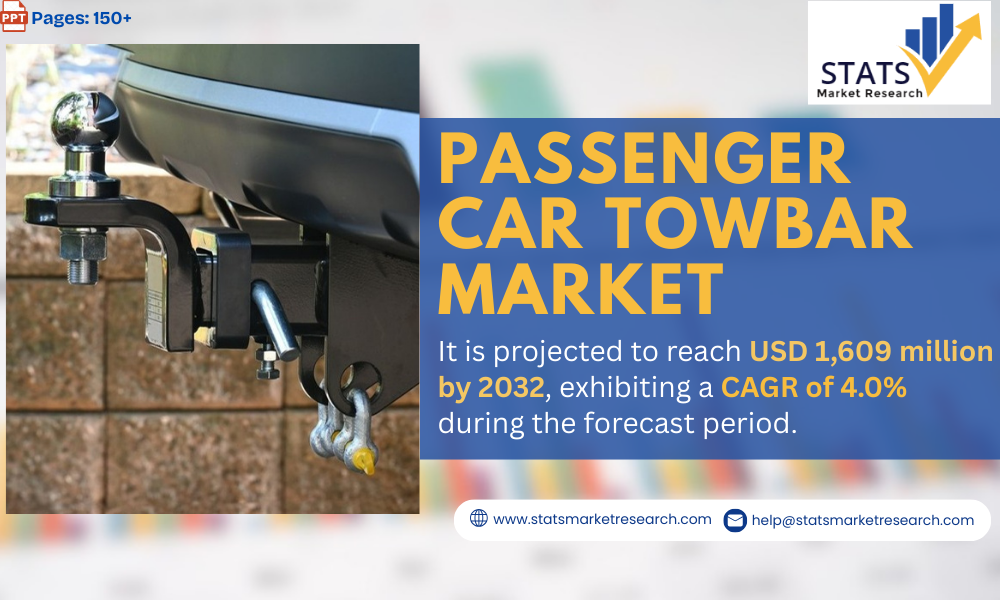
Global Passenger Car Towbar market was valued at USD 1,227 million in 2024 and is projected to reach USD 1,609 million by 2032, growing at a compound annual growth rate (CAGR) of 4.0%.
Download FREE Sample of this Report @ https://www.statsmarketresearch.com/download-free-sample/8058495/global-passenger-car-towbar-forecast-market
This growth reflects increasing vehicle ownership, the expansion of recreational towing activities, and rising adoption of electric vehicles with integrated towbar solutions.
Historically, the market has been driven by the European and North American recreational vehicle sectors, where high caravan ownership correlates with increased demand for towing accessories. Europe alone has over 6 million households owning caravans or motorhomes, generating a strong need for durable fixed and detachable towbars.
The aftermarket segment contributes substantially to market revenue, reflecting vehicle owners’ growing interest in post-purchase upgrades. Modern detachable towbar designs allow installation in under 15 minutes without specialized tools, appealing to DIY automotive enthusiasts. Additionally, the expansion of electric vehicles, particularly SUVs, has created opportunities for premium retractable towbars, integrating smart features like load sensors, braking calibration, and automated deployment systems.
Market Dynamics (Drivers, Restraints, Opportunities, and Challenges)
Drivers
- Expanding Caravan and Recreational Vehicle Market
The rise in caravan and motorhome ownership, especially in Europe and North America, has driven the need for reliable towing solutions. Modern towbars are engineered to handle heavier loads, ensuring safety and stability during recreational activities. - Technological Advancements for Electric Vehicles
With EV adoption approaching 14% of global new car sales, manufacturers increasingly offer factory-installed retractable towbars with smart features. These systems allow seamless integration with vehicle electronics and safety mechanisms, enhancing the multi-functional use of vehicles. - Aftermarket Customization Growth
The aftermarket segment has experienced an annual growth of approximately 8%, fueled by user-friendly detachable towbars and rising DIY culture. Consumers increasingly prioritize features such as quick installation, compatibility with advanced driver assistance systems, and modular designs.
Restraints
- Vehicle Design Constraints
Modern vehicles incorporate complex bumper systems, parking sensors, and rear collision avoidance features, limiting mounting space for traditional towbars. Approximately 30% of new models require substantial design adaptations to accommodate towing solutions. - Regulatory Complexity
Towbar regulations vary across regions, requiring compliance with type approvals, safety testing, and maximum towable weight standards. Europe alone has over 15 national standards, increasing product portfolio complexity and development costs. - Consumer Warranty Concerns
Around 40% of vehicle owners hesitate to install aftermarket towbars due to potential warranty impacts. Despite clarifications in legislation, inconsistent automaker policies and high dealer-installed pricing continue to restrict adoption.
Opportunities
- Smart Towbar Systems
The integration of IoT and connectivity features in towbars presents significant growth potential. Smart systems monitor load distribution, trailer connectivity, and safety diagnostics. These solutions, currently under 5% market penetration, are expected to grow at 15% CAGR, particularly in the premium segment. - Emerging Markets
Asia and South America present untapped potential as recreational vehicle ownership rises alongside disposable incomes. Countries like China and India are witnessing double-digit caravan sales growth, driving towbar demand. - Lightweight Material Innovation
Advanced composite materials, including aluminum alloys and carbon fiber-reinforced polymers, reduce towbar weight by up to 40%, improving EV range and corrosion resistance. While currently under 10% of production, these materials are expected to dominate the premium segment within five years.
Challenges
- Skilled Labor Shortage
A gap of approximately 30% exists between the demand for towbar installation technicians and available skilled labor. Improper installation contributes to 15% of trailer-related accidents, especially for complex retractable systems. - Price Volatility of Raw Materials
Steel and energy price fluctuations impact production costs, squeezing profit margins and leading to market consolidation. - Intellectual Property Threats
Counterfeit towbars account for nearly 20% of the global aftermarket, particularly in price-sensitive regions, posing safety risks and undermining legitimate manufacturers.
Regional Analysis
- Europe: Largest consumer market, driven by recreational vehicle demand and robust OEM partnerships. Fixed towbars dominate here.
- North America: High adoption of aftermarket and OEM towbars, including detachable models for SUVs and pickups.
- Asia-Pacific: Emerging market growth in China, India, and Southeast Asia, fueled by increasing disposable incomes and recreational vehicle adoption.
- Latin America: Rising RV ownership in urban centers presents growth potential.
- Middle East & Africa: Niche demand exists, primarily in urbanized areas and tourist destinations.
Get the Complete Report & TOC @ https://www.statsmarketresearch.com/global-passenger-car-towbar-forecast-market-8058495
Competitor Analysis
The global passenger car towbar market is moderately concentrated, with leading players focusing on innovation, OEM relationships, and regional expansion:
- Brink (DexKo Global Inc., Netherlands): Expanded capabilities through acquisitions, emphasizing detachable and retractable towbar systems.
- Westfalia-Automotive (Germany): Investment in detachable systems and aftermarket solutions.
- Witter Towbars (UK): Strong OEM partnerships in Europe.
- CURT Manufacturing LLC (U.S.) & PCT Automotive (UK): EV-compatible towbar solutions with specialized engineering.
- Regional Players: Jilin Universal Machinery (China), Bosal International (Benelux), Jiechang (China), and Exquisite Automotive (India) leverage localized production and cost-effective solutions.
Global Passenger Car Towbar: Market Segmentation Analysis
This report provides a deep insight into the global Passenger Car Towbar market, covering all its essential aspects. This ranges from a macro overview of the market to micro details of the market size, competitive landscape, development trend, niche market, key market drivers and challenges, SWOT analysis, value chain analysis, etc.
The analysis helps the reader to shape the competition within the industries and strategies for the competitive environment to enhance the potential profit. Furthermore, it provides a simple framework for evaluating and assessing the position of the business organization. The report structure also focuses on the competitive landscape of the Global Passenger Car Towbar market. This report introduces in detail the market share, market performance, product situation, operation situation, etc., of the main players, which helps the readers in the industry to identify the main competitors and deeply understand the competition pattern of the market.
In a word, this report is a must-read for industry players, investors, researchers, consultants, business strategists, and all those who have any kind of stake or are planning to foray into the Passenger Car Towbar market in any manner.
Market Segmentation (by Application)
- OEM (Original Equipment Manufacturer)
- Aftermarket
Market Segmentation (by Type)
- Fixed Towbar
- Subtypes: Single pin, Double pin, Others
- Detachable Towbar
- Retractable Towbar
- Others
Key Company
- Westfalia-Automotive (Germany)
- Brink (DexKo Global Inc.) (Netherlands)
- Witter Towbars (UK)
- CURT Manufacturing LLC (U.S.)
- Jilin Universal Machinery (China)
- GDW Group (Belgium)
- PCT Automotive (UK)
- Tow-Trust Towbars Ltd (UK)
- Bosal International (Belgium)
- Jiechang (China)
- Exquisite Automotive (India)
Geographic Segmentation
- Europe: Germany, Netherlands, UK, Benelux, France
- North America: U.S., Canada, Mexico
- Asia-Pacific: China, India, Southeast Asia
- Latin America: Brazil, Argentina, Chile
- Middle East & Africa: UAE, South Africa, Saudi Arabia
About Us
☎️ International: +1 (332) 2424 294
📄 Website: www.statsmarketresearch.com
Join us on LinkedIn:- https://www.linkedin.com/company/statsmarketresearch




