
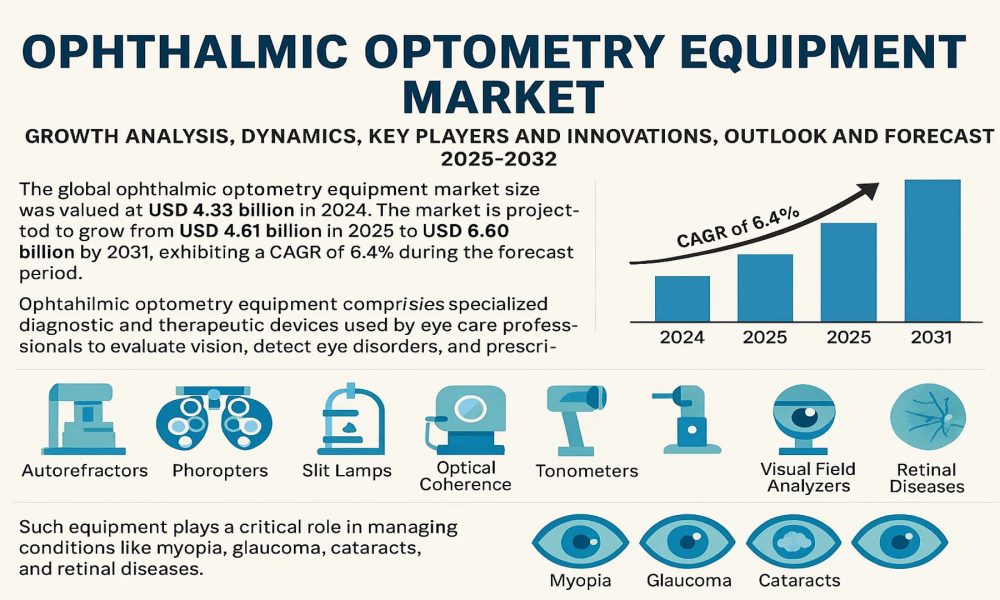
The Global Ophthalmic Optometry Equipment Market size was valued at USD 4.33 billion in 2024. The market is projected to grow from USD 4.61 billion in 2025 to USD 6.60 billion by 2031, exhibiting a CAGR of 6.4% during the forecast period.
Ophthalmic optometry equipment comprises specialized diagnostic and therapeutic devices used by eye care professionals to evaluate vision, detect eye disorders, and prescribe corrective solutions. These tools include autorefractors, phoropters, slit lamps, optical coherence tomography (OCT) systems, tonometers, and visual field analyzers. Such equipment plays a critical role in managing conditions like myopia, glaucoma, cataracts, and retinal diseases.
The market growth is driven by rising global prevalence of eye disorders, with over 2.2 billion people affected by vision impairment according to WHO data. Aging demographics amplify this demand, as individuals aged 60+ face higher risks of conditions like presbyopia and age-related macular degeneration. Technological innovations in digital imaging and AI-powered diagnostics further accelerate adoption, with leading manufacturers like Topcon and Zeiss introducing integrated diagnostic platforms. However, high equipment costs and limited reimbursement policies in developing nations remain key market restraints.
Unlock Your Free Sample Report Here- https://www.intelmarketresearch.com/download-free-sample/9779/ophthalmic-optometry-equipment-market
MARKET DYNAMICS
MARKET DRIVERS
Rising Prevalence of Eye Disorders Boosts Demand for Ophthalmic Equipment
The global burden of vision impairment and eye diseases has been increasing steadily, creating substantial demand for diagnostic and treatment solutions. Over 2.2 billion people worldwide suffer from vision impairment or blindness, with uncorrected refractive errors accounting for the majority of cases. This growing patient pool directly drives the need for advanced ophthalmic optometry equipment in both clinical and retail settings. Conditions such as myopia have seen particularly alarming growth rates, with prevalence reaching nearly 50% among young adults in some regions. This epidemiological shift creates sustained demand for precision diagnostic tools that can accurately assess refractive errors and monitor disease progression.
Technological Advancements Redefine Eye Care Standards
Recent breakthroughs in ophthalmic instrumentation are transforming eye care delivery through enhanced accuracy, efficiency, and patient comfort. Optical coherence tomography (OCT) systems now achieve micron-level resolution, enabling earlier detection of retinal pathologies. The integration of artificial intelligence with diagnostic equipment has improved detection rates for conditions like diabetic retinopathy by over 30%. Modern autorefractors incorporate wavefront technology that provides comprehensive aberration mapping, delivering more precise prescriptions. These technological enhancements not only improve clinical outcomes but also streamline workflow in busy practices, making them essential investments for modern eye care providers.
Aging demographics represent another powerful growth driver, as the risk of vision problems increases significantly after age 40. The global population aged over 60 is projected to double by 2050, creating sustained demand for age-related eye care services and equipment. This demographic shift coincides with rising health awareness and disposable income levels in developing nations, further expanding the addressable market for ophthalmic devices.
MARKET OPPORTUNITIES
Emerging Markets Present Significant Untapped Potential
Developing economies represent the next frontier for ophthalmic equipment growth, as rising healthcare expenditure and expanding middle-class populations create favorable market conditions. Many governments in Asia and Africa have initiated national blindness prevention programs that include subsidies for essential eye care equipment. The establishment of optical retail chains in these regions is driving demand for affordable, high-volume screening devices suitable for mass eye testing campaigns.
Technological innovations that reduce equipment costs while maintaining accuracy could unlock tremendous growth in these price-sensitive markets. Portable, battery-operated devices that deliver clinic-grade diagnostics at a fraction of the cost are particularly well-positioned to succeed. The growing adoption of tele-optometry solutions creates additional demand for connected devices that can capture and transmit standardized eye exam data remotely.
Strategic partnerships between equipment manufacturers and local distributors are proving effective in overcoming infrastructure challenges in emerging markets. These collaborations allow for better after-sales support and maintenance networks, which are critical for building trust with healthcare providers in developing regions. Companies that can adapt their product portfolios and business models to these diverse market conditions stand to gain significant market share in the coming decade.
Segment Analysis:
By Type
- Computer Optometrist
- Phoropter
- Ophthalmic Ultrasound Systems
- Autorefractors
Computer Optometrist dominates due to its automated capabilities, high precision, and efficiency in vision assessment.
By Application
- Optical Shop
- Hospitals
- Ophthalmology Clinics
- Academic Research Centers
Hospitals lead the market, driven by comprehensive diagnostic services and the availability of advanced equipment.
By Technology
- Optical Coherence Tomography (OCT)
- Fundus Camera
- Slit Lamp
- Perimetry
Optical Coherence Tomography (OCT) holds prominence due to its high-resolution imaging capabilities for retinal diagnostics.
By End User
- Optometrists
- Ophthalmologists
- Research Institutions
- Vision Care Centers
Ophthalmologists are the primary adopters, utilizing advanced equipment for detailed clinical assessments.
List of Key Ophthalmic Optometry Equipment Manufacturers
- Topcon Corporation (Japan)
- Carl Zeiss Meditec AG (Germany)
- Nidek Co., Ltd. (Japan)
- Reichert, Inc. (U.S.)
- Essilor Instruments (France)
- Huvitz Co., Ltd. (South Korea)
- Marco Ophthalmic (U.S.)
- Luneau Technology (France)
- Rexxam Co., Ltd. (Japan)
- Righton Co., Ltd. (Japan)
OPHTHALMIC OPTOMETRY EQUIPMENT MARKET TRENDS
Increasing Prevalence of Eye Disorders Drives Market Expansion
The global ophthalmic optometry equipment market is witnessing sustained growth due to the rising prevalence of eye disorders such as myopia, hyperopia, and age-related macular degeneration. Myopia alone affects over 30% of the global population, with rates significantly higher in urbanized regions. As vision impairment becomes more widespread, demand for advanced diagnostic tools like autorefractors, tonometers, and slit lamps has surged. Emerging economies, where access to eye care is improving, are experiencing double-digit growth rates in optometry equipment adoption. This trend is expected to continue as governments and healthcare providers prioritize vision care in public health initiatives.
Other Trends
Technological Integration Reshapes Examination Standards
Digital transformation is revolutionizing eye care diagnostics, with optical coherence tomography (OCT) systems now representing over 35% of premium diagnostic equipment sales. These high-resolution imaging solutions enable earlier detection of glaucoma and retinal diseases compared to traditional methods. Furthermore, the integration of artificial intelligence in devices like fundus cameras improves diagnostic accuracy while reducing examination time. Leading manufacturers are developing hybrid systems that combine multiple diagnostic functions into single platforms, with some next-generation phoropters now incorporating predictive analytics for personalized vision correction.
Demographic Shifts Create Sustained Demand
The aging global population represents a key driver for ophthalmic equipment manufacturers. By 2030, 1 in 6 people worldwide will be aged 60+, significantly increasing the patient pool for presbyopia and cataract treatments. This demographic shift coincides with greater healthcare spending among older adults, particularly in developed markets where comprehensive vision benefits are more prevalent. While North America and Europe currently dominate equipment adoption, the Asia-Pacific region is emerging as a high-growth market due to rapid urbanization and expanding middle-class populations seeking vision correction solutions.
Recent Developments in the Ophthalmic Optometry Equipment Market
- Advancements in AI-Powered Diagnostics
Companies are increasingly integrating artificial intelligence (AI) and machine learning into ophthalmic equipment for early detection of glaucoma, diabetic retinopathy, and macular degeneration. AI-driven imaging solutions are enabling faster and more accurate diagnoses, reducing manual dependency. - Growth in Tele-Optometry Solutions
The rising adoption of telemedicine in eye care has boosted demand for portable ophthalmic devices and cloud-connected diagnostic systems. Companies are launching remote vision testing solutions that allow eye examinations and patient monitoring outside clinical settings. - Introduction of Next-Gen OCT Devices
Several market players have introduced high-resolution Optical Coherence Tomography (OCT) devices with improved imaging depth and speed. These advanced systems support better disease monitoring and treatment planning, particularly for retinal disorders. - Focus on Portable & Handheld Devices
With increasing emphasis on accessibility, manufacturers are developing compact, handheld optometry equipment suitable for rural and home-based eye testing. These devices are gaining popularity in developing regions to address unmet healthcare needs. - Strategic Collaborations & Mergers
Major players are forming strategic partnerships with hospitals, clinics, and research institutes to expand product adoption. Mergers and acquisitions are also reshaping the competitive landscape by enhancing product portfolios and technological capabilities. - Regulatory Approvals & Product Launches
In 2024–2025, multiple companies secured FDA approvals and CE certifications for innovative ophthalmic devices, including digital refraction systems and AI-based fundus cameras. These approvals are accelerating commercialization and global market penetration.
Unlock Your Free Sample Report Here- https://www.intelmarketresearch.com/download-free-sample/9779/ophthalmic-optometry-equipment-market
About Intel Market Research
Intel Market Research delivers actionable insights in technology and infrastructure markets. Our data-driven analysis leverages:
- Real-time infrastructure monitoring
- Techno-economic feasibility studies
Competitive intelligence across 100+ countries
Trusted by Fortune 500 firms, we empower strategic decisions with precision.
International: +1(332) 2424 294 | Asia: +91 9169164321
Website: https://www.intelmarketresearch.com
Follow us on LinkedIn: https://www.linkedin.com/company/intel-market-research




