
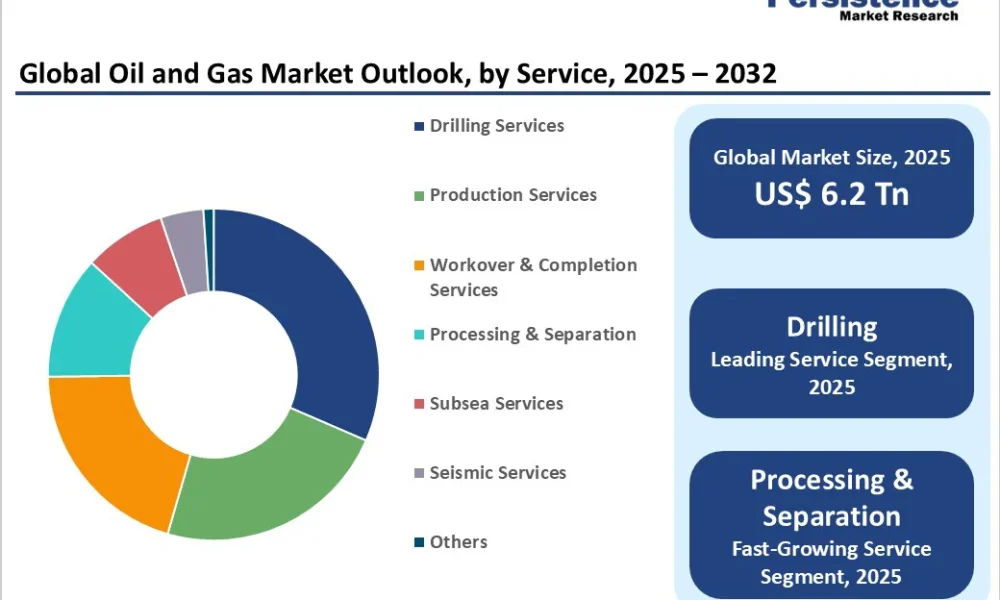
According to Persistence Market Research, the global oil and gas market size is likely to be valued at US$6.2 Trillion in 2025 and is estimated to reach US$8.0 Trillion by 2032, growing at a CAGR of 3.8% during the forecast period 2025–2032. The steady expansion of the oil and gas market is primarily driven by soaring energy demand in emerging economies and robust upstream investments in unconventional resources. As industrialization accelerates and urban populations expand, the consumption of petroleum products, natural gas, and refined fuels continues to rise across power generation, transportation, and manufacturing sectors.
Market statistics reflect a stable yet strategic growth trajectory, supported by long-term supply contracts and sustained capital allocation in exploration and production activities. The upstream segment remains a cornerstone of the global oil and gas industry, benefiting from investments in unconventional resources such as shale formations and deepwater reserves. Geographically, emerging economies represent the leading growth regions due to rising energy consumption and infrastructure expansion. The upstream segment stands out as the leading segment owing to continuous exploration initiatives and technological advancements that improve recovery rates and production efficiency.
Get Your FREE Sample Report Instantly – Click Now : https://www.persistencemarketresearch.com/samples/35744
Key Highlights from the Report
- ➤ The oil and gas market is projected to grow from US$6.2 Trillion in 2025 to US$8.0 Trillion by 2032 at a CAGR of 3.8%.
- ➤ Soaring energy demand in emerging economies is a primary catalyst for market expansion.
- ➤ Robust upstream investments in unconventional resources are strengthening supply capacity.
- ➤ The upstream segment remains dominant due to sustained exploration and production activities.
- ➤ Industrialization and urbanization are fueling consistent petroleum and natural gas consumption.
- ➤ Strategic capital allocation and technological improvements are enhancing operational efficiency across the value chain.
Market Segmentation
The oil and gas market is broadly segmented based on product type into crude oil, natural gas, and refined petroleum products. Crude oil remains a foundational component of the global energy mix, serving as the primary feedstock for refining operations. Natural gas has gained prominence as a cleaner-burning fossil fuel, widely used in power generation and industrial processes. Refined petroleum products such as gasoline, diesel, and jet fuel continue to witness strong demand from the transportation and aviation industries. Each product category plays a critical role in maintaining global energy security and economic stability.
From an operational perspective, the market is segmented into upstream, midstream, and downstream activities. The upstream segment focuses on exploration and production, including investments in unconventional resources that enhance supply resilience. The midstream segment encompasses transportation, storage, and logistics infrastructure that ensures efficient movement of hydrocarbons. The downstream segment includes refining, distribution, and retail operations that deliver finished products to end-users. Among these, the upstream segment leads due to ongoing exploration programs and advancements in extraction technologies.
Customize This Report for Your Exact Requirements : https://www.persistencemarketresearch.com/request-customization/35744
Regional Insights
Emerging economies represent the most dynamic regions within the oil and gas market, driven by expanding industrial bases and increasing energy consumption. Rapid urban development and infrastructure projects are elevating demand for fuels and petrochemical feedstocks. Governments in these regions are encouraging upstream investments to secure domestic energy supplies and reduce import dependency. As a result, exploration and production activities are intensifying, contributing to overall market growth.
Developed markets continue to play a significant role through technological innovation and capital-intensive projects. While energy transition initiatives are gaining attention, conventional oil and gas operations remain critical for meeting baseline energy requirements. Investments in unconventional resources and advanced drilling techniques are sustaining production levels. These regions also contribute to refining capacity expansion and modernization, ensuring efficient processing and distribution of petroleum products.
Market Drivers
The primary driver of the oil and gas market is the soaring energy demand in emerging economies. Industrial expansion, urbanization, and population growth are significantly increasing the need for electricity, transportation fuels, and petrochemical products. As economies modernize, energy-intensive industries such as manufacturing and construction require stable hydrocarbon supplies. This sustained demand directly supports upstream exploration and production activities, reinforcing long-term market growth.
Another major growth driver is robust upstream investment in unconventional resources. Technological advancements in drilling and extraction techniques have improved the feasibility of tapping complex reserves. These investments enhance supply security and diversify production sources, reducing vulnerability to supply disruptions. By unlocking previously inaccessible reserves, companies are strengthening their asset portfolios and supporting steady revenue generation within the oil and gas industry.
Market Restraints
Despite positive growth prospects, the oil and gas market faces certain structural restraints. Price volatility remains a persistent challenge, influencing investment decisions and operational planning. Fluctuations in crude oil prices can impact profitability, particularly for high-cost production projects. Companies must adopt risk management strategies to navigate these uncertainties and maintain financial stability.
Environmental concerns and regulatory pressures also act as constraints on market expansion. Increasing scrutiny of carbon emissions and environmental impact assessments can delay project approvals and raise compliance costs. While oil and gas continue to serve as essential energy sources, regulatory frameworks may influence the pace of new exploration initiatives. These factors require companies to balance operational growth with environmental responsibility.
Market Opportunities
The oil and gas market presents substantial opportunities through strategic investments in unconventional resources. As technology advances, operators can enhance recovery rates and optimize production efficiency. This creates opportunities to extend the lifecycle of existing fields and develop new reserves. Continuous innovation in drilling and reservoir management strengthens competitiveness and operational resilience.
Rising demand for natural gas in power generation and industrial applications also offers growth potential. Natural gas is increasingly preferred for its efficiency and lower emissions profile compared to other fossil fuels. Expanding infrastructure for storage and transportation can unlock new markets and enhance supply chain efficiency. These developments position the oil and gas market for sustained expansion during the forecast period.
Unlock Complete Insights – Buy the Full Report : https://www.persistencemarketresearch.com/checkout/35744
Company Insights
Key players operating in the oil and gas market include:
- Saudi Arabian Oil Company (Aramco)
- Exxon Mobil Corporation
- Shell plc
- BP p.l.c.
- Chevron Corporation
- TotalEnergies SE
- Abu Dhabi National Oil Company (ADNOC)
- PetroChina Company Limited
- Rosneft Oil Company
- Equinor ASA
- Eni S.p.A.
- ConocoPhillips Company
- Occidental Petroleum Corporation
- Petroliam Nasional Berhad
- Woodside Energy Group Ltd.
Recent Developments:
- January 2024 – A leading global energy company announced expanded upstream investments in unconventional resources to strengthen production capacity.
- September 2023 – A major integrated oil and gas player advanced its exploration program to enhance reserve replacement ratios.
Future Opportunities and Growth Prospects
The oil and gas market is expected to maintain steady momentum through 2032, supported by sustained energy demand and continued upstream investments. Strategic focus on unconventional resources, operational efficiency, and infrastructure modernization will shape long-term industry dynamics. As emerging economies expand and technological advancements progress, the global oil and gas industry is positioned to achieve balanced growth while adapting to evolving energy requirements.




