
The Nuclear Magnetic Resonance (NMR) Spectroscopy Market represents a critical pillar of the global analytical instrumentation landscape, underpinning advanced research, industrial quality control, and high-precision molecular characterization across multiple sectors. NMR spectroscopy enables non-destructive, highly reproducible analysis of molecular structure, dynamics, and interactions, making it indispensable in pharmaceuticals, biotechnology, materials science, food testing, petrochemicals, and emerging energy storage research. Unlike many alternative analytical techniques, NMR provides unmatched structural clarity and quantitative reliability, which has positioned it as a gold-standard tool for applications where molecular-level accuracy is non-negotiable.
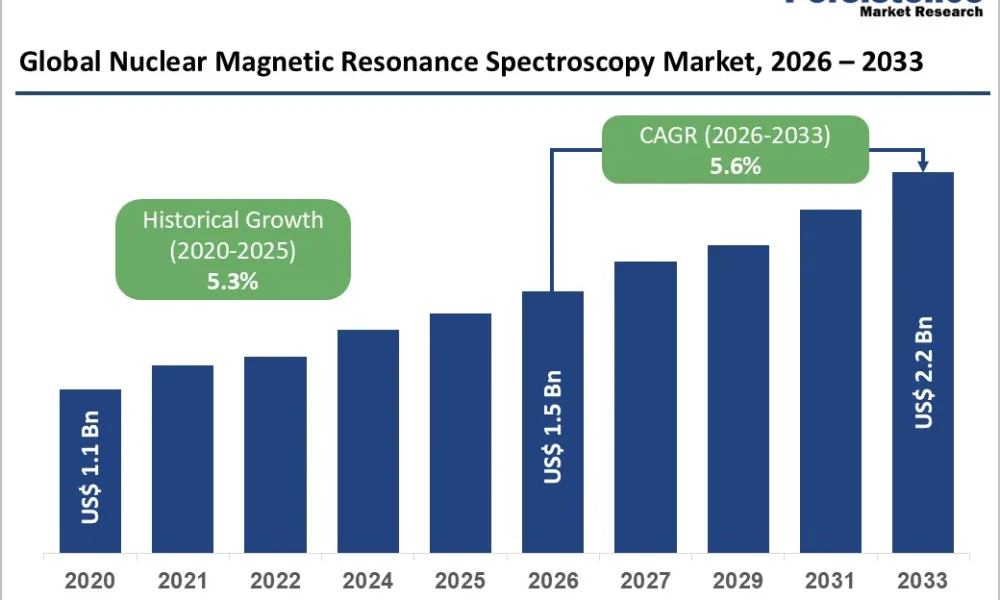
From a market standpoint, the global NMR spectroscopy market is projected to be valued at approximately US$ 1.5 billion in 2026 and is expected to reach US$ 2.2 billion by 2033, expanding at a compound annual growth rate (CAGR) of around 5.6% during the forecast period from 2026 to 2033. This sustained growth trajectory is primarily fueled by rising pharmaceutical and biotechnology R&D spending, increasing adoption of high-field NMR systems in structural biology and drug discovery, and the rapid expansion of battery and advanced materials research programs worldwide. Among market segments, pharmaceutical companies and contract research organizations (CROs) currently represent the leading end-user segment due to their extensive reliance on NMR for structural elucidation, impurity profiling, and regulatory compliance. Geographically, North America dominates the global market with an estimated 40% share, supported by a strong pharmaceutical R&D ecosystem, the presence of leading NMR manufacturers, and well-established academic research networks, while Asia Pacific is emerging as the fastest-growing regional market driven by expanding research infrastructure and government-backed scientific investment.
Download Your Free Sample & Explore Key Insights: https://www.persistencemarketresearch.com/samples/15007
Key Highlights from the NMR Spectroscopy Market Report
• The global NMR spectroscopy market is expected to grow from US$ 1.5 billion in 2026 to US$ 2.2 billion by 2033, registering a CAGR of approximately 5.6%.
• North America is projected to remain the dominant region, accounting for nearly 40% of global market revenue in 2026.
• Pharmaceutical companies and CROs constitute the largest end-user segment, driven by extensive use of NMR in drug discovery and quality assurance.
• Asia Pacific is anticipated to be the fastest-growing regional market due to expanding pharmaceutical manufacturing and academic research investments.
• High-field NMR systems represent the leading product segment owing to their superior spectral resolution and sensitivity.
• Increasing adoption of NMR in battery research and metabolomics is opening new avenues for market expansion.
Market Segmentation Analysis
The nuclear magnetic resonance spectroscopy market can be segmented based on product type, application, and end-user, each contributing uniquely to overall market growth and technology adoption. By product type, the market is broadly divided into high-field NMR systems and low-field or benchtop NMR systems. High-field NMR instruments, typically operating above 300 MHz, dominate the market in revenue terms due to their exceptional spectral resolution and sensitivity, which are critical for complex molecular analysis in pharmaceutical R&D, structural biology, and advanced materials research. These systems are widely adopted by large pharmaceutical companies, academic research institutions, and national laboratories where analytical accuracy directly impacts research outcomes and regulatory approvals.
Low-field and benchtop NMR systems, while accounting for a smaller share of current revenue, are experiencing rapid adoption across industrial and quality control settings. Their compact design, lower capital cost, and ease of operation make them attractive for routine analysis in food authentication, petrochemical processing, polymer testing, and chemical manufacturing. As industries increasingly seek decentralized and real-time analytical solutions, benchtop NMR instruments are gaining traction as practical alternatives for process monitoring and quality assurance.
From an application perspective, pharmaceuticals and biotechnology represent the largest application segment, supported by the critical role of NMR spectroscopy in drug discovery, formulation development, impurity analysis, and regulatory documentation. Beyond life sciences, the energy and battery research segment is emerging as a high-growth application area, as NMR plays a vital role in studying ion transport, electrolyte stability, and solid-state materials used in next-generation energy storage systems. Additional applications in food and beverage testing, petrochemicals, and materials science further diversify the market and enhance its long-term resilience.
End-user segmentation highlights pharmaceutical companies and CROs as the leading consumers of NMR technology, driven by increasing outsourcing of research activities and the need for high-throughput, regulatory-compliant analytical services. Universities and research centers are the fastest-growing end-user group, benefiting from increased government funding, modernization of research infrastructure, and rising demand for high-field NMR systems to support advanced scientific research.
Regional Insights into the NMR Spectroscopy Market
Regional dynamics play a significant role in shaping the competitive and technological evolution of the NMR spectroscopy market. North America continues to lead the global market, supported by a highly developed pharmaceutical and biotechnology sector, substantial R&D expenditure, and the presence of major NMR instrument manufacturers. The United States, in particular, benefits from stringent regulatory standards enforced by agencies such as the FDA, which necessitate robust analytical validation throughout the drug development lifecycle. Additionally, strong collaboration between academic institutions, healthcare systems, and industry players has accelerated the adoption of NMR in metabolomics, translational medicine, and personalized healthcare research.
Europe holds a substantial share of the global NMR spectroscopy market, driven by its strong pharmaceutical manufacturing base, well-established chemical industry, and world-class academic research institutions. Countries such as Germany, Switzerland, and the United Kingdom are at the forefront of high-field NMR adoption, leveraging the technology for drug discovery, materials science, and quality control. The regulatory environment governed by the European Medicines Agency further reinforces the use of precise analytical tools, while collaborative research initiatives between universities and industry continue to foster innovation in NMR methodologies and applications.
Asia Pacific is poised to be the fastest-growing regional market over the forecast period, fueled by rapid expansion of pharmaceutical manufacturing, biotechnology research, and academic infrastructure. China, India, Japan, and South Korea are making significant investments in scientific research and analytical capabilities, enabling broader adoption of both high-field and benchtop NMR systems. Government funding, coupled with the growth of CROs and specialized analytical service providers, is creating a robust ecosystem for NMR technology deployment. The region’s increasing focus on electric vehicles, energy storage, and advanced materials research further amplifies demand for NMR spectroscopy as a core analytical tool.
Get Custom Insights Designed for Your Business: https://www.persistencemarketresearch.com/request-customization/15007
Market Drivers
The primary driver of growth in the nuclear magnetic resonance spectroscopy market is the substantial increase in pharmaceutical and biotechnology R&D expenditure worldwide. As drug development pipelines become more complex, encompassing biologics, gene therapies, and advanced drug delivery systems, the demand for precise and reproducible molecular characterization tools has intensified. NMR spectroscopy provides unparalleled insights into molecular structure and dynamics, enabling researchers to validate compound identity, assess purity, and ensure compliance with regulatory standards. This growing reliance on data-driven research and quality assurance continues to reinforce NMR adoption across pharmaceutical value chains.
Another significant driver is the expanding application of NMR spectroscopy in clinical diagnostics and metabolomics. The technique’s ability to deliver highly reproducible metabolic profiles with minimal sample preparation makes it particularly attractive for biomarker discovery and precision medicine initiatives. Hospitals, clinical research centers, and academic medical institutions are increasingly integrating NMR into their diagnostic workflows to support early disease detection, longitudinal patient monitoring, and personalized therapeutic strategies. These trends are elevating NMR from a purely research-focused tool to a critical component of translational and clinical research infrastructure.
Market Restraints
Despite its analytical advantages, the NMR spectroscopy market faces notable restraints stemming from the availability of alternative analytical techniques. Technologies such as mass spectrometry, infrared spectroscopy, chromatography, and X-ray diffraction often offer faster throughput, lower operational complexity, and reduced capital investment. Many laboratories, particularly those operating under budget constraints or high-volume testing requirements, opt for these alternatives due to their ease of integration into automated workflows and lower total cost of ownership.
Additionally, high-field NMR systems require significant upfront investment, specialized infrastructure, and skilled personnel for operation and maintenance. These factors can limit adoption among smaller organizations and emerging research facilities, particularly in cost-sensitive markets. The need for cryogenic systems and ongoing maintenance further adds to operational expenses, prompting some end-users to prioritize more economical analytical solutions for routine applications.
Market Opportunities
The growing adoption of NMR spectroscopy in energy storage and battery research presents a compelling opportunity for market expansion. As global efforts to transition toward electric mobility and renewable energy intensify, there is increasing demand for analytical tools capable of characterizing complex battery materials and electrolyte systems. NMR’s ability to probe ion transport mechanisms and material stability at the molecular level positions it as a critical enabler of innovation in this space.
Another major opportunity lies in the continued development of compact, benchtop NMR systems designed for industrial and quality control applications. These systems lower the barrier to entry for NMR adoption, enabling broader use across food testing, petrochemical processing, and chemical manufacturing. Advances in automation, software integration, and data analytics are further enhancing the usability and commercial appeal of NMR spectroscopy, opening new growth avenues beyond traditional research environments.
Checkout Now & Download Complete Market Report: https://www.persistencemarketresearch.com/checkout/15007
Company Insights
The nuclear magnetic resonance spectroscopy market is moderately consolidated, with a group of established players accounting for a significant share of global revenue. These companies compete on the basis of technological innovation, spectral performance, automation capabilities, and global service networks.
• Bruker Corporation
• JEOL Ltd.
• Oxford Instruments plc
• Agilent Technologies
• Magritek
• Nanalysis Scientific
• Anasazi Instruments
• Spinlock
• Cryogenic Ltd.
• QOneTec
• Thermo Fisher Scientific
• Shimadzu Corporation
• HITACHI High-Tech
• Waters Corporation
Recent market developments highlight the pace of innovation within the industry. In April 2025, Bruker Corporation launched the Fourier 80 “Multi-Talent” benchtop FT-NMR spectrometer, enabling multinuclear analysis without probe retuning and expanding NMR accessibility across diverse industrial applications. Earlier, in August 2025, researchers at Purdue University achieved atomic-scale NMR spectroscopy using carbon-13 isotopes in two-dimensional materials, demonstrating unprecedented resolution and opening new possibilities in quantum sensing and advanced materials research.
Market Segmentation
By Product Type
- Low-field NMR Spectroscopy
- High-field NMR Spectroscopy
By Application
- Pharmaceuticals & Biotechnology
- Academic & Research Institutes
- Chemical & Petrochemical Analysis
- Food & Beverage
- Materials Science
- Energy/Battery Research & Quality Control
- Clinical & Diagnostic
By End-User
- Pharmaceutical Companies & Contract Research Organizations (CROs)
- Biotechnology Companies
- Universities & Research Centers
- Hospitals & Clinical Labs
- Industrial R&D and Quality Control Labs
By Region
- North America
- Europe
- East Asia
- South Asia & Oceania
- Latin America
- Middle East & Africa
Conclusion
The Nuclear Magnetic Resonance (NMR) Spectroscopy Market is positioned for steady and resilient growth, driven by expanding pharmaceutical R&D, rising adoption in clinical diagnostics and metabolomics, and emerging applications in energy storage and advanced materials research. While competition from alternative analytical techniques and high capital costs pose challenges, ongoing technological innovation, particularly in benchtop and application-specific NMR systems, is broadening market accessibility and use cases. With North America maintaining its leadership, Asia Pacific accelerating rapidly, and Europe sustaining strong adoption across industrial and academic sectors, the global NMR spectroscopy market is set to remain a cornerstone of high-precision analytical science well into the next decade.




