
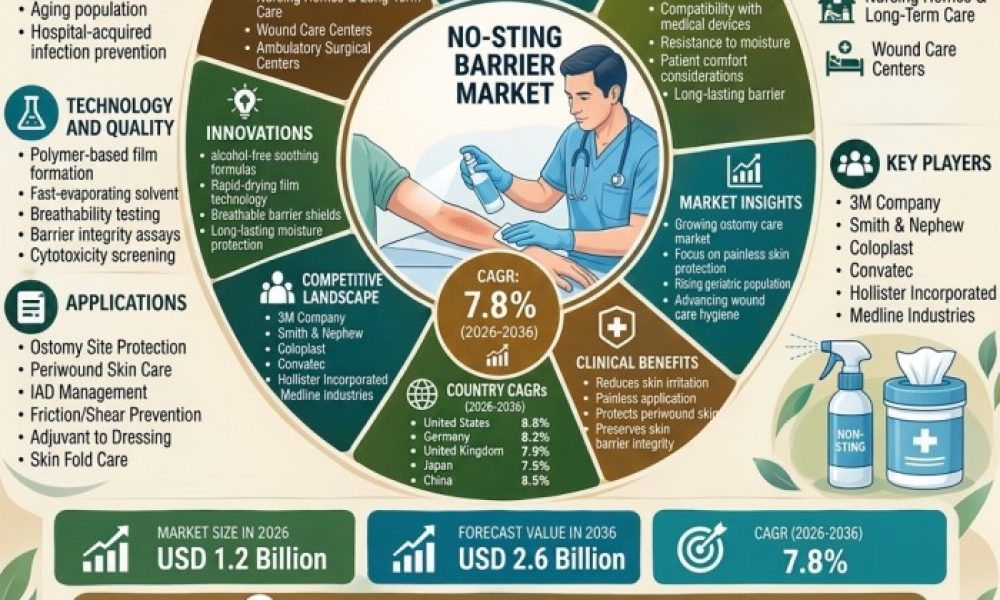
Rockville, Maryland — October 7, 2026 : The global No Sting Barrier market is estimated at USD 438.4 million in 2026 and is projected to reach USD 878.7 million by 2036, expanding at a 7.2% CAGR during the forecast period. Rising emphasis on skin integrity, moisture-associated skin damage prevention, wound management, ostomy care, and protection against repeated medical adhesive exposure is strengthening demand for no sting barrier products across hospitals, long-term care facilities, and home healthcare settings.
Get detailed market forecasts, competitive benchmarking, and pricing trends:
What is driving demand for no sting barrier products?
Growing attention to prevention of moisture-associated skin damage is a major factor supporting market expansion. Clinical care pathways increasingly use barrier preparations to protect vulnerable skin from moisture, incontinence, wound exudate, cleansing, and repeated adhesive contact. Recurring requirements in ostomy and wound care further support product consumption because patients may need ongoing skin protection alongside dressings, appliances, and continence-management routines. Expansion of long-term and home care is also creating opportunities as healthcare providers seek products that can be applied consistently without adding irritation to already sensitive skin.
Which product segment leads the No Sting Barrier market?
Barrier Films account for 42.7% of the product segment in 2026, making them the leading product category. Their thin protective layer is suitable for wound edges, peristomal skin, and moisture-exposed areas while avoiding the heavier coating associated with some topical barriers. The report highlights their usefulness across wound dressings, ostomy appliances, and skin exposed to urine, feces, or adhesive removal.
Other important market segments include Wound Care, which represents 36.9% of application demand in 2026, and Hospitals, which account for 44.8% of end use. Spray products hold 31.6% of the form segment, supported by their ability to cover wider or irregular areas without rubbing irritated skin. Silicone-based ingredients lead with a 53.1% share, reflecting demand for sting-free, fast-drying protection compatible with repeated skin-care applications.
How are key countries shaping market growth?
Germany is forecast to record the fastest growth among the countries highlighted in the report, advancing at an 8.3% CAGR between 2026 and 2036. Its aging population, established healthcare infrastructure, and emphasis on infection prevention and long-term care are supporting demand. Destatis reported 5.69 million people requiring long-term care in 2023, with 86% receiving care at home, creating a substantial base for recurring continence and skin-protection requirements.
Brazil follows with a projected 7.6% CAGR. Public healthcare services for people living with stomas include self-care education, peristomal skin assessment, complication prevention, and access to collection equipment and protective adjuncts. These structured care pathways support recurring demand for no sting barriers and create opportunities for suppliers offering practical formats and clear application guidance.
The United States is expected to expand at a 6.8% CAGR through 2036. Medicare coverage of medically necessary ostomy supplies, together with extensive nursing-home and home-health networks, provides a broad institutional base for wound, continence, ostomy, and skin-integrity management. The country also benefits from advanced healthcare infrastructure and established adoption of specialized skin-protection products.
Who are the major No Sting Barrier market players?
The competitive landscape includes 3M, Cardinal Health, Smith+Nephew, Convatec, Medline, Coloplast, Hollister, Clinimed, Welland Medical, and Safe n’ Simple. Companies are differentiating through silicone-based formulations, hypoallergenic compositions, spray delivery, skin-friendly films, and products designed for ostomy and wound-care applications.
Unlock 360° insights for strategic decision making and investment planning:
What opportunities lie ahead for the market?
Future opportunities are emerging around alcohol-free silicone films and sprays, hospital procurement standardization, portable home-care formats, and products compatible with wound dressings and ostomy appliances. However, suppliers must address price pressure, formulary substitution, potential adhesion issues caused by incorrect application, and the need for healthcare staff to match products with the severity of skin damage.
As healthcare systems place greater emphasis on preventive skin care and consistent clinical protocols, no sting barrier products are expected to gain a broader role across institutional and home-based care. Fact.MR’s detailed market study provides further analysis of market size, segment performance, country-level growth, competitive positioning, and strategic opportunities through 2036.
Explore More Related Studies Published by Fact.MR Research
Non-Invasive Diagnostic Tests Market
CPAP Humidifier Chambers Market
About Fact.MR
Fact.MR is a market research and consulting firm providing syndicated research, customized research, investment research, and market intelligence across a broad range of industries. Its research coverage includes food and beverage, healthcare, pharmaceuticals, biotechnology, consumer products, chemicals and materials, technology, industrial goods, and packaging.
Fact.MR provides market intelligence designed to help organizations understand market dynamics, emerging opportunities, competitive developments, and changing industry requirements.
Media Contact
Fact.MR
Email: [email protected]
Phone: +1 (628) 251-1583
Website: www.factmr.com



