
Nitro Aromatics Market: Overview, Growth Drivers & Future Outlook
Nitro aromatics are a core class of organic chemicals characterized by one or more nitro groups (-NO₂) attached to an aromatic ring. These compounds serve as essential intermediates in multiple major industrial value chains, and their unique chemical reactivity makes them indispensable in the manufacturing of explosives, agrochemicals, dyes and pigments, pharmaceuticals, polyurethanes, and other specialty chemicals. The global nitro aromatics market has established itself as a strategic segment within the broader chemicals industry, with consistent growth driven by both industrialization and evolving end-use demand. Recent market research highlights robust expansion through the forecast period of 2026–2033, supported by expanding chemical production capacities, infrastructure investment, and increasing consumption across both developed and emerging regions.
What Are Nitro Aromatics and Why Do They Matter?
Nitro aromatics include compounds such as nitrobenzene, nitrochlorobenzene, dinitrotoluene (DNT) and other nitro substituted aromatics. These compounds are vital intermediates in many downstream manufacturing processes:
- Nitrobenzene is a key precursor for aniline, which is further used to produce methylene diphenyl diisocyanate (MDI) — a major ingredient for polyurethane foams in automotive, construction, furniture, and insulation applications.
- Dinitrotoluene and related compounds are used in explosives and technical chemicals.
- Other nitroaromatics feed into the manufacture of agrochemicals, pharmaceuticals, dyes, and polymer intermediates.
Their versatility and industrial value make nitro aromatics foundational to sectors ranging from agriculture and mining to healthcare and consumer products.
Get Your FREE Sample Report Instantly – Click Now: https://www.persistencemarketresearch.com/samples/32407
Market Size and Growth Forecast
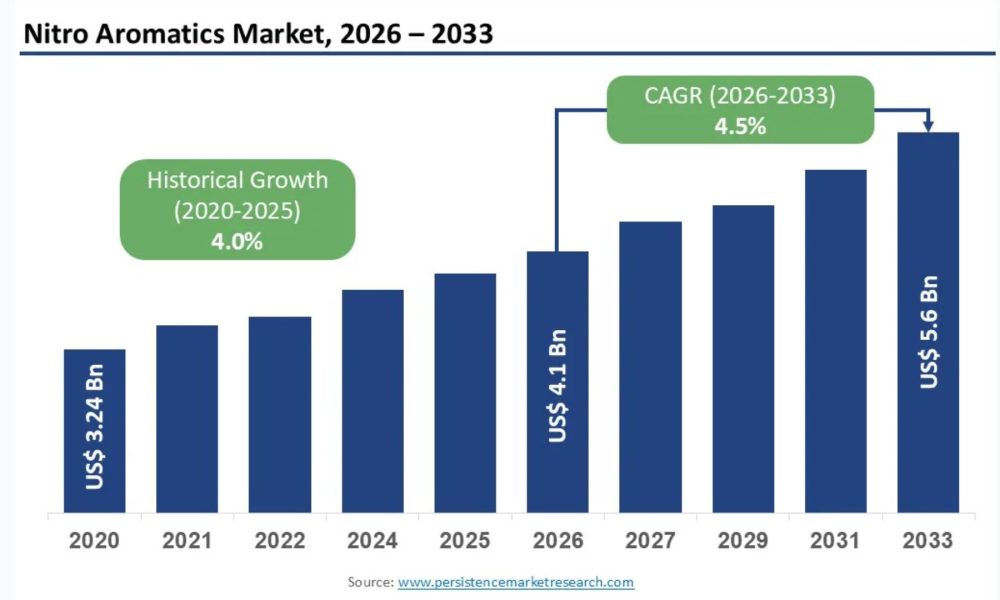
The Nitro Aromatics Market was valued at approximately US$ 4.1 billion in 2026 and is projected to reach around US$ 5.6 billion by 2033, growing at a compound annual growth rate (CAGR) of about 4.5% over the forecast period. This reflects ongoing demand from core industrial sectors and relative resilience even amid regulatory and economic challenges.
The market’s moderate yet steady growth is underpinned by multiple factors — expanding applications in end-use industries, incremental demand tied to infrastructure expansion, and strategic investments that bolster manufacturing capacities in key producing regions.
Key Growth Drivers
- Expanding End-Use Industries
One of the strongest drivers of nitro aromatics demand is their wide range of applications:
- Polyurethanes & Construction: Nitrobenzene is essential for producing aniline, which feeds into MDI and polyurethane foam. Rising construction projects — residential, industrial, and infrastructure — boost demand for polyurethane materials used in insulation, packaging, and comfort components.
- Agriculture & Agrochemicals: Nitro aromatic derivatives serve as precursors for herbicides, fungicides, and other crop protection chemicals. As global agricultural modernization advances, especially in Asia Pacific, demand for effective agrochemical inputs drives nitro aromatic consumption.
- Pharmaceuticals: Nitro aromatics have roles in the synthesis of key pharmaceutical intermediates. For instance, paracetamol production involves nitrobenzene reduction to aniline, making this segment a consistent market contributor.
- Explosives & Defense: Compounds such as DNT and TNT are foundational for military and industrial explosives, sustaining demand linked to defense spending and mining operations.
These broad industrial applications help buffer the market against short-term cyclical slowdowns in any single sector.
- Regional Industrialization and Manufacturing Expansion
Geographically, the Asia Pacific region dominates the nitro aromatics market, holding around 42% of global market share. This leadership position stems from rapid industrialization, strong chemical manufacturing capacities, and growing downstream industries in countries like China and India. China, in particular, is the largest global producer of nitrobenzene and aniline — foundational intermediates for polyurethane and pharmaceuticals — whereas India is emerging as a major growth market across agrochemical and pharma sectors.
North America and Europe also represent significant markets:
- North America sees growth owing to expanding automotive and pharmaceutical sectors along with defense expenditure that supports demand for explosives and high-performance chemicals.
- Europe is characterized by advanced chemical infrastructure, stringent environmental standards, and innovation in sustainable chemical processing — contributing to stable, quality-focused nitro aromatic consumption.
Get a Customized Market View in One Click: https://www.persistencemarketresearch.com/request-customization/32407
Market Challenges and Restraints
Despite strong fundamentals, the nitro aromatics market faces noteworthy challenges:
- Regulatory and Environmental Pressure
Nitroaromatic compounds are subject to stringent regulatory oversight due to concerns about toxicity, environmental persistence, and health risks. For example:
- Several nitroaromatic substances are regulated as priority pollutants in soil and groundwater, requiring costly monitoring and compliance measures.
- Regulations such as the EU’s REACH framework demand comprehensive safety assessments, increasing operational costs for manufacturers.
These regulatory constraints can restrain market growth by elevating compliance burdens and limiting or phasing out certain high-risk compounds.
- Raw Material Volatility and Supply Risks
Nitro aromatics production depends on precursors like benzene, toluene, nitric acid, and other petrochemical intermediates. Fluctuating crude oil prices and geopolitical disruptions can trigger volatile raw material costs. Additionally:
- A concentrated global production footprint — especially in China, Europe, and the U.S. — introduces geographic supply risks.
- Supply chain disruptions, whether from logistics challenges or geopolitical tensions, can impact the timely availability of key inputs.
Such volatility places pressure on profit margins and operational planning, particularly for smaller producers.
Emerging Opportunities
- Electric Vehicles and Emerging Applications
The rapid transition to electrified mobility presents new growth vectors. Nitro aromatics support polyurethane materials used in battery insulation, lightweight vehicle interiors, and acoustic systems — applications critical for electric vehicle (EV) performance and passenger comfort. China’s leadership in EV production — accounting for over half of global output — highlights this emerging opportunity.
- Sustainability and Bio-Based Chemistry
The chemical industry’s shift toward greener production methods opens niches for sustainable nitro aromatic derivatives:
- Companies are investing in bio-based feedstocks and green chemistry technologies to reduce environmental footprints and comply with evolving standards.
- Eco-friendly formulations and low-VOC products are becoming key differentiators in developed markets where sustainability credentials influence purchase decisions.
These shifts not only help mitigate regulatory risks but also create premium markets for differentiated, environmentally responsible products.
Competitive Landscape
The nitro aromatics market is moderately concentrated, with key global players controlling substantial production capacity and international market reach. Major corporations shaping the market include:
- Wanhua Chemical Group Co., Ltd. — a global leader in MDI and associated intermediates.
- BASF SE — with integrated chemical operations spanning Europe, North America, and Asia.
- Covestro AG — focused on innovation and specialty chemicals.
- Huntsman Corporation, Dow Inc., SABIC, Mitsubishi Chemical, LG Chem, Eastman Chemical, Chemours, and Aarti Industries Ltd. — among other influential producers.
Competition revolves around production scale, technological proficiency, and the ability to innovate toward sustainable offerings.
For In-Depth Competitive Analysis, Buy Now: https://www.persistencemarketresearch.com/checkout/32407
Future Outlook
As global industrial activity expands, the nitro aromatics market is projected to sustain moderate growth through 2033 and beyond. While regulatory and environmental concerns will continue shaping production practices, rising demand across construction, automotive, agriculture, and pharmaceutical sectors offers a stable demand base. Strategic investments in sustainable technologies, capacity expansions in emerging markets, and integration with modern manufacturing ecosystems are expected to unlock long-term opportunities.
Overall, the nitro aromatics market exemplifies the interplay between core chemical intermediates and broad industrial value chains, underscoring its importance in modern manufacturing and economic development.
About Persistence Market Research:
Persistence Market Research delivers strategic research solutions that drive business growth. Founded in 2012 and registered in England and Wales in 2023 as Persistence Research & Consultancy Services Ltd., we have completed 3,600+ custom and syndicated studies and supported 2,700+ projects for leading research firms. Combining traditional methodologies with modern tools, we provide actionable insights to multinational corporations, consultants, investors, and government bodies, earning strong trust through long-term client relationships.
Contact Us:
Persistence Market Research
Second Floor, 150 Fleet Street,
London, EC4A 2DQ, United Kingdom
USA Phone: +1 646-878-6329
UK Phone: +44 203-837-5656
Email: [email protected]
Web: https://www.persistencemarketresearch.com




