
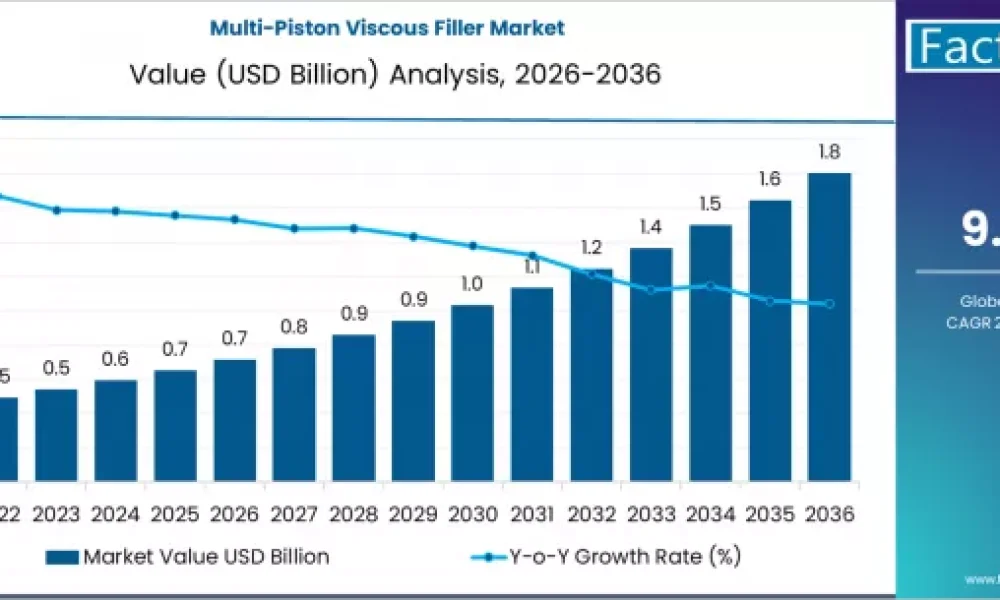
The global multi-piston viscous filler market is projected to experience robust growth over the next decade, driven by increasing demand for precision filling of high-viscosity liquids and pastes across multiple industries. In 2026, the market is estimated at approximately USD 680 million, with forecasts suggesting it could reach around USD 1,720 million by 2036, representing a compound annual growth rate (CAGR) of approximately 9.7%. The steady expansion reflects growing investment in automation, rising consumption of packaged goods, and the adoption of high-precision filling technologies in food, beverage, pharmaceutical, cosmetic, and chemical sectors.
Multi-piston fillers are increasingly preferred over traditional gravity or pump-based filling systems due to their ability to handle viscous and shear-sensitive products with high accuracy. The versatility of these fillers, combined with advancements in automation, is enabling manufacturers to optimize production efficiency, reduce waste, and maintain consistent product quality.
To access the complete data tables and in-depth insights, request a Discount On The Report here: https://www.factmr.com/connectus/sample?flag=S&rep_id=13553
Key Growth Drivers
1. Precision and Automation
Precision and automation are primary drivers for the market. Multi-piston fillers provide repeatable and accurate dosing, which is critical for high-value or sensitive products such as sauces, creams, gels, and pharmaceutical pastes. Automation also allows for reduced labor costs, shorter production cycles, and better compliance with hygiene and regulatory standards, making these systems increasingly attractive for large-scale manufacturing.
2. Rising Demand for High-Viscosity Products
The demand for high-viscosity and chunky products has increased significantly, particularly in the food, cosmetics, and personal care industries. Products such as sauces with suspended solids, creams, gels, and heavy pastes require robust filler designs capable of handling viscous material without compromising fill consistency. Multi-piston systems are uniquely suited for this task, offering precise volumetric control and minimal product damage during filling.
3. Integration of Smart Technology
Industry 4.0 technologies, including smart sensors, predictive maintenance, and real-time monitoring, are being integrated into multi-piston filling machines. These features enable manufacturers to achieve higher operational efficiency, reduce downtime, and monitor critical parameters such as fill weight, viscosity, and line speed. The growing adoption of connected platforms is expected to drive market expansion, particularly in highly regulated industries like pharmaceuticals and food processing.
4. Sustainability and Waste Reduction
Sustainability considerations are increasingly influencing purchasing decisions. Accurate filling reduces product giveaway and minimizes cleaning and maintenance requirements, helping manufacturers meet environmental standards. Waste reduction and energy efficiency are now key criteria for companies seeking to modernize their production lines, further boosting the adoption of multi-piston fillers.
Market Segmentation
By Filler Type
Servo-driven multi-piston fillers account for the largest share of the market due to their high precision, speed, and flexibility. Volumetric, rotary, and inline piston fillers also have significant adoption in specialized applications. The choice of filler type is often determined by product viscosity, container type, and required production speed.
By Viscosity Range
High-viscosity and chunky product fillers dominate the market, reflecting strong demand for foods, personal care products, and industrial pastes that require robust and precise handling. These machines are capable of filling products that cannot be processed effectively with conventional gravity or pump-based systems.
By Technology
CIP/SIP (Clean-in-Place / Sterilize-in-Place) ready systems with hygienic design and quick changeover capabilities are increasingly standard, particularly in the food, beverage, and pharmaceutical sectors. Modular systems allow manufacturers to reconfigure lines for multiple products, maximizing operational flexibility.
By Application
Food and beverage processing, including sauces, creams, dairy products, and condiments, accounts for the largest share of demand. Cosmetics and personal care products represent a fast-growing segment due to rising global consumption and increasing preference for automated, hygienic filling. Pharmaceuticals and chemicals represent a smaller but high-value segment, requiring precision and compliance with strict regulatory standards.
Regional Hotspots
Asia-Pacific is the fastest-growing region, driven by expanding mid-tier and small-to-medium manufacturing enterprises and increasing adoption of automation. India and China are leading growth markets, with CAGRs of 12.8% and 11.5%, respectively. The United States, while experiencing slower growth at 8.4%, remains a major market due to its mature packaged goods sector. Brazil and Germany also represent significant regional markets, with CAGRs of 8.2% and 7.8%, respectively, reflecting growth in the food, beverage, and personal care industries.
The regional variation in market growth is influenced by factors such as industrial capacity expansion, automation adoption, labor costs, and the prevalence of regulatory standards. Asia-Pacific’s rapid industrialization and competitive pricing from local OEMs make it a hotspot for market expansion, whereas mature markets in North America and Europe emphasize high-end, automated, and hygienically designed equipment.
Competitive Landscape
The multi-piston viscous filler market is competitive and characterized by technological innovation, customization, and global service networks. Leading manufacturers focus on product development, automation, precision engineering, and modular system design to differentiate their offerings. The competitive landscape includes multinational suppliers with high-speed automated solutions and regional OEMs offering cost-effective and configurable equipment. Companies compete primarily on precision, production speed, hygienic design, technology integration, and service support.
Pricing Trends and Benchmarking
Pricing for multi-piston fillers varies based on automation level, filler capacity, product viscosity range, and hygienic compliance features. Advanced systems with servo-driven automation, CIP/SIP readiness, and smart sensors command premium pricing. Economies of scale reduce unit costs for high-volume installations, while regional OEMs in emerging markets provide more cost-competitive options.
Overall, manufacturers are balancing initial capital expenditure against long-term savings in product waste reduction, energy efficiency, labor cost reduction, and production reliability. The trend toward modular, flexible, and automated systems indicates that investment in high-performance multi-piston fillers is increasingly seen as a strategic priority for growth-oriented manufacturers.
Key Challenges
Despite strong growth, the market faces challenges. Multi-piston fillers are high-capital equipment, which can limit adoption among smaller manufacturers. Integration complexity, operator training, and maintenance requirements add to upfront costs. Products with extreme rheological behavior or high particulate content may require specialized engineering solutions, increasing system cost and setup complexity.
Conclusion
The multi-piston viscous filler market is poised for significant growth from 2026 to 2036, driven by precision filling requirements, rising demand for high-viscosity products, and the adoption of automation and smart manufacturing technologies. Regional hotspots, particularly in Asia-Pacific, are expected to drive global expansion, while mature markets will continue to focus on advanced, hygienic, and highly automated systems. With increasing emphasis on operational efficiency, sustainability, and product quality, multi-piston fillers are becoming a core component of modern production lines across food, beverage, pharmaceutical, cosmetic, and chemical industries. Strategic investments in technology, modularity, and automation will define the competitive landscape over the next decade.
Have a specific Requirements and Need Assistant on Report Pricing or Limited Budget please contact us – [email protected]
To View Related Report :
Combination Filler Machine Market https://www.factmr.com/report/3687/combination-filler-machine-market
Spill Kits Market https://www.factmr.com/report/spill-kits-market
Spill Containment Systems Market https://www.factmr.com/report/spill-containment-systems-market
Safety Cabinets Market https://www.factmr.com/report/safety-cabinets-market



