
The motorized quadricycle market is emerging as a critical component of modern urban mobility, offering compact, efficient, and cost-effective transportation solutions. According to Persistence Market Research, motorized quadricycles are increasingly adopted in dense metropolitan environments where traditional passenger vehicles face limitations due to congestion and parking constraints. These lightweight vehicles combine the benefits of motorcycles and small cars, delivering enhanced maneuverability, reduced emissions, and lower ownership costs. Urban planners and municipal authorities are also supporting quadricycles as part of sustainable transport initiatives. Growing environmental awareness, stricter emission regulations, and rising fuel prices are reinforcing the demand for fuel-efficient mobility alternatives. In addition, technological improvements in electric drivetrains and safety features are boosting consumer confidence. These vehicles are especially popular among first-time buyers, urban commuters, and fleet operators seeking economical transportation solutions. Overall, motorized quadricycles are becoming essential in reshaping last-mile and urban mobility ecosystems worldwide.
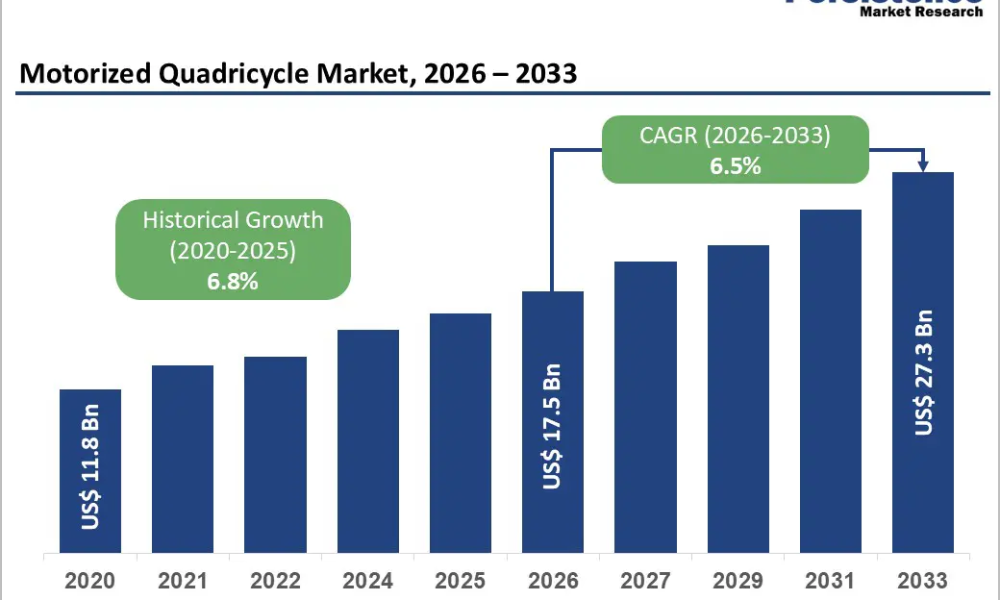
The global motorized quadricycle market size is projected to be valued at US$17.5 billion in 2026 and is expected to reach US$27.3 billion by 2033, growing at a CAGR of 6.5% between 2026 and 2033. This growth reflects increasing urbanization, which continues to create demand for compact mobility solutions capable of navigating crowded city environments efficiently. Traffic congestion is a major catalyst, pushing commuters and businesses toward smaller vehicles that improve travel time and reduce operational expenses. The electric quadricycle segment is emerging as a leading category due to environmental benefits and regulatory incentives promoting low-emission vehicles. Passenger quadricycles dominate market share as urban consumers prioritize convenience and affordability. Europe is currently the leading regional market due to strong regulatory frameworks supporting light vehicles and widespread consumer acceptance. Meanwhile, Asia Pacific is rapidly expanding due to population density and growing urban infrastructure challenges. Fleet operators, delivery companies, and shared mobility providers are also increasing adoption, accelerating market expansion globally.
Get Your FREE Sample Report Instantly Click Now: https://www.persistencemarketresearch.com/samples/13651
The key players studied in the report include:
- Renault Group
- Citroën (Stellantis Group)
- Aixam-Mega
- Ligier Group
- Bajaj Auto Ltd.
- Fiat (Stellantis Group)
- Mahindra & Mahindra
- Tazzari EV
- Club Car (Polaris Inc.)
- Toyota Motor Corporation
- Casalini
- GEM (Global Electric Motorcars)
- Automobiles CHATENET
- Bellier Automobiles
- Loncin Motor Co.
Key Highlights from the Report
➤ The motorized quadricycle market is projected to grow from US$17.5 billion in 2026 to US$27.3 billion by 2033 at a CAGR of 6.5%.
➤ Rapid urbanization and rising congestion are accelerating demand for compact urban mobility solutions globally.
➤ Electric quadricycles are witnessing strong adoption due to emission regulations and growing environmental awareness.
➤ Passenger quadricycles remain the dominant segment due to affordability and urban commuter convenience.
➤ Europe leads the global market due to regulatory support and strong adoption of light urban vehicles.
➤ Fleet operators and shared mobility providers are significantly contributing to long-term market growth.
Market Segmentation
By Product Type
- Light Quadricycle
- Heavy Quadricycle
By Propulsion Type
- Electric
- Internal Combustion Engine (ICE)
By Application
- Personal Mobility
- Commercial
By Region
- North America
- Europe
- East Asia
- South Asia and Oceania
- Latin America
- Middle East and Africa
Regional Insights
Europe dominates the motorized quadricycle market due to favorable regulations, strong environmental policies, and established light vehicle adoption. Governments encourage the use of compact vehicles to reduce congestion and emissions in urban areas. Consumers in European cities widely accept quadricycles due to practicality and efficiency. Electric quadricycles are particularly popular due to infrastructure support and sustainability awareness. The presence of established manufacturers also strengthens regional growth. Urban planning policies support smaller vehicle usage and limit traditional vehicle access in congested areas. This creates favorable conditions for quadricycle expansion. Fleet operators in Europe actively adopt quadricycles for urban delivery services, further boosting demand.
Asia Pacific is emerging as a rapidly expanding regional market due to rising urban population density and infrastructure challenges. Countries in the region face severe congestion, creating demand for compact transportation solutions. Growing middle-class populations and increasing vehicle ownership also contribute to adoption. Urban commuters prefer affordable and efficient mobility options. Governments are supporting electric mobility to reduce pollution levels. Infrastructure expansion and rising commercial activities strengthen market potential. Delivery services and shared mobility providers are rapidly integrating quadricycles. These factors collectively position Asia Pacific as a key growth region for future market expansion.
Customize This Report for Your Exact Requirements: https://www.persistencemarketresearch.com/request-customization/13651
Market Drivers
One of the primary drivers of the motorized quadricycle market is accelerating urbanization, which is transforming transportation needs worldwide. Urban populations require efficient, compact, and affordable vehicles capable of navigating congested city environments. Quadricycles offer superior maneuverability compared to traditional passenger vehicles, making them ideal for dense areas. Rising traffic congestion increases travel time, encouraging consumers to adopt smaller mobility solutions. Environmental regulations are also encouraging adoption of low-emission vehicles. Electric quadricycles align with sustainability goals and reduce carbon footprints. Consumers increasingly prioritize fuel efficiency and affordability. Government policies promoting clean transportation support quadricycle adoption. These factors collectively strengthen long-term market demand.
Another important driver is the expansion of last-mile delivery services driven by e-commerce growth. Delivery companies require efficient vehicles that reduce fuel costs and improve operational efficiency. Quadricycles provide an ideal solution due to low operating costs and easy navigation. Fleet operators benefit from lower maintenance and operational expenses. Urban logistics demand continues to increase globally. Quadricycles improve delivery efficiency in congested areas. Shared mobility services also support market expansion. These vehicles offer practical solutions for urban transportation challenges. Continued technological advancements further enhance vehicle performance and safety.
Market Restraints
Despite strong growth potential, safety concerns remain a key restraint for motorized quadricycles. Consumers often perceive quadricycles as less safe than traditional passenger vehicles due to their lightweight structure. Safety regulations vary across regions, creating adoption challenges. Limited awareness also affects consumer confidence. Manufacturers are investing in safety improvements, but perception barriers remain. Regulatory inconsistencies create compliance complexities. These challenges can slow adoption in certain regions. Consumer trust is essential for long-term market growth. Addressing safety concerns remains a priority for manufacturers.
Another restraint is limited infrastructure support for electric quadricycles in developing regions. Charging infrastructure remains inadequate in several countries. This restricts adoption of electric variants despite strong environmental benefits. High initial costs also discourage price-sensitive buyers. Infrastructure investment is essential for market expansion. Governments and private stakeholders must collaborate to improve support systems. Infrastructure gaps create adoption barriers. Addressing these challenges will strengthen long-term growth potential.
Market Opportunities
Electric mobility expansion presents significant opportunities for motorized quadricycle manufacturers. Governments worldwide are supporting electric vehicle adoption through incentives and regulations. Electric quadricycles align perfectly with sustainability initiatives. Consumers are increasingly interested in environmentally friendly transportation. Technological advancements improve battery efficiency and vehicle performance. Manufacturers can capitalize on growing demand for electric urban mobility solutions. Urban emission regulations favor electric quadricycles. This creates favorable market conditions. Electric mobility trends will drive long-term growth.
Shared mobility and urban delivery expansion also create new growth opportunities. Shared mobility providers require compact vehicles suitable for urban environments. Quadricycles offer ideal solutions for shared transportation. Delivery companies increasingly adopt quadricycles for last-mile logistics. Urban infrastructure supports smaller vehicle integration. Fleet operators benefit from operational efficiency improvements. Commercial applications continue to expand globally. These opportunities strengthen market growth potential significantly.
Recent Developments:
- January 2025: Renault Group expanded production of electric quadricycles to meet rising urban mobility demand.
- March 2025: Bajaj Auto introduced an upgraded quadricycle model focused on urban fleet applications.
Ready to Dive Deep? Buy Full Report Today: https://www.persistencemarketresearch.com/checkout/13651
Frequently Asked Questions
➤ What are the main factors influencing the Motorized Quadricycle Market growth globally?
➤ Which companies are the major players in the Motorized Quadricycle Market?
➤ What are the market opportunities, risks, and overall structure of the Motorized Quadricycle Market?
➤ How do electric quadricycles compare with internal combustion quadricycles in market demand?
➤ What regional trends are shaping the future of the Motorized Quadricycle Market?
Future Opportunities and Growth Prospects
The motorized quadricycle market is expected to witness sustained growth driven by urban mobility transformation and environmental priorities. Electric quadricycles will play a crucial role in reducing emissions and improving transportation efficiency. Infrastructure expansion and supportive regulations will accelerate adoption globally. Shared mobility and urban logistics integration will further strengthen demand. Manufacturers investing in innovation and safety enhancements will gain competitive advantages. Rapid urbanization and technological advancements will continue to create long-term growth opportunities.




