
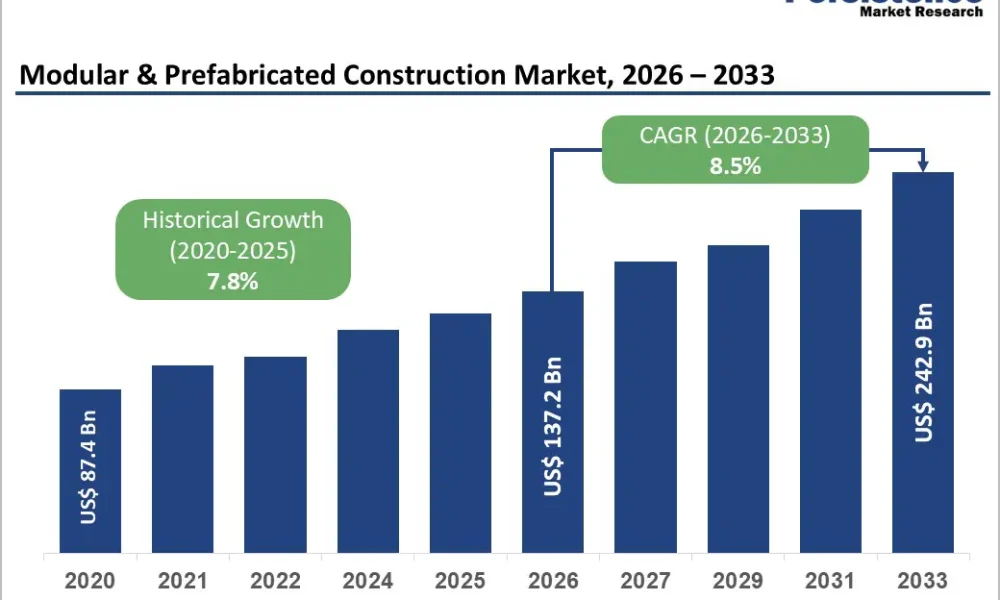
The global modular & prefabricated construction market has been gaining substantial momentum as the construction industry shifts toward faster, cost-efficient, and sustainable building methods. Modular and prefabricated construction refers to the process of manufacturing building components or entire modules in controlled factory environments and then transporting them to the construction site for assembly. This approach significantly reduces construction time, improves quality control, and minimizes material waste compared to traditional on-site construction methods. According to market estimates, the global modular & prefabricated construction market is projected to reach US$137.2 billion in 2026 and expand to US$242.9 billion by 2033, growing at a CAGR of 8.5% during the forecast period. The rising need for rapid project completion, improved construction productivity, and reduced labor dependency is driving adoption across residential, commercial, and infrastructure sectors.
The growth of the market is strongly influenced by urbanization, increasing infrastructure investments, and the global shortage of skilled construction labor. Modular construction solutions help mitigate labor shortages by shifting much of the construction process to factory-based production, where automation and advanced manufacturing technologies can improve efficiency. In terms of market segmentation, permanent modular construction (PMC) represents the leading segment because it offers long-term, durable structures suitable for residential buildings, hotels, hospitals, and office complexes. From a regional perspective, Asia-Pacific dominates the global modular & prefabricated construction market due to rapid urbanization, large-scale housing demand, and government-backed infrastructure development in countries such as China, India, and Southeast Asian nations. The region’s expanding population and increasing need for affordable housing solutions further strengthen demand for prefabricated construction systems.
𝐆𝐞𝐭 𝐚 𝐒𝐚𝐦𝐩𝐥𝐞 𝐏𝐃𝐅 𝐁𝐫𝐨𝐜𝐡𝐮𝐫𝐞 𝐨𝐟 𝐭𝐡𝐞 𝐑𝐞𝐩𝐨𝐫𝐭: https://www.persistencemarketresearch.com/samples/36126
Key Highlights from the Report
• The global modular & prefabricated construction market is expected to grow at a CAGR of 8.5% between 2026 and 2033.
• Market value is projected to increase from US$137.2 billion in 2026 to US$242.9 billion by 2033.
• Rising demand for faster project completion is accelerating adoption of modular construction technologies.
• Labor shortages in the construction sector are encouraging the use of prefabricated building solutions.
• Permanent modular construction systems dominate the market due to durability and scalability.
• Asia-Pacific leads the global market due to rapid urbanization and large-scale housing development.
Market Segmentation
The modular & prefabricated construction market can be segmented based on construction type, material type, end-user sector, and building application. In terms of construction type, the market includes permanent modular construction (PMC), relocatable modular construction, panelized construction, and hybrid prefabricated systems. Permanent modular construction holds a significant share of the market as it provides long-term structural integrity comparable to conventional buildings while offering faster installation. Relocatable modular construction is widely used for temporary structures such as site offices, classrooms, and emergency healthcare facilities. Panelized construction systems, which involve factory-built wall panels, floor systems, and roof components, are also gaining popularity because they allow greater design flexibility while maintaining the benefits of prefabrication.
Based on material type, modular and prefabricated construction solutions commonly utilize steel, wood, concrete, and composite materials. Steel-based modular structures are widely used in commercial and industrial buildings due to their strength, durability, and resistance to environmental factors. Wood-based modular construction is particularly popular in residential housing projects, especially in regions with abundant timber resources. Concrete-based prefabricated components are frequently used for infrastructure projects and multi-story residential buildings where high structural strength is required. Composite materials are also emerging as an innovative option for modular structures, offering a combination of lightweight properties and enhanced durability.
From an end-user industry perspective, the market serves residential, commercial, industrial, and infrastructure sectors. The residential sector accounts for a significant share of the market as modular construction offers an effective solution for affordable housing projects and rapid urban development. Commercial applications include office buildings, hotels, retail spaces, and educational institutions, where modular construction enables faster project delivery and reduced disruption. Industrial facilities such as warehouses, manufacturing plants, and logistics centers also adopt prefabricated building systems to streamline construction timelines. Infrastructure projects, including healthcare facilities, transportation hubs, and public buildings, are increasingly using modular construction techniques to meet tight deadlines and maintain high construction quality.
𝐎𝐧𝐞 𝐂𝐥𝐢𝐜𝐤 → 𝐘𝐨𝐮𝐫 𝐂𝐮𝐬𝐭𝐨𝐦 𝐌𝐚𝐫𝐤𝐞𝐭 𝐕𝐢𝐞𝐰: https://www.persistencemarketresearch.com/request-customization/36126
Regional Insights
Regional dynamics play a crucial role in shaping the growth trajectory of the modular & prefabricated construction market. Asia-Pacific remains the largest and fastest-growing market due to strong urban development, rapid industrialization, and large-scale housing initiatives. Governments across the region are promoting prefabricated construction techniques to address housing shortages and reduce environmental impacts associated with conventional construction. Countries such as China have actively invested in modular construction technologies, while India is witnessing increasing adoption of prefabricated systems in residential and infrastructure projects.
North America represents another significant market, driven by the rising demand for sustainable construction methods and improved project efficiency. The United States and Canada are experiencing a growing adoption of modular construction in residential housing, healthcare facilities, and commercial buildings. The region’s construction industry also faces a shortage of skilled labor, which has accelerated the adoption of factory-based building systems that require fewer on-site workers.
Europe has also emerged as an important market for modular and prefabricated construction, particularly due to strict environmental regulations and sustainability goals. Countries such as the United Kingdom, Germany, and the Nordic nations are increasingly adopting modular construction techniques to reduce carbon emissions and construction waste. The focus on energy-efficient building designs and green construction practices further supports market growth across the region.
The Middle East and Africa are gradually embracing modular construction solutions, particularly in large-scale infrastructure and hospitality projects. Rapid urban expansion, tourism development, and mega infrastructure initiatives in countries such as the United Arab Emirates and Saudi Arabia are contributing to the adoption of prefabricated building systems. Meanwhile, Latin America is also witnessing growing interest in modular housing solutions, driven by urbanization and increasing demand for cost-effective construction methods.
Market Drivers
Several factors are contributing to the growth of the modular & prefabricated construction market worldwide. One of the primary drivers is the increasing need for faster project delivery in the construction industry. Traditional construction methods often face delays due to weather conditions, labor shortages, and supply chain disruptions. Modular construction significantly reduces construction timelines because building components are manufactured in controlled factory environments while site preparation takes place simultaneously. This parallel workflow accelerates project completion and improves overall efficiency.
Another key driver is the global shortage of skilled construction labor. Many countries are experiencing declining availability of experienced construction workers, which has led to increased labor costs and project delays. Modular construction helps address this challenge by shifting much of the construction process to automated manufacturing facilities where fewer workers are required. Additionally, modular construction enhances quality control since components are produced under standardized conditions, resulting in improved structural integrity and reduced construction errors.
Sustainability is also an important factor driving market growth. Prefabricated construction techniques generate less material waste and consume fewer resources compared to conventional building methods. The controlled factory environment allows manufacturers to optimize material usage and reduce energy consumption. As governments and developers increasingly prioritize sustainable building practices, modular construction is emerging as a viable solution for environmentally responsible construction projects.
Market Restraints
Despite its promising growth potential, the modular & prefabricated construction market faces several challenges that could limit its expansion. One of the major restraints is the high initial investment required for establishing modular manufacturing facilities. Setting up advanced prefabrication plants involves significant capital expenditure for equipment, automation technologies, and logistics infrastructure. Smaller construction companies may find it difficult to adopt modular construction systems due to these upfront costs.
Another challenge is the logistical complexity associated with transporting large prefabricated modules from manufacturing plants to construction sites. Transportation limitations, road regulations, and site accessibility issues can sometimes restrict the size and design of modular structures. Additionally, public perception and lack of awareness regarding modular construction methods may hinder adoption in certain regions where traditional construction practices dominate.
Building codes and regulatory frameworks can also pose barriers to market growth. In some countries, existing construction regulations are primarily designed for conventional building methods, making it difficult for modular construction projects to gain approvals. However, as governments recognize the benefits of prefabricated construction, regulatory frameworks are gradually evolving to support these modern building techniques.
Market Opportunities
The modular & prefabricated construction market presents several promising opportunities for industry stakeholders. One of the most significant opportunities lies in the growing demand for affordable housing solutions across rapidly urbanizing regions. Modular construction enables developers to build residential units quickly and cost-effectively, making it an attractive option for large-scale housing projects.
Another major opportunity is the increasing integration of digital construction technologies, such as Building Information Modeling (BIM), automation, and robotics, into modular construction processes. These technologies enhance design accuracy, streamline production workflows, and improve collaboration among project stakeholders. As digital construction tools continue to evolve, they are expected to further strengthen the efficiency and scalability of modular building systems.
The expansion of smart cities and sustainable infrastructure projects also creates opportunities for modular construction solutions. Governments worldwide are investing in modern urban infrastructure, including healthcare facilities, educational institutions, and transportation hubs. Modular construction can accelerate the development of such projects while maintaining high construction quality and environmental sustainability.
𝐆𝐞𝐭 𝐈𝐧𝐬𝐭𝐚𝐧𝐭 𝐀𝐜𝐜𝐞𝐬𝐬 𝐓𝐨𝐝𝐚𝐲—𝐌𝐚𝐤𝐞 𝐒𝐦𝐚𝐫𝐭𝐞𝐫 𝐃𝐞𝐜𝐢𝐬𝐢𝐨𝐧𝐬 : https://www.persistencemarketresearch.com/checkout/36126
Company Insights
Key companies operating in the global modular & prefabricated construction market include:
• Skanska AB
• Bouygues Construction
• Laing O’Rourke
• Kiewit Corporation
• Red Sea International Company
• ATCO Ltd.
• Sekisui House Ltd.
• Clayton Homes, Inc.
• Guerdon Modular Buildings
• Daiwa House Industry Co., Ltd.
Recent developments in the market include the expansion of large-scale modular manufacturing facilities by several construction companies to meet the rising demand for prefabricated building components. Additionally, many companies are investing in digital construction technologies such as BIM and automated production systems to improve efficiency and reduce project timelines in modular construction projects.
Conclusion
The modular & prefabricated construction market is poised for strong growth over the coming years as the construction industry increasingly embraces innovative building methods that improve efficiency, sustainability, and cost-effectiveness. Rising urbanization, infrastructure investments, and the need for faster project delivery are driving the adoption of modular construction across residential, commercial, and industrial sectors. While challenges such as high initial investments and logistical constraints remain, advancements in manufacturing technologies and digital construction tools are expected to overcome these barriers. With governments and developers focusing on sustainable and scalable building solutions, modular and prefabricated construction is set to play a vital role in shaping the future of the global construction industry.




